Decolonizing Elephants
Animal Capital at the End of Empire in Myanmar
DOI:
https://doi.org/10.52537/humanimalia.19646Keywords:
Decolonization, Elephants, Myanmar, Burma, Timber, British ImperialismAbstract
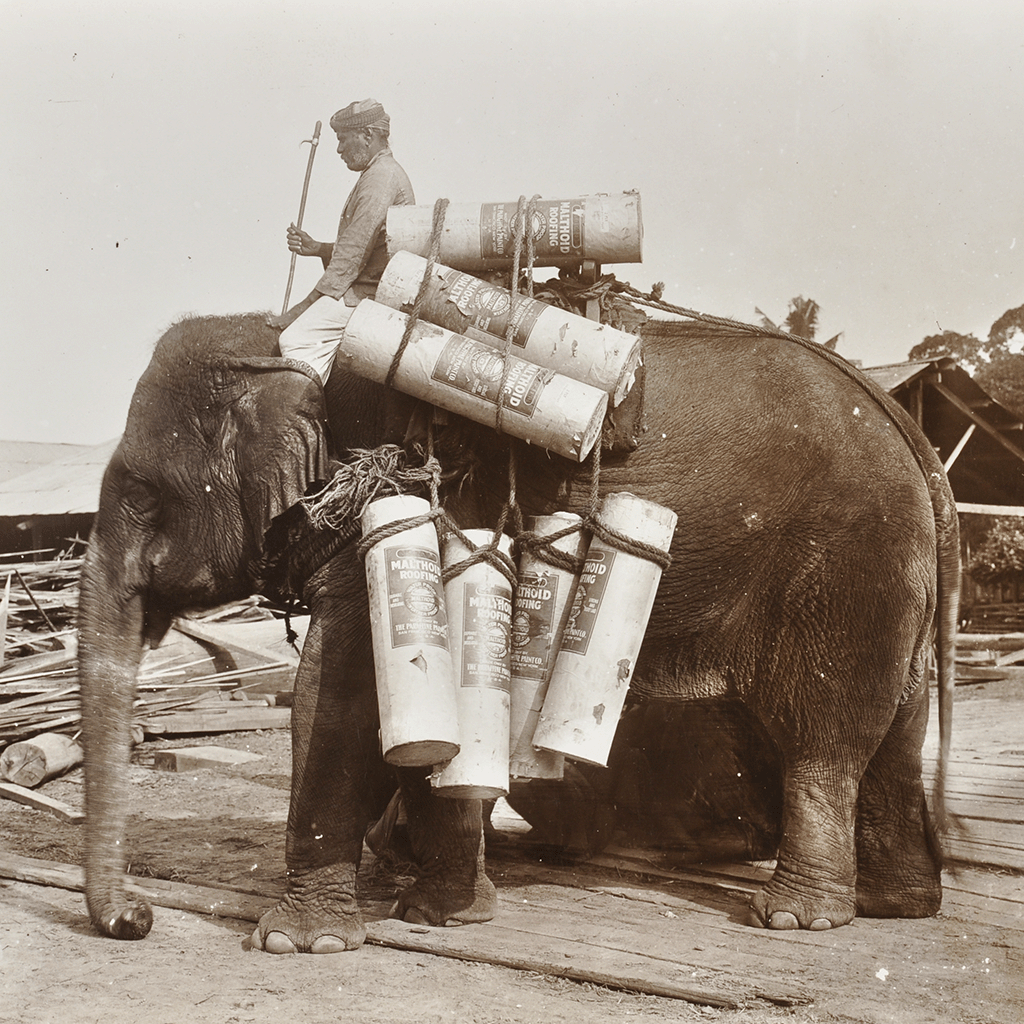
The growing call to decolonize Animal Studies, and Environmental Humanities more broadly, is overdue and welcome. The imperative to decolonize enables scholars in the field to better recognize the underlying hierarchies, biases, and occlusions in our research, encouraging us to find creative ways of reconceptualizing our work anew. Nevertheless, there is something of a tendency in the literature towards considering decolonization as an abstract process and a predominantly epistemological problem. This divorces decolonization in the academy from social and political histories of decolonization. By looking at what happened to Burmese elephants during the collapse of British imperialism in Myanmar, in this article I argue that historical struggles for decolonization can help to ground and hone what it means to decolonize our studies.
Downloads
References
Adas, Michael. The Burma Delta: Economic Development and Social Change on an Asian Rice Frontier, 1852–1941. Madison: University of Wisconsin Press, 1974.
Adcock, Cassie. “Sacred Cows and Secular History: Cow Protection Debates in Colonial North India.” Comparative Studies of South Asia, Africa and the Middle East 30, no. 2 (2010): 297–311. https://doi.org/10.1215/1089201X-2010-014.
Adcock, Cassie. “‘Preserving and Improving the Breeds’: Cow Protection’s Animal-Husbandry Connection.” South Asia: Journal of South Asian Studies 42, no. 6 (2019): 1141–55. https://doi.org/10.1080/00856401.2019.1681680.
Aderinto, Saheed. Animality and Colonial Subjecthood in Africa: The Human and Nonhuman Creatures of Nigeria. Athens: Ohio University Press, 2022.
Asher, Kiran. “Latin American Decolonial Thought, or Making the Subaltern Speak.” Geography Compass 7, no. 12 (2013): 832–42. https://doi.org/10.1111/gec3.12102.
Aung, Geoffrey Rathgeb, and Stephen Campbell. “The Myanmar Radical Tradition: Revolution, Reaction, and the Changing Imperial World Order.” Dialectical Anthropology 48, no. 2 (2024): 193–219. https://doi.org/10.1007/s10624-024-09716-0.
Baker, Liv, and Rebecca Winkler. “Asian Elephant Rescue, Rehabilitation and Rewilding.” Animal Sentience 5, no. 28 (2020): 1–20. https://doi.org/10.51291/2377-7478.1506.
Banerjee, Milinda, and Jelle J. P. Wouters. Subaltern Studies 2.0: Being against the Capitalocene. Prickly Paradigm Press, 2022.
Barnard, Timothy P. Imperial Creatures: Humans and Other Animals in Colonial Singapore, 1819-1942. Singapore: National University of Singapore Press, 2019.
Barua, Maan. “Lively Commodities and Encounter Value.” Environment and Planning D: Society and Space 34, no. 4 (2016): 725–44. https://doi.org/10.1177/0263775815626420.
Bayly, C. A. Forgotten Armies: The Fall of British Asia, 1941–1945. Cambridge, MA: Harvard University Press, 2005.
Bayly, C. A. Rangoon (Yangon) 1939–49: The Death of a Colonial Metropolis. Cambridge: Centre of South Asian Studies, University of Cambridge, 2003.
Behm, Amanda, Christienna Fryar, Emma Hunter, Elisabeth Leake, Su Lin Lewis, and Sarah Miller-Davenport. “Decolonizing History: Enquiry and Practice.” History Workshop Journal 89 (2020): 169–91. https://doi.org/10.1093/hwj/dbz052.
Belcourt, Billy-Ray. “Animal Bodies, Colonial Subjects: (Re)Locating Animality in Decolonial Thought.” Societies 5, no. 1 (2015): 1–11. https://doi.org/10.3390/soc5010001.
Brown, Ian. A Colonial Economy in Crisis: Burma’s Rice Delta and the World Depression of the 1930s. London: RoutledgeCurzon, 2005.
Brown, Ian. “Tracing Burma’s Economic Failure to Its Colonial Inheritance”. Business History Review 85, no. 4 (2011): 725–47. https://doi.org/10.1017/S0007680511001176.
Bryant, Raymond L. “Kawthoolei and Teak: Karen Forest Management on the Thai–Burmese Border.” Watershed 3, no. 1 (1997).
Bryant, Raymond L. The Political Ecology of Forestry in Burma, 1824–1994. London: Hurst, 1997.
Campos-Arceiz, Ahimsa, Thin Zar Lin, Wan Htun, Seiki Takatsuki, and Peter Leimgruber. “Working with Mahouts to Explore the Diet of Work Elephants in Myanmar (Burma).” Ecological Research 23, no. 6 (2008): 1057–64. https://doi.org/10.1007/s11284-008-0466-4.
Chakrabarty, Dipesh. “Postcoloniality and the Artifice of History: Who Speaks for ‘Indian’ Pasts?” Representations, no. 37 (1992): 1–26. https://doi.org/10.2307/2928652.
Chatterjee, Partha. The Nation and Its Fragments: Colonial and Postcolonial Histories. Princeton, NJ: Princeton University Press, 1993.
Coclanis, Peter A. “Southeast Asia’s Incorporation into the World Rice Market: A Revisionist View.” Journal of Southeast Asian Studies 24, no. 2 (1993): 251–67. http://doi.org/10.1017/S0022463400002629.
Cohn, Bernard S. Colonialism and Its Forms of Knowledge: The British in India. Princeton, NJ: Princeton University Press, 1996.
Collard, Rosemary-Claire. “Putting Animals Back Together, Taking Commodities Apart.” Annals of the Association of American Geographers 104, no. 1 (2014): 151–65. https://doi.org/10.1080/
2013.847750.
Collard, Rosemary-Claire, and Jessica Dempsey. “Life for Sale? The Politics of Lively Commodities.” Environment and Planning A 45, no. 11 (2013): 2682–99. https://doi.org/10.1068/a45692.
Collins, Michael. “Decolonization”. In The Encyclopedia of Empire. Wiley Online Library. https://doi.org/10.1002/9781118455074.wbeoe360.
Crawley, Jennie A. H., Mirkka Lahdenperä, Zaw Min Oo, Win Htut, Hnin Nandar, and Virpi Lummaa. “Taming Age Mortality in Semi-Captive Asian Elephants.” Scientific Reports 10, no. 1889 (2020): 1–8. https://doi.org/10.1038/s41598-020-58590-7.
Crawley, Jennie A. H., Mirkka Lahdenperä, Martin W. Seltmann, Win Htut, Htoo Htoo Aung, Kyaw Nyein, and Virpi Lummaa. “Investigating Changes within the Handling System of the Largest Semi-Captive Population of Asian Elephants.” PLOS ONE 14, no. 1 (2019): e0209701. https://doi.org/10.1371/journal.pone.0209701.
Darwin, John. “British Decolonization since 1945: A Pattern or a Puzzle?” The Journal of Imperial and Commonwealth History 12, no. 2 (1984): 187–209. https://doi.org/10.1080/03086538408582666.
Deb Roy, Rohan. “Decolonize Mosquitoes: Invisible Labour, Dissent and the Re-Colonial in South Asia.” History Workshop Journal 98 (2024): 101–24. https://doi.org/10.1093/hwj/dbae028.
Deb Roy, Rohan. “Nonhuman Empires.” Comparative Studies of South Asia, Africa and the Middle East 35, no. 1 (2015): 66–75. https://doi.org/10.1215/1089201X-2876104.
Dube, Saurabh. “Mirrors of Modernity: Time–Space, the Subaltern, and the Decolonial.” Postcolonial Studies 19, no. 1 (2016): 1–21. https://doi.org/10.1080/13688790.2016.1228136.
Evans, George H. Elephants and Their Diseases: A Treatise on Elephants. 2nd ed. Rangoon: Superintendent Government Printing, Burma, 1910.
Ferrier, A.J. The Care and Management of Elephants in Burma. London: Steel Brothers, 1947.
Few, Martha, and Zeb Tortorici. Centering Animals in Latin American History. Durham, NC: Duke University Press, 2013.
Fudge, Erica. “A Left-Handed Blow: Writing the History of Animals.” In Representing Animals, edited by Nigel Rothfels, 3–18. Bloomington: Indiana University Press, 2003.
Giraud, Eva Haifa. What Comes after Entanglement? Activism, Anthropocentrism, and an Ethics of Exclusion. Durham, NC: Duke University Press, 2019.
Glover, M.J. “‘That Other Me, Down and Dreaming’: An Animal Perspective Critique of Decoloniality Theory.” Social Dynamics 49, no. 2 (2023): 260–79. https://doi.org/10.1080/02533952.2023.2220590.
Govindrajan, Radhika. Animal Intimacies: Interspecies Relatedness in India’s Central Himalayas. Chicago: University of Chicago Press, 2018.
Grill, William. Bandoola: The Great Elephant Rescue. London: Flying Eye Books, 2021.
Guha, Ranajit. “On Some Aspects of the Historiography of Colonial India.” In Subaltern Studies I: Writings on South Asian History and Society, edited by Ranajit Guha, 1–8. Delhi: Oxford University Press, 1982.
Hack, Karl. “‘Iron Claws on Malaya’: The Historiography of the Malayan Emergency.” Journal of Southeast Asian Studies 30, no. 1 (1999): 99–125. https://doi.org/10.1017/S0022463400008043.
Haraway, Donna J. When Species Meet. Minneapolis: University of Minnesota Press, 2008.
Hinds, Allister. “Sterling and Decolonization in the British Empire, 1945–1958.” Social and Economic Studies (1999): 97–116. https://www.jstor.org/stable/27865168.
Hopkins, A. G. “Rethinking Decolonization.” Past & Present 200, no. 1 (2008): 211–47. https://doi.org/10.1093/pastj/gtn015.
Hovorka, Alice J. “Animal Geographies I: Globalizing and Decolonizing.” Progress in Human Geography 41, no. 3 (2017): 382–94. https://doi.org/10.1177/0309132516646291.
Jackson, John, Dylan Z. Childs, Khyne U. Mar, Win Htut, and Virpi Lummaa. “Long-Term Trends in Wild-Capture and Population Dynamics Point to an Uncertain Future for Captive Elephants.” Proceedings of the Royal Society B: Biological Sciences 286, no. 1899 (2019): 20182810. https://doi.org/10.1098/rspb.2018.2810.
Kumaravadivelu, B. “The Decolonial Option in English Teaching: Can the Subaltern Act?” TESOL Quarterly 50, no. 1 (2016): 66–85. https://doi.org/10.1002/tesq.202.
Lahdenperä, Mirkka, John Jackson, Win Htut, and Virpi Lummaa. “Capture from the Wild Has Long-Term Costs on Reproductive Success in Asian Elephants.” Proceedings of the Royal Society B: Biological Sciences 286, no. 1912 (2019): 20191584. https://doi.org/10.1098/rspb.2019.1584.
Larkin, Emma. Finding Orwell in Burma. 2nd ed. London: Penguin, 2011.
Lintner, Bertil. The Rise and Fall of the Communist Party of Burma. Ithaca, NY: Cornell University Press, 1990.
Louis, Wm. Roger, and Ronald Robinson. “The Imperialism of Decolonization.” The Journal of Imperial and Commonwealth History 22, no. 3 (September 1994): 462–511. https://doi.org/10.1080/03086539408582936.
Marx, Karl. Capital. Translated by Ben Fowkes. Vol. 1. New York: Vintage Books, 1977.
Maung, Mya. “The Elephant Catching Co-Operative Society of Burma: A Case Study on the Effect of Planned Socio-Economic Change.” Asian Survey 6, no. 6 (1966): 327–37. https://doi.org/10.2307/2642382.
Mignolo, Walter D. “Coloniality of Power and Subalternity.” In The Latin American Subaltern Studies Reader, edited by Iliana Yamileth Rodriguez, María Milagros López, María Milagros López, and Sonia Saldívar-Hull, 424–44. Durham, NC: Duke University Press, 2001.
Mignolo, Walter D. “Epistemic Disobedience, Independent Thought and Decolonial Freedom.” Theory, Culture & Society 26, nos. 7–8 (2009): 159–81. https://doi.org/10.1177/0263276409349275.
Mumby, Hannah S. “Mahout Perspectives on Asian Elephants and Their Living Conditions.” Animals 9, no. 11 (2019): 879. https://doi.org/10.3390/ani9110879.
Mumby, Hannah S., Alexandre Courtiol, Khyne U. Mar, and Virpi Lummaa. “Climatic Variation and Age-Specific Survival in Asian Elephants from Myanmar.” Ecology 94, no. 5 (2013): 1131–41. https://doi.org/10.1890/12-0834.1.
Mumby, Hannah S., Khyne U. Mar, Adam D. Hayward, Win Htut, Ye Htut-Aung, and Virpi Lummaa. “Elephants Born in the High Stress Season Have Faster Reproductive Ageing.” Scientific Reports 5, no. 13946 (2015): 1–11. https://doi.org/10.1038/srep13946.
O’Hanlon, Rosalind, and David Washbrook. “After Orientalism: Culture, Criticism, and Politics in the Third World.” Comparative Studies in Society and History 34, no. 1 (1992): 141–67. https://doi.org/10.1017/S0010417500017461.
Orwell, George. “Shooting an Elephant.” New Writing, no. 2 (1936).
Prakash, Gyan. “Can the ‘Subaltern’ Ride? A Reply to O’Hanlon and Washbrook.” Comparative Studies in Society and History 34, no. 1 (1992): 168–84. https://doi.org/10.1017/S0010417500017473.
Quijano, Aníbal. “Coloniality and Modernity/Rationality.” Cultural Studies 21, no. 2–3 (2007): 168–78. https://doi.org/10.1080/09502380601164353.
Quintero, Pablo, Patricia Figueira, and Paz Concha Elizalde. “A Brief History of Decolonial Studies.” Translated by Lívia Martins. MASP Afterall, no. 3 (2019): 1–12.
Roosa, John. “Passive Revolution Meets Peasant Revolution: Indian Nationalism and the Telangana Revolt.” The Journal of Peasant Studies 28, no. 4 (2001): 57–94. https://doi.org/10.1080/03066150108438783.
Rugy, Marie de. “Looting and Commissioning Indigenous Maps: James G. Scott in Burma.” Journal of Historical Geography 69 (2020): 5–17. https://doi.org/10.1016/j.jhg.2020.04.002.
Saha, Jonathan. “Accumulations and Cascades: Burmese Elephants and the Ecological Impact of British Imperialism.” Transactions of the Royal Historical Society 32 (2022): 177–97. https://doi.org/10.1017/S0080440122000044.
Saha, Jonathan. Colonizing Animals: Interspecies Empire in Myanmar. Cambridge: Cambridge University Press, 2021.
Saha, Jonathan. “Colonizing Elephants: Animal Agency, Undead Capital and Imperial Science in British Burma.” BJHS Themes 2 (2017): 169–89. https://doi.org/10.1017/bjt.2017.6.
Saha, Jonathan. “Do Elephants Have Souls? Animal Subjectivities and Colonial Governmentality.” In South Asian Governmentalities, edited by Stephen Legg and Deana Heath, 159–77. Cambridge: Cambridge University Press, 2018.
Saha, Jonathan. “Global Capital, Local Animal: Some Notes on the Elephant Trade in Colonial Southeast Asia.” In Colonial Dimensions of the Global Wildlife Trade, edited by Claudia Andratschke, Charlotte Hoes, and Annekathrin Krieger, 70–91. Heidleberg: arthistoricum.net, 2024.
Samanta, Samiparna. Meat, Mercy, Morality: Animals and Humanitarianism in Colonial Bengal, 1850–1920. Delhi: Oxford University Press, 2021.
Sampson, Christie, Peter Leimgruber, Shari Rodriguez, John McEvoy, Elaine Sotherden, and David Tonkyn. “Perception of Human–Elephant Conflict and Conservation Attitudes of Affected Communities in Myanmar.” Tropical Conservation Science 12 (2019): 1–17. https://doi.org/10.1177/1940082919831242.
Schendel, Willem van. “Origins of the Burma Rice Boom, 1850–1880.” Journal of Contemporary Asia 17, no. 4 (1987): 456–72. https://doi.org/10.1080/00472338780000311.
Scott, J. G., and Geraldine Mitton. The Life Story of An Elephant. London: A & C Black, 1930.
Shell, Jacob. “Elephant Convoys beyond the State: Animal-Based Transport as Subversive Logistics.” Environment and Planning D: Society and Space 37, no. 5 (2019): 905–23. https://doi.org/10.1177/0263775818805491.
Shell, Jacob. “Elephant Riders of the Hukawng Valley, Kachin State: Evasive Mobility and Vadological Geography.” Journal of Burma Studies 25, no. 2 (2021): 261–98. https://doi.org/10.1353/jbs.2021.0012.
Shell, Jacob. “The Enigma of the Asian Elephant: Sovereignty, Reproductive Nature, and the Limits of Empire.” Annals of the American Association of Geographers 109, no. 4 (2019): 1154–71. https://doi.org/10.1080/24694452.2018.1536534.
Shilliam, Robbie. “Behind the Rhodes Statue: Black Competency and the Imperial Academy.” History of the Human Sciences 32, no. 5 (2019): 3–27. https://doi.org/10.1177/0952695119859727.
Shukin, Nicole. Animal Capital: Rendering Life in Biopolitical Times. Minneapolis: University of Minnesota Press, 2009.
Slim, William Joseph Slim. Defeat into Victory. Pan Military Classics. London: Pan, 2009.
Spivak, Gayatri C. “Subaltern Studies: Deconstructing Historiography.” In Subaltern Studies IV: Writings on South Asian History and Society, edited by Ranajit Guha, 333–63. Oxford: Oxford University Press, 1985.
Suri, Tara. “Between Simians and Cell Lines: Rhesus Monkeys, Polio Research, and the Geopolitics of Tissue Culture (1934–1954).” Journal of the History of Biology 55, no. 1 (2022): 115–46. https://doi.org/10.1007/s10739-022-09666-9.
Tagliacozzo, Eric. “Ambiguous Commodities, Unstable Frontiers: The Case of Burma, Siam, and Imperial Britain, 1800–1900.” Comparative Studies in Society and History 46, no. 2 (2004): 354–77. https://doi.org/10.1017/S0010417504000179.
Tamayama, Kazuo, and John Nunneley, eds. Tales by Japanese Soldier of the Burma Campaign 1942–1945. London: Cassell, 2000.
Taylor, Robert H. Marxism and Resistance in Burma, 1942–1945. Athens: Ohio University Press, 1984.
Taylor, Robert H. The State in Myanmar. New ed. London: C. Hurst, 2008.
Thein, Zar Zar Win, and Zhou Jianhua. “Development of Elephant Conservation Based Tourism after Implementation of Logging Ban Policy in Myanmar.” International Journal of Sciences 7, no. 5 (2018): 87–96. http://dx.doi.org/10.18483/ijSci.1688.
Thomas, Martin. Crises of Empire: Decolonization and Europe’s Imperial States, 1918–1975. London: Hodder Education, 2008.
Tinker, Hugh. “A Forgotten Long March: The Indian Exodus from Burma, 1942.” Journal of Southeast Asian Studies 6, no. 1 (1975): 1–15. https://doi.org/10.1017/S0022463400017069.
Tinker, Hugh. “Burma’s Struggle for Independence: The Transfer of Power Thesis Re-Examined.” Modern Asian Studies 20, no. 3 (1986): 461–81. https://doi.org/10.1017/S0026749X00007824.
Tomlinson, B. R. “Indo-British Relations in the Post-Colonial Era: The Sterling Balances Negotiations, 1947–49.” In Money, Finance and Empire, 1790–1960, edited by A.N. Porter and R.F. Holland, 142–62. London: Routledge, 2006 [1985].
Tomlinson, B. R. “‘The Weapons of the Weakened’: British Power, Sterling Balances, and the Origins of the Colombo Plan.” In The Transformation of the International Order of Asia: Decolonization, the Cold War, and the Colombo Plan, edited by Shigeru Akita, Gerold Krozewski, Shoichi Watanabe, 34–49. London: Routledge, 2014.
Tyner, James A. “Landscape and the Mask of Self in George Orwell’s ‘Shooting an Elephant’.” Area 37, no. 3 (2005): 260–67. https://doi.org/10.1111/j.1475-4762.2005.00629.x.
Toke Gale, U. Burmese Timber Elephant. Rangoon: Trade Corporation, 1974.
Williams, J. H. Elephant Bill. London: Hart-Davis, 1950.
Published
Issue
Section
License
Copyright (c) 2025 Jonathan Saha (Author)

This work is licensed under a Creative Commons Attribution 4.0 International License.
How to Cite