Animal Life at the Threshold
On Scales Political, Temporal, Planetary, and Individual
DOI: http://doi.org/10.52537/humanimalia.28258
Mariam Motamedi Fraser is an Honorary Senior Researcher in the Geography Department, UCL. She works in the field of Animal Studies, focusing in particular on how the epistemologies and methodologies of the animal sciences shape understandings of animals and the politics of animal–human relations. Mariam’s most recent monograph, Dog Politics: Species Stories and the Animal Sciences (Manchester University Press, 2024), is a critical analysis of the naturalization of the dog–human “bond” and of dogs’ evolutionary “species story”. She is co-founder and member of the Institute for Contemporary Critical Thought (contemporarycriticalthought.org).
Email: m.motamedi-fraser@ucl.ac.uk
Martin Savransky is a social theorist currently serving as Distinguished Research Fellow at the Institute for Language, Literature and Anthropology (CSIC), where he leads the “Liveable Futures” Project. Working across philosophy, the social sciences, and the environmental humanities, Martin’s writings explore the unruly politics of liveability amidst permanent planetary instability. He is the author of several books, including, most recently, Exology: Planetary Upheaval and Social Life (Open Humanities Press, forthcoming). He is co-founder and member of the Institute for Contemporary Critical Thought (contemporarycriticalthought.org).
Email: m.savransky@csic.es
Humanimalia 16.2 (Summer 2026)
Abstract
From Aristotle’s scala naturae to the vast scales of animal agriculture, from cognitive scales to moral scales to deathly scales of devaluation, from the world-historical scale of what modernity called “progress” to the “permanent present” to which evolutionary scales condemn animals — in these and countless other ways, animal lives have been and continue to be shaped by different kinds of scales and their positions on them. Yet it is difficult to think about scales without the thresholds they skirt and implicate. In this opening essay, we approach the multiple scales through which animal lives are traversed by probing something of what may be involved in thinking animal life at the threshold. What does it take to cross — or be crossed by — a threshold? What does it mean to create and inhabit a scale? And what is at stake in becoming out-scaled? Articulating pathways through the interventions and conversations that make up this collection on animal scales, and at the same time complicating what we think we know of the politics of scaling, this essay explores how animal lives are made and unmade at the threshold between human mastery of the earth and the planetary upheaval of human ends; at the threshold between human and animal translation and unbridgeability of scale; and at the threshold where scale and perspective connect and disaggregate, giving way to the paradox of “an animal Anthropocene” as a riotous scrambling of scales.
Introduction: The Last Dog?
At 06:07 am, on 11 April 1961, at the height of the Cold War, the Baikonur Cosmodrome (in what used to be the Soviet Union and is now Kazakhstan) stole the thunder of its American counterpart by successfully launching Vostok 1: the first human orbital space flight in history. Before the launch, in a statement to the press, the designated pilot, Yuri Gagarin, spoke of “the tremendous responsibility” he felt, “of being the first to accomplish what generations of people had dreamed of, the first to show man the way to space.”1 Controlled entirely remotely from the ground base and from other automatic systems, Vostok 1 skimmed the upper atmosphere and in 108 minutes completed a single orbit around the Earth. “I see almost everything,” Gagarin said upon reaching orbit. A first in the ongoing space race, this flight was an event of technological, geopolitical, and world-historical scale. One short trip for a man, one giant leap for… humankind? Gagarin wasn’t so certain. Upon his return, the first human (though not the first animal) cosmonaut to be thrust into space and complete that trip around the orbit of the earth is said to have confessed to being unsure “if [he] was the first man in space or the last dog”.
First man, or last dog? This indiscernibility, the indiscernibility of the threshold, is critical to the question of “animal scales”. Indeed, it is difficult to think at a threshold without thinking about scale, just as it is difficult to think scales without the thresholds they skirt and implicate. Thresholds, after all, aren’t mere lines, borders, or frontiers. They’re passageways or phase shifts where space trembles and time drifts: thresholds are zones of scalar indiscernibility. They’re the event before and after the event, the flicker before the stabilization of form and the atmosphere it leaves in its wake — the undecidable zone between above and below, the given and the withdrawn, too early and too late, first and last, human and dog. What does it take, then, to cross — or be crossed by — a threshold? What does it mean to create and inhabit a scale? And what is at stake in becoming out-scaled? It is in order to think through some of the challenges engendered by the questions this issue poses around the notion of “animal scales” that, in this opening essay, we probe something of what may be involved in thinking animal life at the threshold. Clearly, human scales enact, authorize, and justify possible relations with animals. From Aristotle’s scala naturae to the vast scales of animal agriculture, from cognitive scales to moral scales to deathly scales of devaluation, from the world-historical scale of what modernity called “progress” to the “permanent present” and evolutionary tales to which animals are condemned — in these and countless other ways, animal lives have been and continue to be shaped by different kinds of scales and their positions on them. Yet this is only part of it, the part that all but takes for granted that humans are subjects who scale, and animals objects to be scaled. It is not the only part. For while every scaling operation enacts a form of power over the threshold, it’s also the case — it’s also increasingly the case — that it is often difficult if not impossible to discern the threshold that renders some subjects and others objects of the operation of scaling, the threshold over which a scale is something one shapes and under which scale becomes something that shapes who or what one is or becomes, whether and how one lives, and what kinds of lives or deaths are possible or entailed.
The articles and exchanges gathered in this special issue (exchanges that started in a seminar series organized by Mariam Motamedi Fraser and hosted by UCL Anthropocene in 2024) explore some of the pressures and precarities that bear on the lives and deaths of animals at the crossroads, and at the mercy, of various temporal (Baratay, Page, Rath), political (Donaldson and Kymlicka, Cochrane, Mejier), economic and planetary scales (Wadiwel, Gillespie, Barry, Pick and Arnold). And yet, when read together — for what is a special issue if not its own kind of scale? — these interventions and conversations raise some provocative and difficult questions concerning animal life at the threshold. It is precisely through the zones of indiscernibility proper to thresholds that this essay seeks to open up, frame, and introduce this collective experiment in thinking in and across animal scales. Taking seriously the elliptical and indiscernible shape that thresholds assume at and as the limits of scale, we demur from all-encompassing pronouncements or definitive resolutions. We proceed, instead, obliquely and in fragments — at the threshold between human mastery of the earth and the planetary upheaval of human ends; at the threshold between human and animal translation and unbridgeability of scale; and at the threshold where scale and perspective connect and disaggregate, giving way to the paradox of “an animal Anthropocene” as a riotous scrambling of scales.
Earth at a Threshold
Earth — or less than half of it. But one earth all the same. Earth at large, altogether and all at once, captured whole in one refulgent image, out of the dark, rising. Gagarin claimed he could see “almost everything” from orbit, but few images have done as much in the last half century to render perceptible the power of scale or the act and event of scaling than William Anders’s Earthrise, taken seven years later, on 24th December 1968 while NASA’s Apollo 8 mission was in orbit around the Moon. It was hardly the first photographic image of the earth from space, and merely the then-latest instalment in a much longer Apollonian tradition of scaling and seeing the entire Earth through the deployment of rational and geometric projections that turned it into a coherent, ordered whole.2 But it was the first of such photographs taken by a human person.
For reasons that connect what and how the image represents to forces that always lie outside its regime of representation, Earthrise constituted less the novelty of access to (or awareness of) a previously invisible terrestrial scale, than the crossing of a threshold — a scalar event — in and of itself: the image binding the extractive geological histories of its own photographic materials to the bodily scale of the human eye and hand, drawing on long visual traditions and on geopolitical forms of imagination and telemetry in order to situate the human sensorium over the planetary curvature.3 Earthrise did not, in other words, merely reveal the whole Earth from without, on a new scale. It staged a temporarily convergent crossing of geological, world-historical, technological, geopolitical and cosmic scales making it possible for a human being to make the planet suddenly appear, from the cosmic dark, to the human eye. Of course, Laika had seen it already. But as Éric Baratay’s essay in this issue reminds us, the modern notion of “history” (always already world-history) is to animals what Hegel claimed it was to the Indians themselves; neither were deemed to have one.4 As Baratay argues, Western philosophy and science — from Aristotle, through Christian theology, to Heidegger and Lorenz — has actively withheld the temporal dimension from animals, refusing them individual biographies, histories, historical “eras”, and therefore the possibility of cultural change.5
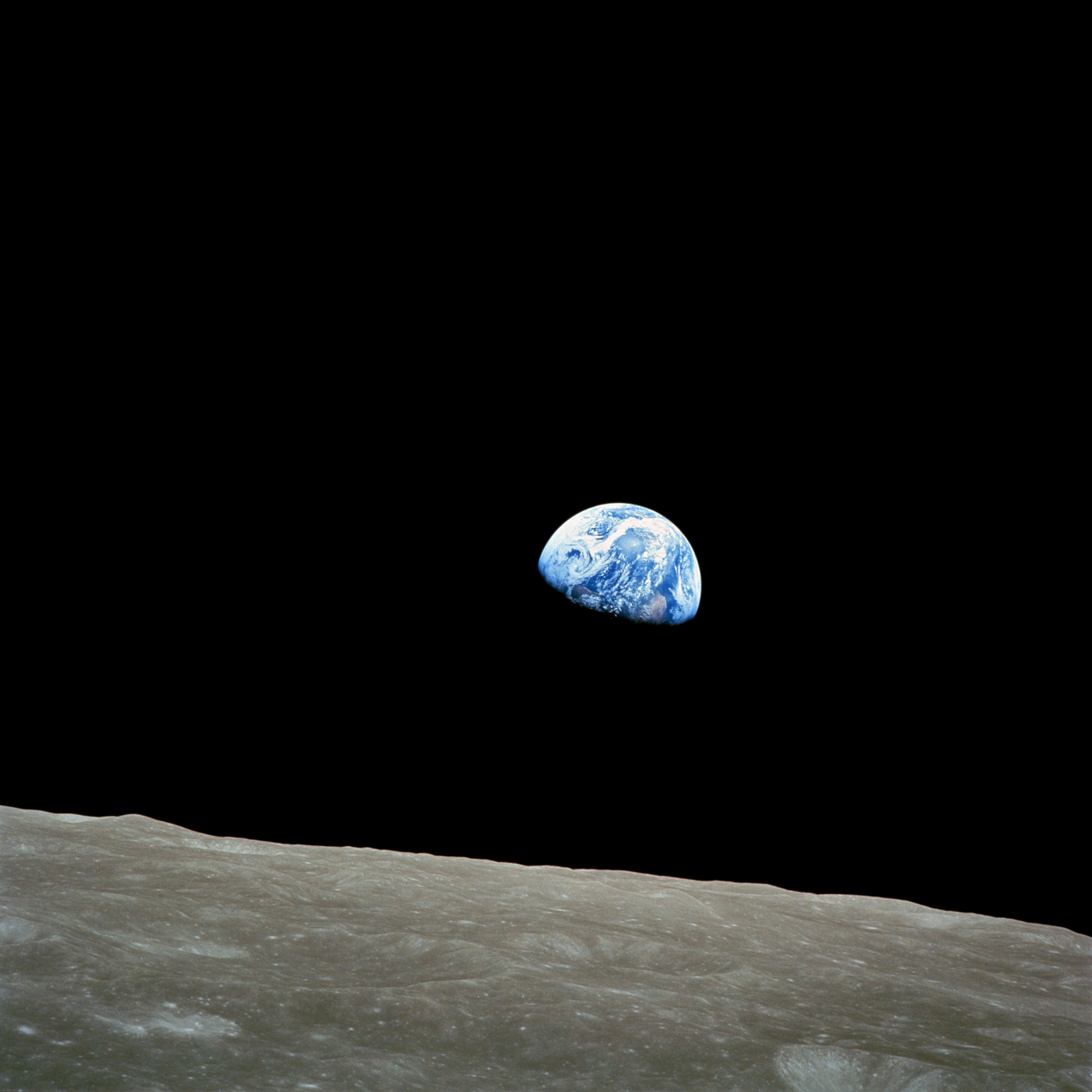
Fig. 1 NASA / Bill Anders, Earthrise (1968)
Image source: Wikimedia Commons.
For their part, Sophie Page’s and Thom Rath’s diverse engagements (in this issue) with Baratay’s essay illustrate the latter’s point that the temporal scales through which animals are written into or out of history are, as Rath puts it, “like cartographic maps”, shaped by the interests and aspirations of those who create them.6 It could have been different, Page argues. Drawing on medieval European accounts of hawks, cats, foxes, wolves, and whales, Page shows how attending to long temporal scales not only reveals “patterns of adaptation that are invisible when animals are studied only in a single period”, but also illuminates the contingency of contemporary human-animal relations. Yet, the imaginative horizon is often narrowed by what Page calls the “shifting baseline syndrome”, or “the tendency of each generation to imagine that the environmental conditions at the edge of their own memories represent the way the world used to be.”7 To what memories, resources and/or practices should we refer, when “we approach the history of human–animal relations”?8 This is among the several important questions raised by Thomas Rath, as he insists that the exclusion of animals from “History” is primarily a European and colonial project. From Mexico to Patagonia, Rath shows how the colonial transformation of animals into stable categorical resources (military horses, farmed ganado) — bounded and boundaried species on which the colonial order depended — was imposed on indigenous worldviews that otherwise figured animals as kin, and as agents of their own histories (see also Donaldson and Kymlicka, this issue). Together, these papers illustrate that the histories and pasts of “the other” register only so long as they are a part of the history of the civilized, a step on the progressive march towards a future reserved for that species called “Man”.9
That too was the intended beholder of Earthrise. Appearing thanks to and in the middle of the Cold War, amidst the effervescence of the western environmental movement, Earthrise quickly became the visual inscription and iconic sign of its universal plight. Alongside the 1972 “Blue Marble”, these orbital images rapidly became enlisted into a cosmopolitan geopolitics of scale: one that sought to make of the earth the transcendent plane and common ground for the unity of humankind, just as it rendered the world it was said to envelop and represent but a small, fragile, finite space on which all are bound to dwell and which they must inexorably learn to share. In a context “where both the United States and the Soviet Union deployed the rhetoric of universal freedom and common human rights in their respective political idioms,” Tariq Jazeel writes, “the race for outer space was one key medium through which competing political universalisms were contested.”10 Through this contestation, such visual events of scale sought to transform the image of the world — if never, as it turns out, the world itself — into what Paul Gilroy once yearningly called “a different kind of object, approached through a geopiety that operates on an earthly scale and is not oriented by fundamental concern for the sovereign territory of national states,” but by the emergence of a “novel planetary consciousness.”11
Thus far, the story of Earthrise — like the history of History itself —registers scale as visual and epistemic construct, freighted with techno-political power and characterized by techno-political violence. Anna Tsing describes scalability as the ideological “hallmark of modern knowledge”, inextricable from the history of colonialism and capitalist expansion, from the modern rhythm of “progress” as an operation of homogenization that replaces the significance of situated interrelationships with fungible elements in a logistical space of extraction, expansion, and exchange.12 “Only without the indeterminacy of transformation,” Tsing writes, “can you nest scales — that is, move from small to large without redoing the design.”13 On the other hand, the ever-proliferating scales and metrics through which contemporary life is captured, measured, and governed often bring about the relationships they purport to describe. These relationships ceaselessly invent new scales and new ways of “scaling the scalers”, enfolding human and animal lives alike into indeterminacies of transformation that undo and redo whatever designs they might have sought to implement.14 Social science and humanities research on scale demonstrates that sustained effort is required to make and maintain a scale, that scaling is a “process before it is a product”.15 The long history of what Lorraine Daston calls “the several intellectual and cultural shifts that created the perspectival mode”16 would be an example here; as, conversely, are the gendered, classed, and racialized power relations that contribute to what Donna Haraway describes as “the god trick of seeing everything from nowhere”.17 So transformed have we become by the scales that shape our lives that “the scales that seem most natural to us”, E. Summerson Carr and Michael Lempert write, are also the most “intensively institutionalized”.18
Understood as a technical and epistemic achievement, scales are perhaps best described as an operation of power first and foremost: always an assembling and ordering of the world, the striation of the living and the earth through operations of commensuration, zones of intervention and manipulation, thresholds of presence and signification. And, as becomes apparent in the discussion that runs through Sue Donaldson and Will Kymlicka’s contribution to this issue, this very power, this capacity to scale — to zoom in and out, to cross every threshold and move between registers deciding what matters and what is rendered irrelevant or superfluous to the operation — is always a matter of political contestation. Central to Donaldson and Kymlicka’s contribution is the question of what scales of political community, under what circumstances, can sustain just forms of multispecies flourishing. Contesting the status of the nation state as a primary political unit, they show how two Indigenous treaties, the Haudenosaunee treaties, instantiate an entirely different scalar framework for politics, whether through shared stewardship of place (The Dish with One Spoon treaty), or through divergent and non-sovereign coexistence in shared space (The Two Row Wampum treaty). Significantly, in these treaties, animals are not subject to a political order that excludes them (the sovereign nation state) but are members of multispecies polities grounded in relation and in place.
Where Donaldson and Kymlicka show that scalar questions and political questions are often one and the same, Alasdair Cochrane asks, in response, what work would be required to transform their normative proposal into a real scale of political life. In particular, Cochrane argues that legitimacy for any new interspecies polity depends on constructing what he calls “interspecies solidarity”.19 Interspecies solidarity is never given but must always be actively cultivated, and it is in this cultivation that the scales of individuals and collectives are most productively enmeshed. In Eva Meijer’s engagement with Donaldson and Kymlicka’s essay, the question pertains not solely to what scales of political community are desirable or practicable, but to what political contestation over scale might look and feel like at its most immediate and embodied. Meijer shows, for example, how the sheep of the tidal island of Erraid resist human roundups by exploiting their superior spatial knowledge of the terrain, thereby the scalar logic of property/ownership (and husbandry) with a competing cartography inseparable from their own knowledge and social life.
One might be forgiven for imagining that humans hold sovereignty over their own scales. Yet the sheep of Erraid and the animals of the Frontenac Arch (as Donaldson and Kymlicka discuss) suggest otherwise. So too does the earth. For we know, over half a century after Gagarin, that when one sees “almost everything”, almost is the operative word. We know, in other words, that despite what Earthrise promised and what iconic films like Powers of Ten sought to demonstrate, those acts of scaling do not by themselves wield the power to summon a profoundly violent and unstable earth into the ecumenical space of a shared terrain. If anything, “the cosmic zoom,” Zachary Horton writes, “is, in one sense, a way to shore up the fragments of the human against our (scalar) ruins.”20 Indeed, to the once pious effects of the “earthly scale” fleetingly achieved by these orbital images, one might today appose the frightful and devastating consequences of another kind of planetary scale: that which, as the earth swerves and swirls, undermines modernity’s geohistorical conditions and its promise to deliver a redemptive future for humanity (if never anyone else).21 That which, in the face of the geohistorical disjunctures we associate with the ever intensifying dynamics of climate change and other attendant upheavals and extinctions of life on earth, now convokes the living to a common ground and shared existence given only in and as catastrophe.22 This is to say that, where Earthrise represented a visual (as much as technological and geopolitical) capture of the whole earth by “Man”, the impersonal rise of planetary forces places what the Enlightenment came to call “humanity” in the hold of geological and biological scales and dynamics “whose force is a kind of inertia or potential paralysis in the hoped-for emergence of ‘species-being’ as a recognized universal human self-image.”23 Climate change, nuclear weapons, viruses, comets, capitalism, the promise of a better future that modernity keeps on making and that keeps slipping away: all render us objects of their own scales, whether or not we have had something to do with their emergence.
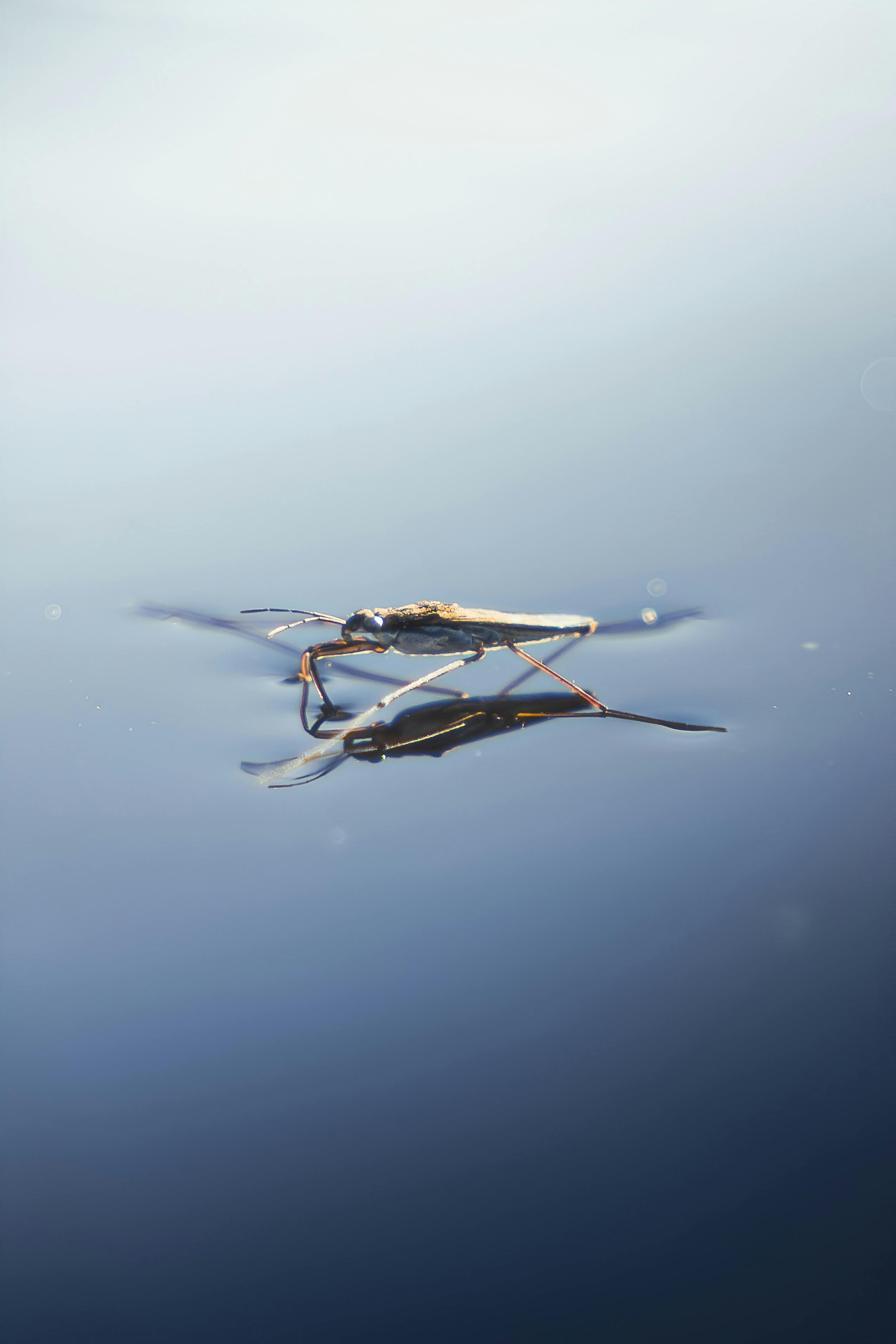
Fig. 2 A water strider
Image credit: Alex Urezkov / Pexels
Sense at a Threshold
The first man in space, or the last dog, Gagarin asks. Unmoored by scale, Gagarin is becoming-dog. Or rather, Gagarin is becoming-dog from Gagarin’s perspective, from the disorienting and powerless perspective of a space race that had already seen dozens of animals — including fruit flies, monkeys, and dogs — thrust off the face of the earth in its name. Other perspectives remain, however. Indeed, we would like to insist more forcefully on the alterity of perspectives, bringing them more explicitly into Marilyn Strathern’s definition of scales as “the organization of perspectives on objects of knowledge and enquiry.”24 To insist, for instance, that scaling pertains not solely to our different organizations of perspective — with all their power-saturated, uneven, and violent ramifications — but to other perspectives as well, perspectives that are neither by us, for us, nor about us. Which is, in truth, what makes it difficult for Gagarin to become dog. Alas, the concept of “species” too is a scale.25
In a 2019 study designed to test how dogs could be used in biomedical research, Astrid Concha and others sought to establish the “olfactory threshold” of dogs’ sensitivity to amyl acetate (a banana flavouring) in mineral oil. Having dissolved amyl acetate at progressively weaker concentrations, the researchers concluded that the “olfactory detection threshold for fluid mixtures [ranges] from 40 parts per billion to 1.5 parts per trillion.”26 This was the first published study — the first, if priority is measured in the scale of the history of science — to determine the limits of odorant detection in fluid.27 Long before it, however, dogs’ olfactory powers were (from a human perspective) commonly made accessible through liquid analogies.28 This should not be surprising: analogy is, among other things, a technique of scalar mediation. In canine ethologist Alexandra Horowitz’s version, a dog can smell a teaspoon of sugar in a million gallons of water, or the size of two Olympic swimming pools.29 In the US National Institute of Standards and Technology (NIST) version, it is a quarter teaspoon in a single Olympic swimming pool.30 Of course, neither Horowitz’s or NIST’s analogies come close to the parts-per-trillion detection demonstrated by the most sensitive dogs in the study designed by Concha and colleagues, even though both roughly match the dogs in the middle of the latter’s range. Nevertheless — “other perspectives remain,” says Strathern while immediately adding that this is a problem “long familiar to species classification.”31
Compulsively, a sensibly meaningless ratio at the scale of human perception (“parts per trillion”) must be metabolized into teaspoons and swimming pools. Scaled to human bodies and worlds, the analogy implies that a dog performs a quantitatively amplified version of human detection. But it is not just that the technique of analogy enables a comparison between a dog’s and a human’s respective range of perception, rendered in teaspoons of sugar and Olympic pool multiples. It is that such scalar mediation is mediated by another scale: it is mediated by the scale that “species” entails, one that trades particularity for abstract generality, and allows a thousand-fold range of inter-dog variation to be condensed into a single figure: “a dog can smell …”. But in relay and return, what the analogy does not admit — what, in fact, it actively disavows — is that dogs operate in an inaccessible, because qualitatively different, sensory regime. The question, in other words, is not whether any given analogy can accurately translate a dog’s sensorium. The question is why translation by analogy is necessary at all. Which is to say that analogy refers not to the scalar continuity between dogs and humans — canine olfaction as a scaling up, or scaling out of human olfaction — but to the discontinuity between radically different perspectives. The swimming pool, for all its vividness, is a human, not a canine, analogy. Scaling a dog’s sensuous perspective up and down to the world of human perception, the analogy of the swimming pool is, in short, a record of scalar failure.
Understood thus, scales are not only or always epistemic achievements that could be constructed or configured otherwise. Often, and perhaps especially when it comes to animals, scales are markers of intractable difference. A violent gloss over a threshold. A gloss over the fact that bodies matter, and they matter not only because physical forces operate differently on different bodies, but because the composition of different forces on different bodies is what a “perspective” constitutes. Less point of view (point de vue) than point of life (point de vie).32 Consider, in this sense, the radical shifts in perspective that are given in surface effects: for insects and other small organisms, water is a “skin”, sticky and potentially lethal; air is viscous and thick; a fall is rarely fatal. At this scale, walls themselves are scalable. For larger organisms, water yields easily but is unforgiving; air, at its best, is thin enough to breathe; walls may impede; falls can be lethal. “The central insight here,” to borrow Zachary Horton’s apt words, “is that organisms do not linearly scale: any change in size requires a redistribution of organs and their functions — in other words, a redesign of the organism.”33
The articles in this special issue straddle the threshold between scalar travel and scalar breakdown — or the emergence of scales that are simply not navigable. Inviting us not simply to consider but to inhabit the political scales engendered by different animal communities (Donaldson & Kymlicka, Cochrane, Meijer, Rath), the temporal scales rendered perceptible by animals’ individuality (Baratay, Page, Arnold and Pick), and even the intimate scales intimated in the inscription of animal bodies in capitalist food systems (Wadiwel, Gillespie, Barry), many of the articles in what follows probe the possibility of scalar travel — the possibility, however fraught, of moving across scales. But, at one and the same time, they remain critical of the operative analogies performed by the cosmic zoo(m), of what is given and what is taken away in glossing over the threshold. They are alert to what scalar mediation erases, alive to the violence that scales can and do engender, sensitive to the risk that in scalar travel “we injure the other beings we encounter through our anthropocentric attempts to force them to conform to our rules — rules developed by us, for us, at our native scale.”34 Other perspectives remain, and just as the so-called Anthropocene reveals the forces of world-history to have become out-scaled by planetary forcings they may have stoked but over which they can neither extend nor exert any form of restraint, neither can any amount of scalar travel undo or repair, by itself, the active and ongoing forms of erasure that the anthropocentric scales of history, politics, species, animal agriculture, and extraction exert over the threshold of animals’ lives themselves.35 Straddling the threshold between scalar travel and scalar breakdown, in other words, the articles in this special issue also trouble the hold that scaling can exert on our imagination. They render us sensitive to scalar differences at their most incommensurable, to something of what it means and what it takes to be out-scaled, to inhabit scales that exceed (and so often frustrate and impair) the conditions of one’s own experience and even of one’s existence.
Scale at the Threshold
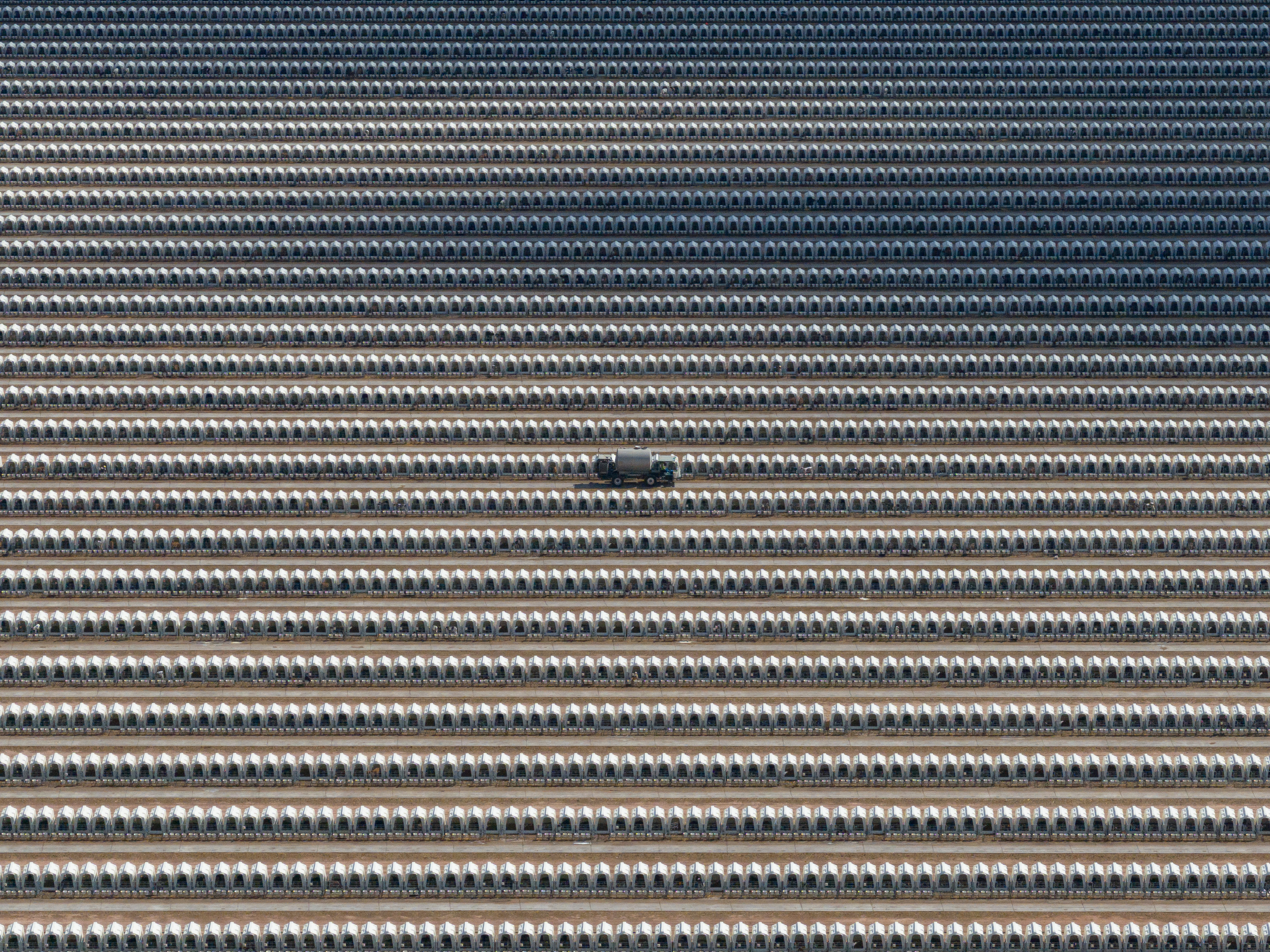
Fig. 3 A milk dispenser truck drives between some of the thousands of calf hutches in a massive dairy farm’s yard. Turkey Creek Dairy, Pearce, Arizona, USA, 2023.
Ram Daya, which is not the photographer’s real name, is a We Animals photojournalist. We Animals (weanimals.org) advocates for animals through photojournalism. This photograph was taken with a drone.
Image credit: Ram Daya / We Animals (2023)
The calf hutch is scaled exactly to the dimensions of a newborn calf. Calves on Riverview are separated from their mothers immediately at birth and kept in hutches for up to ninety days, after which they are either used for milk production in Arizona or sold (for meat or milk production).36 Sized to and enclosing one animal, the hutch is an architecture of individuation. From above, however, an entirely different scale becomes perceptible. The aerial view reveals the hutch as much as the calf — a pixel in a pixellated image — as a module in an industrial grid, a repeating unit organizing the desert landscape into a pattern of mass production. From this vantage point, the hutch is a technology of proliferation that operates not at the scale of an individual life, but at the scale of agricultural commodity flows. This is individuation as the very condition of violent multiplication, enacting the forced separation that is, as Dinesh Wadiwel’s contribution to this issue demonstrates, the constitutive moment of capitalist dairy production: the calf routed as raw material into a distinct value chain, the cow repositioned as labourer whose gestational work must perpetually begin again. So modestly, and yet so completely, the calf hutch instantiates mass-scale forced gestational labour — the “reproduction of reproduction” — that is the structural engine of the animal agricultural system.37
The hutch, then, is positioned at the threshold of irreducible temporal scales: the biological temporality of an individual calf’s life; the relentless cyclical temporality of industrial dairy production and commodity exchange; the deep temporality of domestication; the geological temporality of intensive agriculture that reshapes the earth itself. And it is also positioned at the threshold of irreducible spatial scales, scales which converge, as Katie Gillespie’s engagement with Wadiwel’s essay illustrates, on “the geography of the closest in”: the body, the intrauterine space, the cellular, the psychic interior. It is in these intimate registers that the forced separation enacted by the hutch — just one realization of “external processes of power and politics” — extracts its deepest costs, severing the affective bond between cow and calf at the very moment it is first forged.38 There is no nestling, mediating, smoothing over or resolving disparate temporal and spatial scales here. Like the orbital photograph of the earth, the hutch is a zone of intensity where a multiplicity of scales intersperse and interlace without resolution or reserve.
The hutch is thus akin to what Gabrielle Hecht calls an “interscalar vehicle,” that is, a “means of connecting stories and scales usually kept apart.”39 Interscalar vehicles do not, despite their name, facilitate scalar travel. Rather than enable one to zoom one’s way across scales, these are “vehicles” for the unruly movement or passage of incommensurable scales. In Ram Daya’s image, the interscalar vehicle is arguably an actual vehicle: the milk truck, facilitating the passage of the scale of the individual calf to scale of the supply chain, the biological to the industrial, the somatic to the economic, the agricultural to the planetary. The milk truck is the vehicle through which Daya’s photograph (another interscalar vehicle, as we have noted) becomes intelligible, in the same way as it is the vehicle through which the scale of animal exploitation is rendered visible. It limns the commodity value of the calf, while simultaneously marking, however spectrally, the affective bond between cow and calf as residue, refuse, remainder — an externality none of the scales the vehicle has been designed to serve can register or sense. The milk truck is, in this way, the threshold between the scalar politics of value and waste.
What if it was in and through such vehicles and thresholds — in and through their ability not to resolve but to hold together a multiplicity of divergent and interlacing scales — that we were to approach the planetary disarray that is the present tense? Some version of this question appears to be at stake in Hecht’s own concept of “an African Anthropocene”. For indeed, at issue here is neither a geographical essentialization (which would create some kind of comparative scale between an “African”, “Asian”, or “European” Anthropocene, whatever that might mean) nor exactly an intervention into debates and contestations disputing the nomenclature or the world- or geo-historical scale of this age. At issue, rather, is the attempt to fabricate the means or vehicle for “holding the planet and a place on the planet on the same analytical plane”.40 Which is to say, as indeed she herself says, that the expression “an African Anthropocene” produces a generative paradox holding together in disjunction the question of perspective and scale: attention to the specificity of place — of a terrain where colonial, extractivist, racialized histories, geographies and geologies meet particular human experiences — upends the smooth politics of Anthropos or the Earth that would encourage us to zoom out by way of interscalar travel to presumptively appropriate earth-system and species scale (the rest be damned).41 “An African Anthropocene” does not, therefore, merely draw our attention to the uneven distribution of damage caused and suffered across a specific continent of the earth. It renders perceptible the violence and erasure that the particular form of scalar travel “the Anthropocene” names, exerts, and entails. Thinking anthropologically with interscalar vehicles such uranium-bearing rocks in their extractive movement from Mounana, Gabon to France and Japan, Hecht’s “an African Anthropocene” attempts to offer ways of holding together the scalar mess of the planetary present while tracing “the interscalar complexity” that the politics of the earth represents.42
But again: other perspectives remain. If the extraction and transport of uranium-bearing rock opens up the perspectival unscaling that is “an African Anthropocene”, what might the interscalar vehicle of the calf’s hutch open up instead? Could we, in this sense, take the leap of thinking the perhaps even more paradoxical — not to say preposterous — figure of “an animal Anthropocene”? What would it mean to take such a leap? Needless to say, it most certainly would not be a matter of contesting the primacy of the anthropogenic causes — capitalist, colonial, extractivist, agricultural — that, in a perverse recursion, give rise to the anthropocentrism of the name “Anthropocene” itself. Perhaps “an animal Anthropocene” would mark an event defined less from the perspective of the locus of agency than from the perspective of the mass scale of animal death — through industrial farming, habitat appropriation and destruction, and extinction. Holding “the planet” and “a place on the planet” on the same analytical plane would not here pose a problem or constraint. Not simply because “a place” is as much a perspective on scales as it may be a geographical locale, but also because the Anthropocenic scale of animal death itself produces a striated and implacable geography — potentially, even, its own geology. In Australia, for instance, where animal agriculture has cleared over seventy per cent of historic land, the resulting fragmented, desiccated landscapes helped light the 2019–2020 “Black Summer” bushfires that killed or displaced an estimated three billion animals.43 And being everywhere and nowhere, it may be less a specific geographical setting than the bone geochemistry and sheer combined mass of broiler chickens — as well as the radical transformation of the biosphere they represent — that becomes a way of signalling where and how on earth “an animal Anthropocene” is emplaced.44
Uranium rocks are not inherently interscalar: they require work through and upon them. In Hecht’s framework, interscalar vehicles (rocks, maps, photographs, warning signs, atomic bombs) become so through human work and creative mobilization.45 No animal could pursue this political labour — at least, not as politics is currently organized.46 Rather, as Andrew Barry’s engagement with Wadiwel’s and Gillespie’s contributions to this issue makes perceptible, it is often animals’ bodies themselves — their very “industrialized metabolism” — that are turned into inter-scalar vehicles through which biochemical, industrial, urban, legal, and political-economic scales pass.47 Nonetheless, especially when it comes to animals whose physiological and affective lives bear recognizable similarities to ours, perhaps the threshold forces itself upon us, unbidden. After all, is not the grief inspired by the calf hutch already a form of recognition — of an individual body, of confinement, of separation from a parent and social networks, of an entire life, “from eyes open to eyes closed”, written off as waste?
“From eyes open to eyes closed” is the expression Andrea Arnold invokes, in her conversation with Anat Pick in this issue, to describe the project that became Arnold’s film Cow. Cow sits, as Pick argues, at the threshold between individual recognition, “its [unique] engagement with a single cow and her child”, and systemic exposure, capturing the interscalar movement between one cow, 2.65 million UK dairy cows, and 270 million worldwide. In attending to that singular life, Cow is an attempt to give back to animals precisely what Baratay (in this issue) insists Western philosophy and science have consistently withheld from them: recognition of a life with its own temporal arc, the individual biography from birth to death, encompassing “personality, singular experience, relationships with others, transformations over the course of a lifetime.”48 In their conversation, Pick and Arnold explore how it might be possible to cultivate the kind of attention that aims not, presumptively, to cross the threshold into an animal’s experience but to register the life on the other side of it. Arnold, one might say, refuses the point de vue — “[t]here is this tendency to say, let’s put a GoPro camera on top of an animal and then shoot from their perspective, which never seems to come off right”49 — in favour of an effort to capture Luma’s point de vie, the singular life constituted by the composition of forces on a particular body, and perceptible, however partially, at its surface; what Arnold calls Luma’s “invisible aliveness”.
Yet, at the outset, Pick records her ambivalence: “in the process of revealing Luma as an autonomous and sentient being, Cow itself consumes her, converting every gesture, every ripple of the muscle, every vocal plea into images. More than any other film of the last decade, perhaps, Cow crystallizes cinema’s entanglement in systems of value-extraction from the bodies of living animals.”50 And indeed, the economic conditions of the film’s making compound this. Arnold’s project was to film the “conscious lifetime” of a singular cow from birth to death, “from eyes open to eyes closed”, unabridged. In the event, however, says Arnold, “nobody was willing to fund us filming for eleven, twelve years.”51 Arnold was obliged to fashion a single biographical subject out of the temporal scales of two lives — Luma’s calf Malu (“from eyes open”) and Luma (“to eyes closed”). The irony here is piteous: the very individual scale that the film sought to hold up to our gaze is compromised by the timescale of filmmaking under capitalism. And if these are the challenges posed by the experiences of creatures with whom humans are already at least somewhat identified, what hope of even involuntarily registering, let alone understanding, the experiences of those organisms whose temporal and spatial scales are so radically discontinuous with our own? What form of attention, however unbidden, for bacteria, for whom a human day constitutes multiple generations? What analogy for coral, whose lifespans encompass geological epochs?
These issues raise for us a broader question. To what extent is “an animal Anthropocene” dependent upon animal experience? If the Anthropocene is understood as a geological event, then animal experience is beside the point — what matters is the measurable impact on bodies, populations, and ecosystems. The broiler bone landfill testifies to the geological scale of animal death, regardless of how the individual chicken experienced it. If, however, the Anthropocene is understood as a scalar event — an event that disrupts the conditions of inhabiting a world at a particular scale — then the inaccessibility of animal experience (the failure of analogies, of scalar travel) is not an obstacle to be overcome but a constitutive feature of the definition. For what is at stake here is not merely inaccessible points de vue, but inaccessible points de vie: perspectives organized through sensoria and temporalities that no analogy or construction can capture. An animal Anthropocene, understood as a scalar event, would thus name not only the mass scale of animal death but the mass proliferation of thresholds that matter, even when no interscalar vehicle has been designed to cross or straddle them. The riotous scrambling of scales that “an animal Anthropocene” names is also therefore, constitutively, a riotous scrambling of perspectives — not viewpoints, but points of life whose very existence multiplies the thresholds at which our scales become inadequate and unworkable, rendered thoroughly other to themselves.
Funding statement
Martin Savransky’s research for this article has been supported by Grant ATR2024-154966 funded by MICIU/AEI/10.13039/501100011033.
Notes
Gagarin, Soviet Man in Space, 15.
Cosgrove, Apollo’s Eye.
Angus, Camera Geologica.
Hegel, Lectures on the Philosophy of World History, 96–118.
Baratay, “Scale: Temporal”
Rath, “Time, Species, and Human–Animal Relations”, 111.
Page, “Actors in Time”, 127, 132.
Rath, “Time, Species, and Human–Animal Relations”, 120.
Motamedi Fraser, “Politics”; Savransky, Exology; Wynter, “1492”.
Jazeel, “Spatializing Difference”, 82.
Gilroy, After Empire, 81.
Tsing, Mushroom, 38.
Tsing, “On Nonscalability,” 507.
Lury, “How Do We Count Ourselves?”
Carr and Lempert, Scale, 4.
Daston, “Intelligences”, 53; qtd. in Despret, “Secret Agents”, 30.
Haraway, “Situated knowledges,” 581.
Carr and Lempert, Scale, 4.
Cochrane, “Interspecies Political Scales”, 52.
Horton, Cosmic Zoom, 36.
Savransky, “Regimes of Futurity.”
Savransky, Exology.
Clark, Ecocriticism on the Edge, 15.
Strathern, Partial Connections, xvi.
Motamedi-Fraser, Dog Politics.
Concha et al., “Canine Olfactory Thresholds”.
Guest and Otto, “Editorial.”
Although not all dog olfactory analogies are liquid. For example, James Walker, former director of the Sensory Research Institute at Florida State University, notes that “[i]f you make the analogy to vision, what you and I can see at a third of a mile, a dog could see more than 3,000 miles away and still see as well” (Tyson, “Dogs’ Dazzling”).
Horowitz, Inside of a Dog, 72.
“NIST Nose a Hit When They Smell It: A New Generation of Odor-Releasing Materials for Training Dogs.” National Institute of Standards and Technology, 17 Sept 2013, https://www.nist.gov/news-events/news/2013/09/nist-nose-hit-when-they-smell-it-
new-generation-odor-releasing-materialsStrathern, Partial Connections, xiv.
Coccia, Life of Plants, 20.
Horton, Cosmic Zoom, 18.
Horton, Cosmic Zoom, 2.
Chakrabarty, Climate of History.
We Animals, “Arizona’s Mega-Dairies and Water Crisis”, 16 November 2023, https://weanimals.org/project/arizonas-mega-dairies-and-water-crisis/.
Wadiwel, “Industrial Scale Surrogacy”, 154.
Gillespie, “Working Bodies”, 183. As Mariam has noted elsewhere, drawing on the work of Jessica Eisen, “the social relationships of most significance to cows, and the priorities currently most devastatingly frustrated by the conditions of industrial agriculture under which they work, are those of parent and friend.” Motamedi Fraser, Dog Politics, 150.
Hecht, “Interscalar Vehicles”, 115.
Hecht, “Interscalar Vehicles”, 112; emphasis in the original.
Hecht, “Interscalar Vehicles”, 109.
Hecht, “Interscalar Vehicles”, 115.
Van Eeden et al., “Impacts”.
Bennet et al., “Broiler Chicken”.
Hecht, “Interscalar Vehicles”, 115.
Hence the profound significance of Donaldson and Kymlicka’s analysis of animals and politics (this issue, and see also their Animals and the Right to Politics).
Barry, “Biochemical Scale”, 179.
Baratay, “Scale: Temporal”, 106.
Pick, “From Eyes Open to Eyes Closed”, 207.
Pick, 201.
Pick, “From Eyes Open to Eyes Closed”, 205.
Works Cited
Baratay, Éric. “Scale: Temporal — Towards a History on the Side of Animals.” Translated by Nick Millet. Humanimalia 16, no. 2 (2026): 87–108. http://doi.org/10.52537/humanimalia.28272.
Barry, Andrew. “Biochemical Scale.” Humanimalia 16, no. 2 (2026): 167–80. http://doi.org/10.52537/humanimalia.28280.
Bennet, Carys E., Richard Thomas, Mark Williams, Jan Zalasiewicz, Matt Edgeworth, Holly Miller, Ben Coles, Alison Foster, Emily J. Burton, and Upenyu Marume. “The Broiler Chicken as a Signal of a Human Reconfigured Biosphere.” Royal Society Open Science 5, no. 12 (2018): 180325. https://doi.org/10.1098/rsos.180325.
Carr, E. Summerson, and Michael Lempert, eds. Scale: Discourse and Dimensions of Social Life. University of California Press, 2016.
Chakrabarty, Dipesh. The Climate of History in a Planetary Age. University of Chicago Press, 2021.
Clark, Timothy. Ecocriticism on the Edge: The Anthropocene as a Threshold Concept. Bloomsbury, 2015.
Coccia, Emanuele. The Life of Plants: A Metaphysics of Mixture. Translated by Dylan J. Montanari. Polity, 2018.
Cochrane, Alasdair. “Interspecies Political Scales and the Question of Legitimacy.” Humanimalia 16, no. 2 (2026): 45–59. http://doi.org/10.52537/humanimalia.28265.
Concha, Astrid, Claire M. Guest, Rob Harris, Thomas W. Pike, Alexandre Feugier, Helen Zulch, and Daniel S. Mills. “Canine Olfactory Thresholds to Amyl Acetate in a Biomedical Detection Scenario.” Frontiers in Veterinary Science 5 (2019): 343. https://doi.org/10.3389/fvets.2018.00345.
Cosgrove, Denis. Apollo’s Eye: A Cartographic Genealogy of the Earth in the Western Imagination. Johns Hopkins University Press, 2003.
Despret, Vinciane. “From Secret Agents to Interagency.” History and Theory 52, no. 4 (2013): 29–44. https://doi.org/10.1111/hith.10686.
Donaldson, Sue and Will Kymlicka. Animals and the Right to Politics. Oxford University Press, 2025.
Gagarin, Yuri. Soviet Man in Space. Foreign Languages Publishing House, 1961.
Gillespie, Kathryn. “Working Bodies, Feeding Lives: The Spatial-Temporal Regimes and Affective Ruptures of Farmed Animals’ Reproductive Labour.” Humanimalia 16, no. 2 (2026): 181–96. http://doi.org/10.52537/humanimalia.28279
Gilroy, Paul. After Empire: Melancholia or Convivial Culture? Routledge, 2004.
Guest, Claire and Cynthia, M. Otto. “Editorial: Canine Olfactory Detection.” Frontiers in Veterinary Science 7 (2020): 100. https://doi.org/10.3389/fvets.2020.00100.
Haraway, Donna. “Situated Knowledges: The Science Question in Feminism and the Privilege of Partial Perspective.” Feminist Studies 14, no. 3 (1988): 575–99. https://doi.org/10.2307/3178066.
Hecht, Gabrielle. “Interscalar Vehicles for an African Anthropocene: On Waste, Temporality, and Violence.” Cultural Anthropology 33, no. 1 (2018): 109–41. https://doi.org/10.14506/ca33.1.05.
Hegel, G. W. F. Lectures on the Philosophy of World History, Volume II: The Lectures of 1830–1831. Edited and translated by Peter C. Hodgson and Robert F. Brown. Oxford University Press, 2025.
Horowitz, Alexandria. Inside of a Dog: What Dogs See, Smell, and Know. Simon and Schuster, 2012.
Horton, Zachary. The Cosmic Zoom: Scale, Knowledge, and Mediation. University of Chicago Press, 2021.
Jazeel, Tariq. “Spatializing Difference beyond Cosmopolitanism: Rethinking Planetary Futures.” Theory, Culture & Society 28, no. 5 (2011): 75–97. https://doi.org/10.1177/0263276411410447.
Lury, Celia. “How Do We Count Ourselves? The New Political Arithmetic of Personalisation.” Keynote lecture at the 9th Nordes Design Research conference, Kolding, Denmark, 17 August 2021.
Motamedi Fraser, Mariam. Dog Politics: Species Stories and the Animal Sciences. Manchester University Press, 2024.
Motamedi Fraser, Mariam. “The Politics of Animal Time: Species, Race, and The Anthropocene.” Environment and Planning E: Nature and Space 8, no. 4 (2025): 1389–1407. https://doi.org/10.1177/25148486251345307.
Page, Sophie. “Actors in Time: Animal Histories, Behavioural Plasticity, and the Medieval Past.” Humanimalia 16, no. 2 (2026): 125–46. http://doi.org/10.52537/humanimalia.28276.
Pick, Anat. “From Eyes Open to Eyes Closed: A Conversation with Andrea Arnold.” Humanimalia 16, no. 2 (2026): 197–213. http://doi.org/10.52537/humanimalia.28281.
Rath, Thomas. “Time, Species and Human–Animal Relations in Latin America.” Humanimalia 16, no. 2 (2026): 109–24. http://doi.org/10.52537/humanimalia.28275.
Savransky, Martin. Exology: Planetary Upheaval and Social Life. Open Humanities Press, forthcoming.
Savransky, Martin. “Regimes of Futurity: Progress, Catastrophe, and Historicity in the Anthropocene.” Futures no. 173 (2025): 103682. https://doi.org/10.1016/j.futures.2025.103682
Strathern, Marilyn. Partial Connections. Updated ed. AltaMira Press, 2004.
Tsing, Anna Lowenhaupt. The Mushroom at the End of the World: On the Possibility of Life in Capitalist Ruins. Princeton University Press, 2021.
Tsing, Anna Lowenhaupt. “On Nonscalability: The Living World Is not Amenable to Precision-Nested Scales.” Common Knowledge 18, no. 3 (2012): 505–24. https://doi.org/10.1215/0961754X-1630424.
Tyson, Peter. “Dogs’ Dazzling Sense of Smell.” NOVA, Public Broadcasting Service, 4 October 2012. https://www.pbs.org/wgbh/nova/article/dogs-sense-of-smell/
van Eeden, Lily M., Dale Nimmo, Michael Mahony, et al.. Impacts of the Unprecedented 2019–20 Bushfires on Australian Animals. World Wildlife Fund, 2020.
Wadiwel, Dinesh, “Industrial Scale Surrogacy.” Humanimalia 16, no. 2 (2026): 147–66. http://doi.org/10.52537/humanimalia.28277.
Wynter, Sylvia. “1492: A New World View.” In Race, Discourse, and the Origin of the Americas: A New World View, edited by Vera Lawrence Hyatt and Rex Nettleford, 5–57. Smithsonian Institution Press, 1995.