Creative Animals — or “Animal” Creativity?
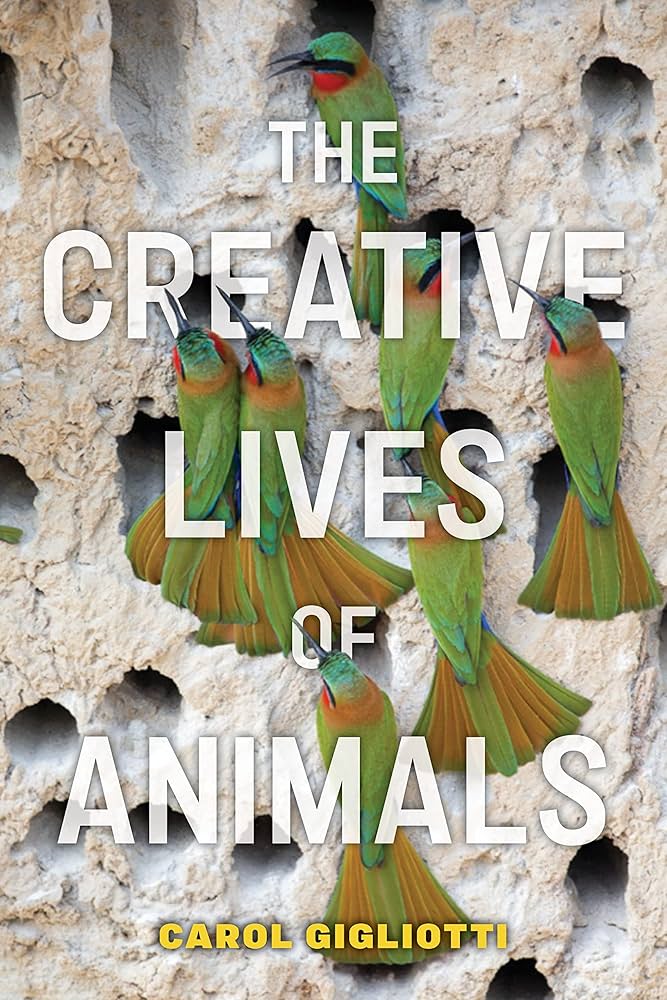
Review of Carol Gigliotti, The Creative Lives of Animals. Animals in Context. New York: NYU Press, 2022. 289 pp. $25.00 (pb). ISBN: 978-1-479-81545-6.
Kiene Brillenburg Wurth is Professor of Literature and Comparative Media at Utrecht University, Netherlands.
Email: K.Wurth@uu.nl
Humanimalia 16.2 (Summer 2026)
Zhuangzi (ca. 400–300 BCE), the famous Warring States text that advocates perspectival agility and suspension of judgement, opens with the story of an immense fish-bird: Kun-Peng. Beginning as a tiny fish egg, Kun navigates the darkness of the Northern Sea where he mysteriously transforms into Peng, a giant bird who beats the water with his wings and rides a massive whirlwind to the Southern Sea.1 Together, Kun and Peng may embody a Daoist idea of life-and-death as constant movement and transformation. The bird and fish are not separate “entities” (as Aristotle would see them) but rather phases in an ongoing dynamic. In the same way, the five phases or wuxing in classical Chinese philosophy are interdependent and morph into one another: wood (mu) turns into fire (huo), fire into earth (tu), earth into metal (jin), metal into water (shui), and water again nourishes wood. As continuous movement, Kun-Peng also embodies continuous opening. The fish, surrounded by water, leaps high in the sky, where the sea suddenly looks like a pond. From different viewpoints, different worlds emerge. Why stick to only one? Why not cultivate the flexibility to integrate the many?
Carol Gigliotti’s The Creative Lives of Animals opens with a similar question. It invites us to stretch our minds to reconsider creativity, traditionally seen as a uniquely human trait, as an intelligent capacity not limited to the human animal. In Zhuangzi (a text full of animal tales), a fixed view narrows understanding and leads to judgement. Thus, when Kun-Peng soars into the sky, a cicada and a small bird ridicule them: “What’s all this about ascending ninety thousand and flying south?” But what do they know about Kun-Peng, who holds a multitude of perspectives? Just so, perhaps, Gigliotti’s book asks: What do we know about the creative lives of animals? Do we keep thinking of animals as “merely useful contributors to our human needs”, or can we let go of that transactional view and see how they contribute creatively to an equally creative ecosystem (13)? Can we, in other words, become a bit more like Kun-Peng?
Gigliotti never references Zhuangzi, though the latter might have served her well. It is a text dedicated to decentring and situating one’s experience in the world in a way that both anticipates and broadens perspectives on creativity and flow proposed in the twentieth and twenty-first centuries.2 Instead, Creative Lives builds on modern, established definitions of creative thinking enabled by, on one hand, the animal creativity research conducted by Alison B. Kaufman and James C. Kaufman and, on the other, by biologists’ and sanctuary workers’ observations on animal behaviour (12). Yet, if the point of her richly researched book is to change our minds about other-than-human-animal creative abilities, it only partly succeeds in doing so. As I argue below, Gigliotti’s approach comes with several problems. First, it uses the standard definition of creativity as unusual yet useful human problem-solving skills. This definition, proposed during the Cold War, still underpins today’s creative economies and their demand for constant innovation.3 I argue that an inclusive, ecological approach calls for a different framework. Second, Creative Lives lacks a clear focus and deeper philosophical argument. Is it a book about animal creativity, or animal intelligence? Is creativity a matter of intelligence only? I suspect Gigliotti has written a book about animal creativity to make a point about animal intelligence, which includes problem-solving. But could creativity also be more than problem-solving? To answer these questions, I first review the book in the context of creativity research. I then offer a response to Gigliotti, drawing on Zhuangzi, Jacques Derrida’s concept of the gift, and Alfred North Whitehead’s processual idea of creativity, which, I argue, offers a less human-centred perspective. I conclude that The Creative Lives of Animals is a richly detailed book on animal agency and intelligence that, however, does not fully explain what makes their capacities and behaviour creative.
Creativity across Species
The Creative Lives of Animals is an impassioned account of how other-than-human animals think and behave creatively. Its aim is not to show that animals are “just like humans” in their cognitive abilities, but to show how we can rethink human creativity by studying animals’ capacities, behaviour, and production. It seeks to change our minds about ourselves and our creative abilities by opening ourselves up to animal perspectives. On a deeper level, it seeks to show how this expanded view compels us to reconsider animals’ interior lives. As Gigliotti puts it in the introduction: “Openness to new ideas is a crucial characteristic of the creative process, yet disregarding the possibility of animals being creative has blinded us to alternative and richer ideas about what creativity is and how it operates across species” (13). How can we be more creative about creativity?
Clearly, humans have much to learn from animals when intellectual ability and creativity are at stake. But what is creativity? Since WWII, beginning with Joy Paul Guilford’s famous presidential address to the American Psychological Society in 1950, psychological and neuroscientific research has settled on a definition that emphasizes problem-solving: creativity is the ability to produce novel and valuable ideas or products by thinking or acting both divergently (thinking or doing out of the box, generating multiple ideas or solutions) and convergently (selecting a valuable idea from what was generated divergently) in response to a specific problem. This definition implies that creativity is a mode of intelligence, as intelligence is a complex that includes problem-solving. It also implies that creativity is an individual ability, rather than an interdependent one, and one that any individual may develop rather than just the gifted few. Thus, as a learnable skill, creativity in the Cold War era was increasingly claimed by the military, science, technology, and business management, ultimately becoming an obligation in capitalist economies. Today, it is a social imperative that compels corporations and individuals to generate — and purchase — novelty, to be original, and to constantly (re-)invent themselves and grow.4
Gigliotti sides with these modern approaches to creativity that she considers “current”:
More traditional human assumptions about creativity have placed its manifestation in only the most celebrated of human artists, scientists, or innovators. Current thinking about creativity, however, has expanded to accommodate the ordinary individual and cooperation among groups of people in creative ventures of all kinds (18).
Elsewhere, Gigliotti describes creativity as a “common quality throughout human activity” that researchers in the biological sciences have also identified in animals as novel, meaningful behaviour in problem-solving and adaptation (7). Following evolutionary biologists Simon M. Reader and Kevin N. Laland, Gigliotti treats creativity and innovation as continuous. She sees innovation as the outcome of creative activity — its application — and creativity as the “driver” (11). The key question for her, as for Reader and Laland, is whether animals have that drive.
My issue with treating these two terms as causally related — innovation as the logical outcome of creativity — lies in the postwar definition of creativity as problem-solving. That definition democratized creativity, but it also dramatically narrowed the concept. Viewing creativity as problem-solving inevitably leads to a focus on usefulness, no matter how broadly the term “useful” has been stretched in creativity research in recent decades. Typically, creative activity involves finding “better,” more “meaningful,” or “efficient” solutions. It serves a goal within a community (even though “exploratory” creativity is recognized as one of its less useful variants, while also treated as mere preparation for innovation). In this vein, Gigliotti defines creativity as “a dynamic process in which novel and meaningful behaviors are generated by individuals with the possibility of affecting others at cultural, species, and evolutionary levels” (4).5 Thus animal creativity, too, becomes purposive, even if it is the complexity and specificity of the process, more than the outcome, that counts.
By contrast, Daoist texts such as Zhuangzi, which precede and enrich current popular conceptions of creative flow such as those of Mihály Csíkszentmihályi, emphasize the importance of uselessness.6 Openness to experience, rather than meaningful application, and co-creation, rather than individual intention and ability, inform the experience of flow.7 In her Introduction, Gigliotti does pick up this view on creative flow when she briefly — all too briefly — considers David Bohm’s On Creativity ([1967] 1998) to elaborate on a “larger and more universal creativity” (18). For Bohm, a quantum physicist and a philosopher, creativity is about open, unpredictable exploration rather than skill, about responding to the complexity of nature and its plural manifestations, rather than producing something useful.8 If creativity is a form of intelligence, Bohm does not privilege the human as its unique possessor. He sees creativity as arising from an “undefinable” potentiality that generates all perception rather than as just an individual skill (10). This argument is vital to Gigliotti’s account, as her book aims to paint the richness of animals’ creative lives on a canvas that stretches from problem-solving to biodiversity, from the individual to the ecosystem, as a creative process (10). Yet, she then drops the issue. More solid theoretical framing was needed here. In the last section, I try to connect the dots on creativity as pure potentiality, showing how Bohm’s views on creativity relate to Whitehead’s earlier conceptualization of the term as an ongoing process in nature.
Perhaps Gigliotti focuses less on theoretical framing because her main goal lies elsewhere: to share with us the incredible richness and diversity of animal behaviour across many species and to make us reconsider and create space for them. An eye for diversity implies an eye for complexity and situatedness. Animal creativity, Gigliotti proposes, is situated: each instance outlined in the book reveals an animal’s problem-solving skills in “unique circumstances” (15). Gigliotti takes stock of these circumstances and uses them to structure her book around seven themes: cognition, communication, play, architecture, sexual selection, animal emotions, and animal art. I discuss these chapters below.
Chapter 1 explores how animal intelligence relates to creativity. That relation appears in the animals’ ability to think abstractly, to retain memories, and to flexibly produce new knowledge from memories — an ability found not just in primates but also in pigs, reptiles, fish, and birds. They generate novelty. Even so, Gigliotti continues, creativity in animals is not limited to intelligence as a “logical function” but extends to its multiple functions in animal behaviour, including empathy, social learning, and mimicry (24–25, 22). Still, after reading this chapter, I had learned a great deal about the varieties of animal intelligences, but less so about the specificities of animal creativity. Is it about generating novelty based on what is already available in memory, flexible collaboration, or about emotional “engagement” (39)? And if all of them, how do they hang together as instances of creative behaviour? The chapter raises more questions than it answered by failing to show what creativity adds to intelligence.
Gigliotti’s discussion of Howard Gardner’s concept of multiple intelligences — a heavily contested idea that some consider a neuromyth — illustrates my point. Gardner defines intelligence as “a biopsychological potential to process information that can be activated in a cultural setting to solve problems or create products that are of value in a culture,” and Gigliotti treats this as cross-species potential (46). While this definition offers a way out of human chauvinist conceptions of intelligence, it also leaves us with a relatively uninteresting conclusion: creativity is (a form of) intelligence, and vice versa. Can it be more than that? Gigliotti does not raise the question — unless the answer is already embedded in Chapter 2, which treats communication as a creative activity. The chapter traces how animal language use, as observed in the animals’ environments, may involve imaginative engagement. As Gigliotti shows, researchers such as Con Slobodchikoff and his team have demonstrated that prairie dogs use distinct calls to signal whether a threat is predatory and to distinguish among individuals of the same species (e.g., large, small, red shirt, etc.). Chickens also use situated, complex sound systems to communicate with one another. Trees communicate with scents. Consequently, Slobodchikoff sees language not as human-specific but as a “biological system shared with other species” that evolved over time (57). Gigliotti and Slobodchikoff both believe that creativity — as a cognitive ability — may have evolved in the same way. The prairie dogs, they argue, generate “new terms not seen before” for different species and unique individuals by combining two or more familiar sounds (54). Other animals deploy “chemical, visual, acoustic, vibrational, sonic, bioluminescent, electric, and tactile systems of communication in unlimited combinations” (60). Here, I cannot help but see humans as the small birds and cicadas in Zhuangzi, blinded by their limiting belief that language is uniquely theirs.
The example above shows that cognitive ability can become creative when it involves what Arthur Koestler calls bisociation: the generation of novelty through connecting what is already available across previously unconnected fields.9 Metaphor is a case in point. In prairie dogs, bisociation concerns the surprising or, in any case, ingenious combination of disparate sounds into a novel sound that resonates meaningfully within their community. In the 1990s and 2000s, Margaret Boden expanded Koestler’s theory by arguing that the combination of disparate fields, which she calls conceptual spaces, is but one (and, to her, not the most exciting) dimension of creative activity. The other two are exploring the potential of a conceptual space (what is and is not possible) and expanding it (by changing the rules of the game). Yet it seems to me that exploring and even expanding a conceptual space is precisely what Koestler means by “a new synthesis of previously unconnected matrices of thought”.10 Somehow, humans have seen themselves as the privileged generators and keepers of the new. Unfortunately, the rest of Chapter 2 gave me little opportunity to explore whether bisociation could serve as a framework for Gigliotti’s discussion of animal communicative skills. It offers fascinating material, such as improvisational bird singing, but little conceptual synthesis.
Chapter 3 focuses on play as both an aspect of and a pointer to creative behaviour in animals. The chapter opens with Mihály Csíkszentmihályi’s concept of flow, first developed in the 1970s.11 As noted above, the concept resonates with Daoist ideas, especially weiwuwei, or “do-not-doing”: non-goal-oriented activity.12 Flow is about the process, not the outcome, the pleasure of doing something and being joyfully in sync with or immersed in it. Elsewhere, I have critiqued Csíkszentmihályi for making “flow-ing” purposive by linking it to the pursuit of happiness.13 Still, the concept of flow has significant potential in the context of animal creativity: it drives creativity across multiple processes, not just artistic ones. In his later Creativity: Flow and the Psychology of Discovery and Invention (1996), Csíkszentmihályi describes the role of flow in creative activity and presents a five-step model of the creative process. Gigliotti mentions the model and wonders how play could fit into it. Yet in his earlier research on flow, Csíkszentmihályi already outlined how flow is like play. If flow is like play, and if flow is the engine of creativity, then why identify play as a sixth part of the model? A sharper discussion of Csíkszentmihályi’s theory could have helped reinforce Gigliotti’s claims. Notably, Csíkszentmihályi sees humans as differing from animals in their creative abilities, while Gigliotti’s richly researched examples demonstrate how animals introduce novelty into their fields through play. She thus could have made a case against Csíkszentmihályi’s speciesist view of creative activity as distinctly human.
If play need not have a useful or meaningful outcome to be called creative behaviour, Chapter 4, by contrast, shows how animal creative behaviour can be intentional. How and in which circumstances do animals build things to make life better or easier for themselves? The chapter zooms in on animals’ capacity to build elaborate structures, such as beaver dams, and takes us back to creativity as a problem-solving ability. It approaches creativity as a skill for sustaining and enhancing animal lives in their natural settings, a skill that transcends instinct. Thus, in beavers, problem-solving evolves into an imaginative, innovative, and improvisational activity — as it does in human animal architects, artists, writers, scientists, or in children exploring their environment (111–13). Gigliotti proposes using the beavers’ creative activity as a model for other animal behaviour to broaden our perspective on creativity beyond a human one, seeing animal activity as more than mindless, “just innate” behaviour. She then carefully traces instances of animal architectural creativity in insects, showing how their thinking is flexible (adapting to circumstances) and interdependent with others in their social group. Do these insects, like beavers, show us how to think differently about intelligence? The final part of the chapter consists of Gigliotti recounting research on the architectural artistry of male and female bower birds. Do they build for necessity, or also for pleasure taken in beauty? We can only answer these questions when we let go of calcified human views steeped in binary oppositions between humans and animals, and consider concepts such as art, pleasure, aesthetics, or intelligence from a nonhuman-animal perspective.
The creative lives of animals are meaningful lives, Gigliotti insists, and our failure to acknowledge this has disrupted the ecosystem. Chapter 5 taps into this meaningfulness from the angle of sexual selection. Is animal sexual selection more than “simply instinctual”? Is it (also) a matter of pleasure and individual choice? Evolutionary ornithologist Richard O. Prum has proposed in The Evolution of Beauty (2017) that mating in animals is not just a matter of survival but also one of sheer pleasure. Busting another myth, his book also argues that female animals’ perception of, valuation of, and desire for male beauty may have been crucial in evolutionary processes.14 Inspired by his approach and findings, Gigliotti draws on Prum’s rereading of Darwin’s Descent of Man (1871), though she does not mention that researchers in evolutionary psychology have already done extensive work in this direction, likewise diverging from the utilitarian view of evolution based on so-called good genes.15 Prum calls this alternative reading coevolution.
Whether Prum is correct is debatable. His theory is clearly relevant to Gigliotti, who assumes that animals are “sophisticated decision makers creatively involved in their own sexual choices” (139). From a creativity studies perspective, Prum’s proposal to re-view evolution as based on non-functional choice and subjective value, and his idea of evolution as co-creative becoming, both argue for a conception of creative activity beyond individual, purposive problem-solving. That, to my mind, is a necessary change of view. However, from an evolutionary perspective, his theory has received mixed reviews.16 Other research framing Gigliotti’s chapter on sexual exuberance, including Bruce Bagemihl’s Biological Exuberance (1999), supports the idea that animals do things for pleasure, not just for function. Still, the controversy around Prum’s work on beauty as a driver of evolutionary diversity makes it a problematic basis for Gigliotti’s core claim that “animals are creative in individual, species, cultural, and biodiverse ways” (129).
Chapter 6 proposes emotion as a driver of animal creative activity. Gigliotti argues that empathy is “often a crucial forerunner of the creative process” in imaginative work, but she fails to explain why (166). As much as the material in the chapter touched me, the argument remains fuzzy, making it hard to say whether the chapter is about emotion, empathy, and imaginative relating within and between species (chicken; chicken and horses; chicken and humans; fish) or about creativity and personality traits conducive to it. More solid framing would have helped elaborate Gigliotti’s point. I can therefore do no more than hazard the guess that recognizing emotional-imaginative behaviour as a creative (and by implication, intelligent) activity aligns with Gigliotti’s fluid conception of creativity (it could manifest in any animal activity), her proposal to reconsider established ideas of creativity by exploring the concept through animal perspectives, and her ultimate goal of having human animals recognize the (emotional) intelligence of nonhuman animals.
Chapter 7 returns to Gigliotti’s initial definition of creativity across three levels. It is, in many ways, a crucial chapter, exploring how animals are cultural and cultured, if one defines the cultural as the production and circulation of shared values, information, behaviours, and memories in a community, and the cultured as having been trained or educated into these values, information, behaviours, and memories. Recognizing that animals have cultures and enculturation shows that they share and pass on what binds their community socially, rather than only genetically. As Gigliotti shows, these include dialects and hunting skills in whales and dolphins, tool use in chimpanzees, and regional song dialects in birds. Indeed, animals develop cultural memory and change shared values over time, combining their creative abilities and skills with information passed down to them. The chapter draws on a wide range of research, but its many examples often obscure its core message. Some sections are framed as illustrations of creative activity generating cultural phenomena and of creative work evolving through cultural evolution. Yet instead of deepening that perspective, they move on to other questions, such as “Is animal song music?” “Do animals generate what we think is art?” I was at a loss when the chapter took a turn toward morality in the subsequent section. Morality and creativity may both rely on judgement, or making choices to solve a problem, as Gigliotti suggests, but this claim remains unexamined, like most of the questions the chapter raises.
Agile Responsiveness: From Innovation to the Gift
In her Epilogue, Gigliotti invokes Lewis Hyde’s The Gift to suggest that creativity is never owned but offered, like a gift, circulating among all: the “larger and universal” creativity already announced towards the end of the introduction (18). As she aptly puts it, we are “swimming in an ocean of creativity. It is happening all around us all the time, in all the creatures surrounding us, even in those that we do not see” (225). This gift of creativity is a transformative plurality — continuous and novel at once — that sustains the ecosystem and its situated arisings, emerging through intra-active dynamics. As part of the gift, Gigliotti argues, we must set limits on our own creative work, for much of it “has been directed towards the benefit of our own species, often to the detriment of other species” (228). Precisely as an obligation to innovate, however, creativity reveals its own duplicity as a gift. When put in the service of a goal (the useful), the gift loses its potential as radical valuelessness. It literally loses its value. In response to this paradox, I would propose a more fluid approach: creativity as an open, distributive activity of mutual becoming, rather than a targeted personal ability. Thinking with Gigliotti’s idea of creativity as a gift, I unpack this approach in the next section through a “diffractive” reading of Whitehead’s notion of creativity, the Zhuangzian idea of xiaoyaoyou, or “free and easy wandering” (a movement derived from animals), and Jacques Derrida’s reading of the gift as a gesture not to be recognized as such.17 I conclude that what I call “animal” creativity is about agile responsiveness instead of translating problems into opportunities.
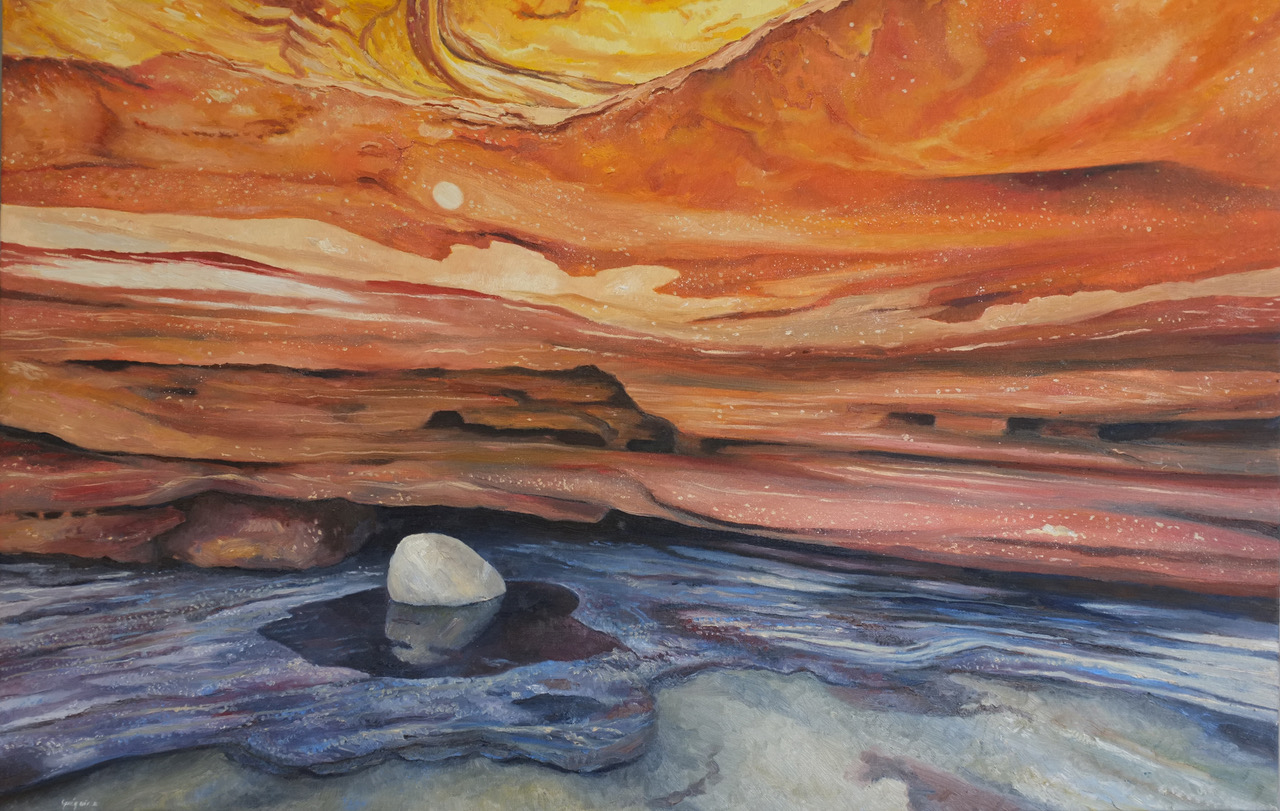
Fig. 1 Jacques Grégoire, Heelal in steen (2013), oil on canvas, 80 × 125 cm.
Courtesy of the artist. Used with permission.
“Animal” Creativity: A Response to Gigliotti
In the 1920s, Whitehead conceptualized creativity as a ceaseless dynamic manifesting in all phenomena. As he writes in Process and Reality, this dynamic amounts to an impersonal “bringing forth”, without characteristics of its own.18 This means that creativity is emergent with and through infinite becomings, rather than being an entity in itself: the “function of creatures [i.e., occasions] […] constitute[s] the shifting character of creativity”.19 Another way of putting this is that creativity is an unmanifest that both affects and is affected by all occasions or “creatures”.20 It relies on limitless manifestations to become distinctly manifest — i.e., it is meaningless as an abstraction yet it also drives them as an energetic force in any way possible. “Any way possible” implies openness, while the impossibility of identification implies groundlessness: “creative advance”, as Whitehead calls it, is a process without anchor.21 Thus, in Whitehead’s original coinage of the term, “creativity” cannot be seen as a recognizable ability of a (Godlike, human, or animal) creator separate from a process. It is not reducible to an “external agency with its own ulterior purposes”.22 Moreover, the productive intra-activity of creativity and creatures means there will always be novelty, regardless of human goal-setting. Thus, humans and all kinds of in/organisms are always already co-becomings of creativity.23 Thirdly, since creativity is entangled with creatures, I conclude that no occasion is (to borrow Graham Parkes’ words) “in this world” without opening “a world of its own”. Occasions do not appear for us, in this “one” world, but multiple worlds are generated through “any particular focus of energy”.24
Unremarkable, functionally interdependent, and more-than-human, creativity in Whitehead’s process philosophy concerns the agency of anything entangled with anything else, not a specific ability in sentient beings to bring novelty to the world. For Whitehead, all matter, sentient or insentient, is activity, perishing while arising in an experiential field. This view decentres the human self as an out-standing mirror of logos in creative activity, while Gigliotti, on the other hand, precisely centres this self by basing herself on utilitarian definitions of creativity. Like Whitehead’s “ultimate”, the self in process philosophy can be imagined as much a “turner” as a “being turned”25 — a process of experiencing (a subject) that is also an outcome (a superject) to be integrated into new drops of experience. Seen in this light, the “self” in Whitehead’s process philosophy of creativity amounts to an ongoing, transformative implication in complexity. Such complexity is inherently unpredictable, since it consists of non-linear intra-actions. This is why Bohm, too, calls nature creative: because it is a self-organizing, adaptive process that remains open-ended. Creativity in its processual sense thus revolves around indeterminate doing, since new patterns emerging from pure potentiality can never be fully anticipated.
Gigliotti’s take on creativity approaches Bohm’s in that she removes the human as a dominant agent and shows how each mode of problem-solving behaviour in animals’ lives contributes to biodiversity. Yet she also reinforces the mirage of separation that centres the human as the cognitive filter and organizer of experience — the mirage of “self” — by projecting that filter onto animals. I would say that creative activity emerges from a universe in movement. It is non-intentional; not tied to individual (intelligent) ability. As such, this processual view of creativity moves toward weiwuwei in Daoist thinking.
In Zhuangzi, we have seen Kun-Peng participate in events with ease and adaptability. This is called xiaoyaoyou, or “free and easy wandering”: wandering aimlessly into the mountains, forgetting one’s destination, or dissolving in water.26 Aimlessness is not easily tolerated in today’s capitalist systems. It connotes a lack of productivity. One must contribute. In Daoist settings, it is precisely the opposite. Targeted doing is inevitably selective; when singling out the one, the multiple is lost.27 If foci direct to outcomes “elsewhere”, they also lead away from what Donna Haraway calls the “thick present”.28 Kun-Peng shows how to become unfocused — and present. As if materializing Whitehead’s energetic force, the bird, Yuka Kamamoto writes, is not limited to any one way but depends on “all things” when using a maze of rolling winds for take-off and opening yet another experiential field.29 Thus, Kun-Peng can “feel at home anywhere in the world without being tied to anything” in particular — its freedom is not a matter of autonomy or disconnection but of flexible in-dependence; moving through any attachment rather than getting stuck in one.30 It is multiple and arises with the waters and the winds; it cannot exist apart from them. Such integrated “response-ability” is intimately linked to the idea of the “animal” in Zhuangzi.31 Xiaoyaoyou is gleaned from animals that “look at the entire world as a source of nourishment” instead of “hoarding” everything for themselves.32 This “animal” way is a “nomadic” way: a decentring of self through weiwuwei or non-identity-driven doing.33
In our age of mass extinction, the conditions for Kun-Peng’s meandering have shrunk dramatically, just as the wild spaces without “strict boundaries,” where sages, animals, and “countryfolk” once wandered aimlessly, have perished.34 Yet becoming “animal” in a Zhuangzian way remains urgent for research on the creative lives of animals today. If dominant ideas of creativity reinforce a hoarding I enfolded in exploitative systems that require constant innovation, “animal” creativity is about borrowing “different things at various times”: an activity borne of pure potentiality.35 Nothing is lost or missed. This, I show below, is how creativity can be an activity of valuelessness; a gift of no-thing.36
In a conversation with Jean-Luc Marion on the topic of the gift, Jacques Derrida famously said:
I take [the gift] out of the circle of economy, of exchange, but not to conclude, from the impossibility of the gift to appear as such and to be determined as such, to its absolute impossibility. I said, to be very schematic and brief, that it is impossible for the gift to appear as such. […] [I]f there is a gift, through this impossibility, it must be the experience of this impossibility, and it should appear as impossible.37
Gifting, in a Derridean context, is the impossibility of intentional giving, which also connotes “appearing” in a phenomenological sense. Creativity, in an “animal” sense, is the impossibility of intentional appearing: it is not limited to an activity of a willing subject. Following Derrida, intentionality starts from lack (finding a solution that is not there yet), while “animal” creativity — as an activity of gifting — starts from “affirmation” and responding to whatever appears from infinite multiplicity and difference.38 It is an agentially distributive activity of participating in what unfolds. Chinese and Japanese scholar’s rocks (Gongshi, translated as “spirit stones”) may help to illustrate this activity. Gongshi are lime or marble stones with ragged, holed shapes formed by natural erosion (ziran). They are venerated as manifestations of entangled non-goal-oriented activity: formed by erosion, each stone is an unforeseen outcome of the co-creative workings of water, weather, minerals, and numerous other factors.39 In turn, these stones have agency. They change the river’s course, purify and harden the water, enrich it with minerals, and affect humans. Thus, Gongshi foreground the idea that natural processes are too complex for one (human) force to control; creativity becomes co-creation as a process beyond intentions of usefulness.
Likewise, Chinese-American artist-scholar Bingyi illuminates microscopic processes in nature through “earthworks” that revisit the long history of Chinese ink painting. Bingyi participates in the work of nature, but they do so through materialities of ink and rice paper, or ink and canvas in projects that may unfold over months or even years. Thus, they have poured washed ink onto long scrolls of rice paper laid out on Emei Mountain (2018) to document the interplay among these materials, human and animal activity, topography, weather, and gravity. Emei Waterfall, Birth of Water, or Birth of Geology are like fossils that make otherwise imperceptible pressure variations apparent. As illuminations of intra-active processes, these works perform “animal” creativity by showing how any force or arising in nature may embody creative agency. None of these forces is privileged.40 Each occurrence is key; creativity has no centre. It is about intensities rippling through a liquid web in which open relations can form. That, I believe, is what both a Daoist-processual and a Bohmian view of creativity amounts to: implying and decentring in complexity.
Conclusion
How to align “animal” creativity with The Creative Lives of Animals? My use of the “animal” in “animal” creativity is about intra-activity, yet it does not deny what Silke Panse calls the healthy boundaries between species.41 It does not flatten biodiversity but reinforces it by resisting “one-sided […] reification” and by attending to phenomena as ever-new arisings in their situatedness (how does this phenomenon arise in this situation?).42 Indeed, if Gigliotti sees us swimming in a sea of creativity, “animal” creativity opens a perspective beyond future-oriented activity. I think it nudges toward the gift that Gigliotti is looking for: an activity that implies affirmation. Her focus on animal lives as performances of creativity offers a promising step in this direction. Yet forcing these performances into the problem-solving frame developed within a scientific-entrepreneurial-military-technological complex hardly helps. The Creative Lives of Animals, therefore, did not fully convince me as a book that aims to change our minds about creativity through animal behaviour. Given her opening salute to Bohm, one would have expected Gigliotti to develop an approach that challenges conceptualizations of creativity contributing to mindless extraction (rather than borrowing) and mass extinction (rather than returning). If her intention was to stretch existing frameworks by considering creative activity in animals’ own surroundings, she could have reconsidered the activity in a less humanist way. This might also have helped her frame her arguments more clearly in each chapter. As it is, we are left with a rich and well-researched book advocating for animal agency, which could have developed a better and more ecological argument about what makes their agential possibilities uniquely creative.
Notes
Zhuangzi, 3.
Wang et al, “Transformation”; Chung, “The Zhuangzi”; Brillenburg Wurth, “Easing the Sublime”; Slingerland, Trying Not to Try.
Brillenburg Wurth, “Creative Writing”; Van Eekelen, “Creative Intelligence”.
Reckwitz, The Invention of Creativity, 7.
This definition echoes Margaret Boden’s conception of creativity as the generation of “new, surprising, and valuable” things or ideas, implying that the creative and the new overlap but can also be differentiated on the count of the last dimension of value or meaningfulness (Boden, The Creative Mind). To her, creativity may occur in all sorts of activities, while it can also occur in different gradations. We cannot make binary distinctions between the creative and uncreative. All we can do is assess how creative an idea or thing may be. Perhaps most importantly in relation to Creative Lives, this leads Boden to see creativity as ranging across different levels: there is P-creativity, creativity on a personal level when someone explores and generates things or ideas that are novel and meaningful to themselves, and there is H-creativity or historical creativity: what is new and meaningful to an entire community. Psychologically, she continues, P-creativity is the most relevant.
Csikszentmihalyi, Flow.
Ironically, in Daoist thought, labelling an activity “creative” and defining it assigns value to it, which undermines it.
Bohm, “On Creativity”, 139.
Koestler, The Act of Creation, 207.
Koestler, The Act of Creation, 182.
Csíkszentmihályi, Beyond Boredom; Csíkszentmihályi and Selega, Optimal Experience.
Zhang and Berger, “Wu Wei”, 309–15. Zhang and Berger stress that wu wei has a range of meanings (309).
Brillenburg Wurth, “Creativity”.
Prum, The Evolution of Beauty.
Verpooten, Review of Prum.
Patricelli et al, Review of Prum; Verpooten, Review of Prum.
Kaiser, “Politics of Diffractive Reading”, 31.
Whitehead, Process and Reality, 213.
Whitehead, Process and Reality, 32.
Whitehead, Process and Reality, 21, 22.
Whitehead, Process and Reality, 21.
Whitehead, Process and Reality, 222.
Garland, “The Mystery of Creativity”.
Parkes, “Body-Mind and Buddha-Nature”, 139.
I use this phrase because it echoes Eihei Dōgen’s thirteeth-century Instructions for the Cook (see Warner et al., Nothing Is Hidden). Whitehead’s theory of creativity resonates quite strongly with Zen ideas of interdependence, while Dōgen in turn echoes Zhuangzi.
Kamamoto, “Zhuangzi’s Concept of You”, 1–28. In her analysis of xiaoyaoyou, Yuka Kamamoto extensively quotes from Wu Kuang Ming’s explanation: “Hsiao [or xiao] is interchangeable with hsiao, ‘to dissolve’ (as in water), though both hsiao’s mean ‘roaming’. Wang Fu-chih read in hsiao (keeping the two meanings in mind) a traversing far in time, passing through series of events as one forgets them one by one (as the flight of a bird which leaves no trace behind). Yao is synonymous with ‘far’ (yao yuan) and ‘waving’ (yao). It is to travel far in space, traversing many horizons that keep changing. Such travel is with ease and leisure, ‘as an old man having an after-the-meal stroll […]’” (Wu 84, qtd. in Kamamoto 5).
Kamamoto, “Zhuangzi’s Concept of You”, 25–28.
Haraway, Staying with the Trouble, 1.
Kamamoto, “Zhuangzi’s Concept of You”, 22.
Kamamoto, “Zhuangzi’s Concept of You”, 5.
Haraway, Staying with the Trouble, 2.
Kamamoto, “Zhuangzi’s Concept of You”, 63.
Braidotti, “Animals, Anomalies”, 530.
Kamamoto, “Zhuangzi’s Concept of You”, 13.
Zhuangzi, 60.
Derrida, Given Time, 7.
Derrida and Marion, “On the Gift”, 59.
Derrida, “Dialangues”, 143.
Singer, Elias, and Hu, Spirit Stones
The term “phase” here specifically refers to wuxing (five phases) in classical Chinese philosophy. Where Greek philosophy starts from the four elements (fire, air, water, earth), solid and discrete building blocks of all matter, wuxing, as I noted in the introduction, revolves around phases that are mutually implicated: wood, fire, earth, metal, and water, each generating the next. These phases partake of, and constantly (re)generate, a holographic network of creative agential possibilities that Bingyi’s site-specific works tap into, as if they were fossils absorbing complex physical imprints.
Panse, “No Extinctions”.
Nelson, Daoism and Environmental Philosophy, 12.
Works Cited
Bagemihl, Bruce. Biological Exuberance: Animal Homosexuality and Natural Diversity. St. Martin’s Press, 1999.
Boden, Margaret Ann. The Creative Mind: Myths and Mechanisms. Routledge, 2004.
Bohm, David. “On Creativity”. Leonardo 1, no. 2 (1968): 137–49.
Braidotti, Rosi. “Animals, Anomalies, and Inorganic Others.” PMLA 124, no. 2 (2009): 526–32. https://doi.org/10.1632/pmla.2009.124.2.526.
Brillenburg Wurth, Kiene. “Creative Writing”. In Literature: An Introduction to Theory and Analysis, edited by Mads Rosendahl Thomsen et al., 373–383. Bloomsbury Academic, 2017.
Brillenburg Wurth, Kiene. “Creativity”. In Key Terms in World Philosophies: A Toolkit for Philosophers, edited by Chiara Robbiano and Sarah Flavell, 361–68. Bloomsbury, 2023.
Brillenburg Wurth, Kiene. “Easing the Sublime: Flow, Daoism, and Being-Nature.” Possibility Studies & Society 1, nos. 1–2 (2023): 21–28. https://doi.org/10.1177/27538699231173344.
Chung, Julianne Nicole. “The Zhuangzi, Creativity, and Epistemic Virtue.” Philosophical Studies 180, no. 3 (2023): 815–42. https://doi.org/10.1007/s11098-022-01917-z.
Csíkszentmihályi, Mihály. Beyond Boredom and Anxiety: Experiencing Flow in Work and Play. Jossey-Bass, [1975] 2000.
Csíkszentmihályi, Mihály. Creativity: Flow and the Psychology of Discovery and Invention. Harper Collins, 1996.
Csíkszentmihályi, Mihály. Flow: The Psychology of Optimal Experience. Harper & Row, 1990.
Csíkszentmihályi, Mihály and Isabella Selega Csíkszentmihályi, eds. Optimal Experience: Psychological Studies of Flow in Consciousness. Cambridge University Press, 1988.
Derrida, Jacques. “‘Dialangues’.” In Points…: Interviews, 1974–1994, edited by Elisabeth Weber, translated by Peggy Kamuf. Stanford University Press, 1995.
Derrida, Jacques. Given Time: I. Counterfeit Money. Translated by Peggy Kamuf. University of Chicago Press, 1992.
Derrida, Jacques, and Jean-Luc Marion. “On the Gift: A Discussion between Jean-Luc Marion and Jacques Derrida. Moderated by Richard Kearney.” In God, the Gift, and Postmodernism, edited by John D. Caputo and Michael J. Scanlon, 54–78. Indiana University Press, 1999.
Garland, William Jay. “The Mystery of Creativity.” In Handbook of Whiteheadian Process Thought, edited by Michel Weber, 265–78. De Gruyter, 2008.
Guilford, J. P. “Creativity.” American Psychologist 5, no. 9 (1950): 444–54. https://doi.org/10.1037/h0063487.
Haraway, Donna. Staying with the Trouble: Making Kin in the Chthulucene. Duke University Press, 2016.
Hu, Kemin, ed. The Spirit of Gongshi: Chinese Scholar’s Rocks. Art Media, 1999.
Kaiser, Birgit Mara, and Kathrin Thiele, eds. Diffracted Worlds — Diffractive Readings: Onto-Epistemologies and the Critical Humanities. Routledge, 2018.
Kamamoto, Yuka. “Zhuangzi’s Concept of You 遊: Limitless Transformation Along with Things.” Master’s thesis, Nanyang Technological University, Singapore. https://hdl.handle.net/10356/160978.
Kaufman, Alison B. and James C. Kaufman, eds. Animal Creativity and Innovation. Elsevier Academic Press, 2015.
Koestler, Arthur. The Act of Creation. Hutchinson, 1964.
Nelson, Eric S. Daoism and Environmental Philosophy: Nourishing Life. Routledge, 2020.
Panse, Silke. “There Are no Extinctions in Relations without Bodies: On the Violence of Flat Ontologies.” Parse 15, no 4 (2022). https://doi.org/10.70733/ldogd836bbdw.
Parkes, Graham. “Body-Mind and Buddha-Nature: Dōgen’s Deeper Ecology.” In Classical Japanese Philosophy, edited by James W. Heisig and Rein Raud, 120–145. Nanzan Institute for Religion and Culture, 2010.
Patricelli, Gail L., Eileen A. Habets, and Tamra C. Mendelson. Review of The Evolution of Beauty by R. O. Prum. Evolution 73, no 1 (2018): 115–24. https://doi.org/10.1111/evo.13629.
Prum, Richard O. The Evolution of Beauty: How Darwin’s Forgotten Theory of Mate Choice Shapes the Animal World — and Us. Doubleday, 2017.
Reckwitz, Andreas. The Invention of Creativity: Modern Society and the Culture of the New. Translated by Steven Black. Polity, 2017.
Singer, Jonathan, Thomas S. Elias, and Kemin Hu. Spirit Stones: The Ancient Art of the Scholar’s Rock. Abbeville Press, 2014.
Slingerland, Edward. Trying Not to Try: Ancient China, Modern Science, and the Power of Spontaneity. Crown, 2014.
Van Eekelen, Bregje F. “Creative Intelligence and the Cold War: US Military Investments in the Concept of Creativity, 1945–1965.” Conflict and Society 3, no. 1 (2017): 92–107. https://doi.org/10.3167/arcs.2017.030108.
Verpooten, Jan. Review of The Evolution of Beauty, by Richard O. Prum. History and Philosophy of the Life Sciences 42, no. 19 (2020). https://doi.org/10.1007/s40656-020-00313-2.
Wang, Yifan, Hong Yang, and Uradee Amnueypol, “Transformation with AI: Zhuangzi’s ‘Wuhua’ Theory Inspires AI-Generated Art Development.” Thinking Skills and Creativity 62, Part A (2026): 102239. https://doi.org/10.1016/j.tsc.2026.102239.
Warner, Jisho, Shohaku Okamura, John McRae, and Taigen Dan Leighton, eds. Nothing Is Hidden: Essays on Zen Master Dōgen’s Instructions for the Cook. Weatherhill, 2001.
Whitehead, Alfred North. Process and Reality: An Essay in Cosmology. Corrected edition. Edited by David Griffin and Donald Sherburne. The Free Press, 1978.
Wu, Kuang-Ming. The Butterfly as Companion: Meditations on the First Three Chapters of the Chuang Tzu. State University of New York Press, 1990.
Zhuangzi: The Complete Writings. Translated, with Introduction and Notes by Brook Ziporyn. Hackett, 2020.