Piet & Soya the Cow
A Queer Interspecies Encounter
DOI: http://doi.org/10.52537/humanimalia.28007
Keywords: animal drag; care ethics; human-cow relations; intersex embodiment; interspecies performance; queer and trans* studies; vegan feminism
Louis van den Hengel is Associate Professor of Care Ethics and the Arts at the University of Humanistic Studies, Utrecht. Their research brings performance studies and feminist care ethics into dialogue with queer, trans*, decolonial, and ecological thought. They have published widely on feminist theory, queer ecology, ecosexuality, performance art, and human–animal relations in journals and edited volumes including Textual Practice, Biography: An Interdisciplinary Quarterly, and The Routledge Companion to Gender, Sexuality and Culture. They are currently co-editing The Oxford Handbook of Artistic Care (Oxford University Press) and are working on a monograph entitled Radical Worlding: Performance and the Ethics of Decreation.
Email: l.vandenhengel@uvh.nl
Leonie Cornips is a sociolinguist affiliated with NL-Lab at the Royal Netherlands Academy of Arts and Sciences and holds the chair of Languageculture in Limburg at Maastricht University. Her research focuses on multilingualism, dialects, and emerging language varieties in the Netherlands, as well as on local identity construction through language practices, including linguistic place-making and belonging. More recently, she has been exploring nonhuman animal languages, questioning the assumed divide between human culture and animal nature. Conceptualizing language as a multimodal, embodied, and multisensorial phenomenon, she is currently conducting ethnographic fieldwork on industrial dairy farms in the Netherlands.
Email: leonie.cornips@meertens.knaw.nl
Daniel Hellmann is a theatre maker, singer, and performer from Zürich whose work combines performance, music, and activism. Since 2012, he has created internationally recognized projects exploring bodies, desire, and social norms, including Full Service (2014) and Traumboy (2015). In 2018 he introduced Soya the Cow, a queer-feminist, vegan drag persona at the heart of his artistic practice. With Soya, he has developed performances, concerts, exhibitions, an album, and the interspecies Arten Festival (2024). Hellmann has received awards from the City of Zürich (2012, 2023) and the Swiss Federal Office for Culture (2015, 2025).
Website: https://www.daniel-hellmann.com/ and https://www.soyathecow.com/
De Transketeers is a Dutch transgender filmmaking and advocacy collective established in 2015 by Bart Peters, Chris Rijksen, and Jonah Lamers. Based in Utrecht, they produce short documentaries, educational videos, and web and TV series that foreground positive, nuanced representations of gender diversity. Emerging from a media landscape that often reduces trans* lives to tragic or sensational tropes, De Transketeers set out to tell their own stories — on screen, in classrooms, and in public conversations. Combining professional filmmaking with lived expertise, their work is strongly human-interest-driven, ranging from resources for healthcare and education to broader television productions, while also exploring more-than-human relations and the ethics of coexistence — most recently in the short documentary film Piet & Soya.
Website: https://transketeers.com/
Piet and their herd — Janneke, Noortje, Cato, Roos, Saar, and Sandy — live in a meadow in Weert, the Netherlands. They spend their days grazing, resting, and moving together as a small, familiar group, in everyday kinship with one another and with their human caretakers.
Humanimalia 16.2 (Summer 2026)
Abstract
This essay weaves together artistic and scholarly modes of inquiry to propose a queer ethics of care, love, and attunement across species boundaries. It is grounded in a collaborative artistic research project that explores diverse perspectives on human-cow relations, beginning from the premise that queer, nonbinary, and trans* perspectives can offer distinct and generative strategies for confronting and disrupting the gendered structures of oppression in industrial animal production. Combining photography, film, theory, and performative writing, this essay documents a live encounter between Piet — an intersex bovine living in a meadow in the south of the Netherlands — and Soya the Cow, the vegan queer-feminist drag persona of Swiss performance artist Daniel Hellmann. Staged by the authors as a one-day interspecies performance in the spring of 2024, and filmed by the Utrecht-based transgender advocacy and filmmaking collective De Transketeers, this encounter offers a speculative exploration of what this essay calls a trans*species ethics of care — one that attends to embodied experiences and modes of being that resist conventional classifications of gender and sexual variance, not only among humans but across species differences. It models more responsive and egalitarian ways of relating to the more-than-human beings with whom we share a multispecies world, while foregrounding how gender and animality are co-constituted within, and against, anthropocentric norms.
Prelude
It’s a warm afternoon in May, the kind of day that hums with the first promises of summer. In a quiet meadow just outside Weert, the Netherlands, a colourful group has gathered: a few artists, academics, cows, caretakers, filmmakers — and a striking drag queen named Soya, dressed in bright red, wearing cow ears and long black horns. The sky hangs low over the open land and the air is thick with the earthy smell of mud and grass. Under the shade of a tall tree at the edge of the meadow lies Piet, half-curled, their large body relaxed and still. The reddish-brown fur on their back — Piet is still shedding their winter coat — is warm to the touch, soaking up the day’s slow heat, and their face — a soft white, broken only by a brown patch over the right eye — appears peaceful, content. Summer flies buzz lazily around Piet’s muzzle and eyes. Every so often, Piet flicks an ear, swishes their tail, or rumbles with a low, blissful purr — but otherwise, they remain motionless. Piet’s massive frame takes up much of the space, yet there’s a gentleness in the way they sink into the grass, as if making room for the rhythms of the day to pass around them.
Soya the Cow, radiant even beneath the sun’s full gaze, steps into the meadow, carefully balancing as her heels sink into the hoof-pocked ground, still soft and yielding after weeks of rain. Leaning on caretaker Henk for support, Soya’s figure cuts sharply through the vivid green of the field. Long black sleeves, strapped with buckles and belts up to her elbows, recall a bird’s wings, giving her the strange, arresting presence of a creature caught between ground and flight. Usually, Soya’s flamboyant presence — a dazzling emblem of queer-feminist vegan drag — exudes theatrical command: larger than life, bold, and fierce as f*ck. But here, under this open sky, she moves differently. Slower, almost reverent. Before her lies Piet, their large form resting in the grass. Piet’s size could be overwhelming, with a bull’s broad shoulders and a frame that seems made to command attention, but instead, there’s something about them that holds space gracefully — a peculiar contrast to the vastness of Piet’s body. Soya approaches from behind, her movements delicate and deliberate, and places her hand on Piet’s back. The touch is tender, almost hesitant, as if she’s attuning herself to Piet’s presence. Around them, time seems to widen, the world caught for a moment in the soft gravity of their togetherness.
Piet and Soya walk together, sit together, lie together, their movements unfolding in quiet synchronicity. When Piet turns their head to the left, ears flapping, Soya follows, mirroring the gesture with careful precision. When Piet lowers their head and lets it rest on the grass, Soya does the same, settling beside them in shared stillness. Then, suddenly, Soya lifts her head again — and Piet, less than a heartbeat later, follows her lead. None of this is planned. There’s no choreography or fixed sequence of actions — what emerges instead is a form of attention: a caring responsiveness that is neither rehearsed nor staged but felt. Theirs is a dialogue of bodies — sensing, breathing, touching — a visceral call and response beyond the human–animal divide. At times, Soya sprawls across Piet’s broad back like a queen at rest; at others, she becomes unexpectedly small. Her usual stature — grand, dazzling, defiant — melts away as she nestles her head into the hollow of Piet’s shoulder. And sometimes, Piet playfully interrupts their silent dance to lick Soya’s face, sniff her ears, or nibble at her black-haired wig.
Soya sings.
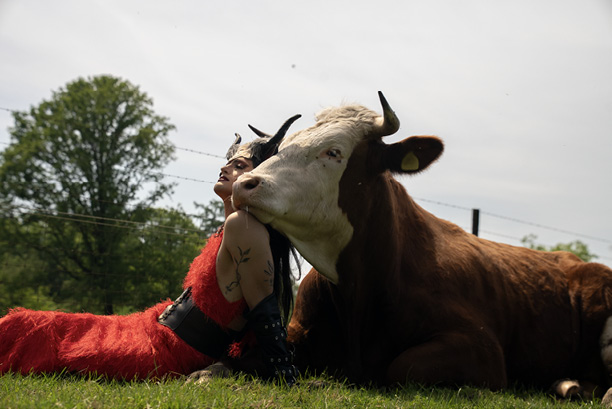
Fig. 1 Piet and Soya.
Photograph by De Transketeers.
Softly at first: a low humming rises from somewhere deep in her chest. The sound folds into the breeze, into the background hum of insects, birdsong, wind moving through the grass. Piet tilts their head slightly, one ear twitching towards Soya’s peaceful voice, as if listening intently. This song is not for human ears; it is sung at the threshold of species, a language without words, each note expanding the boundaries of being. The melody passes almost unnoticed, yet it lingers in the air, drawing a line of connection between Soya, Piet, and the other creatures present: Piet’s herd — including Cato, the mother cow who adopted them and who is growing increasingly impatient with this strange display — several humans, including the first two authors of this article taking notes, a PhD student, the filmmakers with their large camera equipment, and Piet’s caretakers — as well as the myriad unseen life forms inhabiting this meadow. All around, the grasses sway, insects hum, and the warmth of the sun envelops everything, drawing this queer moment into a hush of more-than-human presence.1
I
Piet’s ears twitched as we entered the meadow. I — Leonie — stayed close, speaking to Piet in a soft voice, as I always do, naming each person as I introduced them. Daniel wasn’t yet in drag — not yet Soya — but already attuned to the place and the herd. Bart and Ari, the filmmakers, had left their equipment behind, meeting Piet first without a lens between them. Louis waited a little further off, hesitant, unsure how close to come. Piet stepped forward, sniffing, then licking their hands one by one. I wanted Piet to know who was entering the meadow. This place is not a set or a stage, but a home Piet shares with the herd. We are here as guests, and I needed Piet to feel that we knew that.
Piet came into my life five years ago, during sociolinguistic research I was conducting on the language of cows at an industrial dairy farm in the Netherlands.2 In these farms, it is customary to separate the newborn calf from the mother within five to ten minutes of their birth. The calf is then confined to a small box, preventing any embodied social interaction with other calves — such as touching, licking, and grooming each other — to reduce the risk of infection and disrupt maternal bonding. Newborn bull calves are typically transported to calf-fattening facilities and slaughtered before the age of nine months. While I was helping the farmer bottle-feed one particular bull calf during my fieldwork, he mentioned almost in passing that this calf — with white socks, a white head, and a beautiful brownish spot around his eye — would likely be killed upon arrival at the fattening facility, as he was not expected to reach the minimum rearing weight of thirty-five kilograms.
The next day, with the farmer’s permission, I decided to “adopt” the calf. Since cows in the Netherlands are automatically classified as consumption animals, a formal adoption wasn’t legally possible — the calf simply changed owners on paper, from the farmer to me. Nor was it particularly desirable, given the colonial and racialized history of human adoption practices.3 Still, I needed to create a new system of care and kinship for this little calf. I didn’t take him away from his cow family, as he had already been separated from his mother immediately after birth and was spending his days alone in a wooden box. I visited him almost every week for three months, giving him a bottle of milk and sharing time with him in his box. The “adoption” — which in practice meant finding him another place to live — turned out to be successful. After three months, the calf was moved to live with a human couple who kept three adult cows and two of their calves in a large open meadow behind their home in Weert. He was named Piet by his sponsors — after Piet Meertens, the first secretary of the Meertens Institute, where I work. Naming is central to the act of making kin — and oddkin4 — as it helps transform an anonymous calf into a singular, recognizable being. This is something a calf adopted as kin has over all those nameless ones for whom there is no place in the dairy industry — either because they are bull calves (m), or because the farmer already has too many heifer calves (f).
When Piet was about six months old, the caretakers arranged for a veterinarian to examine him in preparation for castration — an intervention considered necessary to keep the meadow safe for horses and humans. But the procedure never happened. The vet discovered that Piet was intersex: born with a body that doesn’t fit typical definitions of “male” or “female”. They had two quarters of an udder, a penis positioned atypically, and no descended testicles — making castration unnecessary. Piet had been one of a pair of twins, but their sibling had died at birth. In such cases, the twins’ placentas may develop vascular connections — a process known as anastomosis — through which blood vessels fuse and allow blood and hormones to circulate between the foetuses. This hormonal exchange can affect development; when the surviving calf is female, she is typically infertile and referred to as a “freemartin” or, in Dutch, a kween — a queen. For centuries, freemartin cows have unsettled agricultural and scientific understandings of sexual differentiation, troubling the categories through which bovine bodies are sorted and valued and revealing how human anxieties about gender, fertility, and procreative value shape the shifting boundaries between productive, reproductive, and economically “unproductive” bodies within the logic of industrial farming.5 At the same time, farmers and scientists have repeatedly sought to recuperate this apparent lack of procreative value by putting the freemartins’ infertility to use within selective breeding regimes, for instance by employing them as “heat detectors” — living technologies used to identify fertile cows ready for insemination.6
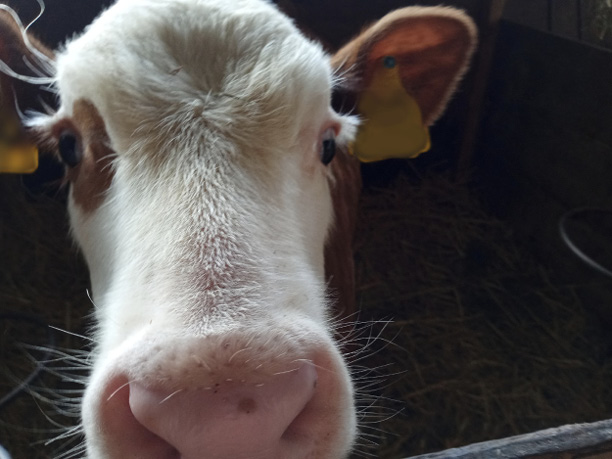
Fig. 2 Piet at a younger age.
Photograph by Leonie Cornips.
In Piet’s case, the vet suspected a similar hormonal influence in utero, resulting in a mix of traits. But such bodily variance is rarely noticed in bull calves, who are usually killed before their bodies have had time to grow into — let alone reveal — anything unexpected. While the freemartin has a place in the farmer’s lexicon, the intersex bull does not — a linguistic absence that marks what Judith Butler, writing about the nineteenth-century intersex memoirist Herculine Barbin, calls “the sexual impossibility of an identity”.7 Yet Piet exists. The unusual — we might say, queer — nature of their embodiment attracted attention from far beyond the meadow: the veterinarian even had to ask a colleague in Canada about this phenomenon. Spared from early death, Piet became a living exception — a queering of what farm animal life is usually permitted to be, and an invitation to reimagine kinship beyond the boundaries of gender, species, and animal categories. Over time, the “he” I first used gave way to the gender-inclusive “they” — not because Piet asked, but because something shifted in me.
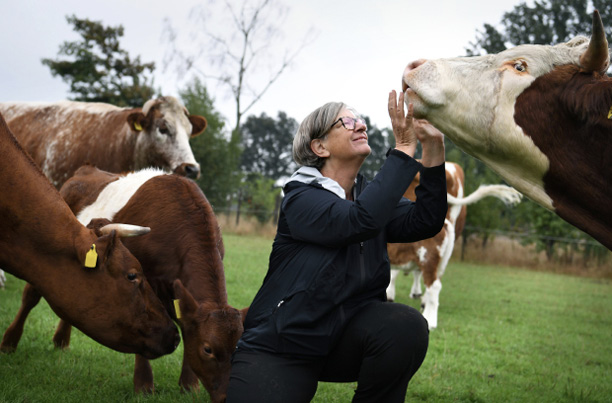
Fig. 3 Leonie, Piet, and the herd.
Photograph by Marcel van den Bergh.
Piet lives about an hour and a half away by train, and I try to visit them about once a month. Early on, I brought together a small circle of supporters who care about Piet and contribute financially to their food, medical needs, and overall well-being. At the time of writing, Piet is five years old. Over the years, I have come to know them more deeply, both as an individual with their own ways of being, and as part of their herd. Unlike bulls, who tend to separate from the herd as they age — if they age at all — Piet remains closely connected to the others, living, moving, grazing, resting, and responding alongside them. I’ve become very attached to them, and our relationship, our kinship, has grown. Along the way, new forms of multispecies knowledge have emerged: slow, reciprocal ways of learning how to be attentive to one another while unlearning human-centred bodily habits,8 how to listen, how to inhabit vulnerability and responsiveness across human-cow boundaries, and how to stay with the responsibilities of care in the name of a shared life.
II
When I — Daniel — travelled from Switzerland to this meadow in the Netherlands, I wasn’t quite sure what to expect. Would Piet like me? Would I like Piet? Would I even know how to be with them? I had heard so much about Piet since I had met Leonie a year ago, after a show I did in Amsterdam. But stories can only carry so much of a body, of who a person is, what makes them “them”. Standing at the edge of the field, I felt nervous — it was a bit like going on a blind date. But not just any blind date: a blind date for cows! I was in full drag, as Soya the Cow — long lashes, painted lips, a tall wig with horns tucked in, and a thick layer of makeup carrying a strong scent. We were unsure how Piet might react. Would the bright red dress, the buckled sleeves, the wig confuse them? Leonie reassured me that Piet, after our greeting ritual earlier that day, would likely sense the person beneath Soya’s surface. My cow-self stood facing their cow-self, in anticipation of what might happen. Would Piet recognize me as kin, or back away from this strange, sparkly creature?
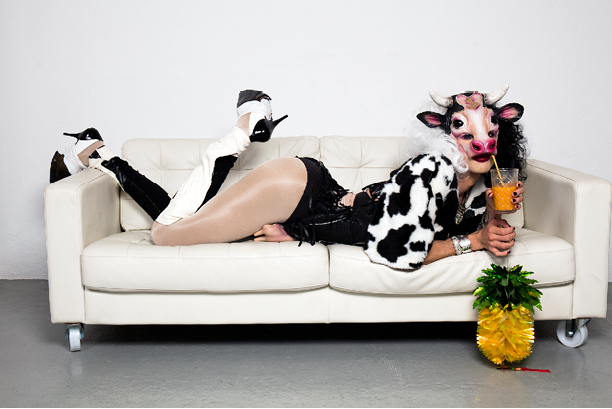
Fig. 4 Soya the Cow.
Photograph by Maya Rochat.
In the six years leading up to this encounter, I had placed nonhuman animals and the injustices they endure — especially in the food, clothing, and entertainment industries — at the centre of my work as a theatre maker, performance artist, and activist. I had developed a practice of cow drag that combined elements of classical femme drag — exaggerated feminine features, wigs, high heels, corsets, jewellery — with bovine references: cow-print clothing, hooves, horns, udders. These elements never all had to be present at once; just a few details were enough to signal the double identity: both drag queen and cow. This playful hybridity allowed me to disrupt binary logics of gender and species while offering a human face to the cow — thus inviting audiences to consider her individuality and sparking curiosity for her perspective, one so often marked by extreme physical, psychological, sexual, and spiritual violence.
I created Soya as a larger-than-life alter ego — a force of nature born from deep discomfort with the normalized atrocities of our world — who could attempt the impossible and transcend human limitations: pop star and healer, activist and clown, present and future. Inspired by the radical energy of drag kings, queens, and in-betweens from queer club culture and shows like RuPaul’s Drag Race, I envisioned Soya as bold, unafraid to speak uncomfortable truths, yet brimming with love and infectious joy. Animal drag, defined by Nicola McCartney as “an activist performance in which a human critically and consciously performs ‘animality’ in order to de-centre humanism, with dress and adornment as key aspects of its dissidence”,9 became central to Soya’s identity, allowing me to explore what it means to critique human exceptionalism while inhabiting other-than-human perspectives with both irony and care. Through humour, sensuality, curiosity, and concern, I bring Soya to the stage with the full power and ridiculousness of a cow-shaped desire to change the world, refiguring dominant scripts of the human and the animal into a more unruly, intimate, and liveable choreography of kinship.
As Nicole Seymour argues in her work on animal drag, “nonserious affective modes” — including humour, impropriety, and theatrical excess — carry an ethical force that can help probe “the trans-, or intersectional and interdependent, nature of human and nonhuman life”.10 In this sense, Soya also enacts what Seymour elsewhere describes as an “irreverent” environmentalism, one that turns to camp, frivolity, irony, and other seemingly improper affects to challenge the sense of earnestness, guilt, purity, and self-righteousness often associated with mainstream environmental discourse, opening more embodied, queer, and affectively flexible ways of engaging ecological politics.11 In Emelia Quinn’s terms, Soya’s artificial stylization of species-being might also be understood as a form of “vegan camp”: an aesthetic practice that, without disavowing the horrors of industrial animal production, mobilizes camp’s failed seriousness — or what Susan Sontag in her “Notes on ‘Camp’” describes as “the theatricalization of experience”12 — as a survival strategy for vegan individuals, one that “does not exclusively focus on revelations of violence”, but instead offers “an alternative mode of looking and witnessing”.13
Over the years, Soya the Cow has grown into a complex being who not only occupies most of my artistic practice, but also most of the space in my wardrobe, now stacked with shiny costumes, headpieces, and carefully sourced cruelty-free makeup. I have brought Soya to life in theatres, at music festivals, in galleries, on television, at gala dinners, during art walks in the streets, and at climate protests — always with a nod to cows and other farm animals. These performances challenge the human-centred worldview that subordinates nonhuman life, weaving together songs written from a dairy cow’s perspective with sharp arguments that extend queer-feminist concepts such as affirmative consent and gender dissidence to other animals. In doing so, my work restores what Carol J. Adams calls the “absent referent”,14 undoing the symbolic and material severance that enables humans to consume other animals by obscuring the relation between the “meat” on their plate and the living being it once was. Adams also traces how this logic is sustained through gendered and sexualized metaphors, linking the objectification of animals to that of women and other sexualized, racialized, and naturalized “Others” whose social and symbolic existence is likewise effaced.15 By embodying a vegan drag cow as a speaking, singing, feeling subject, I interrupt this logic of disavowal and erasure — framing ethical veganism as not only smart and sexy, but also as a political practice of solidarity and a moral imperative for our time. Soya reclaims visibility and voice, unsettling the norms and structures that render animal lives — especially the feminized bodies of dairy cows — exploitable and disposable, reduced to sources of meat, milk, and reproductive labour.
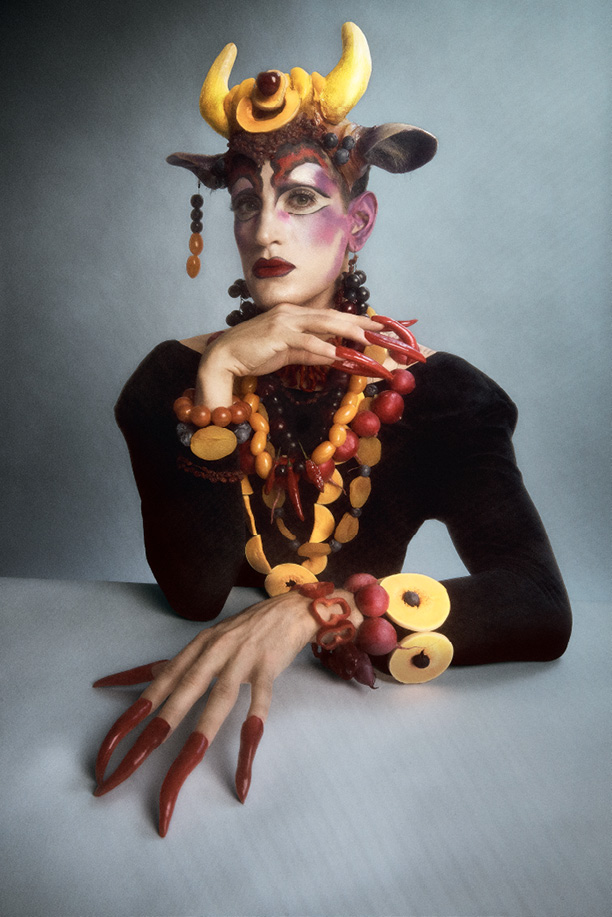
Fig. 5 Soya the Cow, from the series Vogue Végétale.
Photograph by Tomas Eyzaguirre.
To maintain uninterrupted milk production, dairy cows are subjected to an unrelenting cycle of forced pregnancy and birth. As noted earlier, their calves are taken from them shortly after delivery — a practice that suppresses one of the most fundamental relationships: the caring bond between mother and child.16 As ecofeminist Greta Gaard poignantly observes: “Inside each glass of milk is the story of a nursing mother separated from her offspring.”17 To feel comfortable in severing these bonds, not only dairy farmers and milk consumers but the entire assemblage of agricultural policy, EU regulations, supermarket chains, advertising industries, animal transport systems, and capitalist market logics must participate in what Gaard calls a collective denial of “the web of relationships that defines healthy ecosystems”.18 This denial is embedded in gendered, racialized, and speciesist grammars of domination, where cows’ reproductive roles are framed as natural and necessary, reflecting wider societal mechanisms that control feminized bodies across species lines.
The dairy industry thus reduces cows’ maternal bodies to mere instruments of production — vessels for profit — while erasing their individuality, agency, and emotional lives. But the violence does not end with the mothers. Bull calves, deemed economically useless because they do not produce milk, are routinely discarded, killed shortly after birth, or sent into veal production.19 Their masculinized bodies are treated as disposable by-products of an industry built on the commodification of reproductive labour. This gendered bifurcation of value — where life is extracted from dairy cows through forced reproduction while bull calves are consigned to death through slaughter or neglect — reveals the patriarchal, anthropocentric, and “repro-centric”20 hierarchies that underpin the treatment of farmed animals within what Barbara Noske has termed the “animal-industrial complex”.21
Cow drag confronts these hierarchies head-on by queering the figure of the cow — it enacts a becoming-cow that resists the brutal logics of disposability and control, not by imitating the animal, but by entering an imaginative, embodied relation with her. Yet when I stood in this meadow with Piet, despite everything I had tried in my journey of cow-becoming, I felt acutely aware of my own humanness. Suddenly, I was no longer making art for cows or about cows, but with a cow. I surrendered to the only guide I had left: instinct. I approached Piet slowly, as I had learned to do with animals throughout my life, especially while volunteering at the animal sanctuary Hof Narr in Switzerland during the first COVID lockdown. I let Piet come to me with their gaze and attention. And then it clicked. My worries that Piet might be distracted by my appearance dissipated. Piet knew exactly who I was — not through the superficial markers of clothing or wigs, but through something deeper: energy and presence. And there we were, two rather big queer mammals, lying side by side in a Dutch meadow, meeting one another with the gift of calm kindness and embracing the many possibilities of peaceful coexistence.
From there, it became an improvisation: a shared dance of movement, gesture, breath, and then — a voice. My soft humming became a thread of connection between us. I sang for Piet, and Piet honoured me with their listening, inviting me to remain in their world. It might sound naïve, but in that moment, I felt immense love for Piet — love bound up with resistance, and with a desire to honour their queer existence as someone who defies so much of our human-made world and its extractive logic. Piet, a survivor of the dairy industry and of thousands of years of domestication etched into every living cow’s body; a survivor of a world marked by gender violence, where bodies are disciplined into rigid binary norms; a survivor of an agricultural system that severs maternal bonds, denying calves the chance to grow up with their mothers and interrupting the transmission of care and culture across generations. And yet, despite all this, Piet welcomed me with a generous, open heart, offering us all a profound lesson in forgiveness.
The afternoon ended with me removing my makeup, changing into my out-of-drag, mostly-human self, and joining the rest of our human team for an early dinner at a nearby restaurant. As we left the meadow, my gaze fell on the large, flat building adjacent to it — a shed that usually houses chickens. I felt my chest tighten. Was this a concentrated chicken farm, forming the backdrop to our soft, poetic encounter? Who was living — and dying — in there? What were they enduring? How might we widen the circle of care so that they, too, might be included in our trans*species solidarity, rather than left unseen and mutilated behind closed doors?
This unease lingered during our meal. The restaurant, a lovely place by a lake, had no real vegan options, so I ordered fries and a salad while watching others choose cheese- or egg-based dishes — and some, pork, chicken, or fish. I struggled to swallow. Despite the discourse, love, and care expressed for Piet and their herd, that tenderness did not extend to other cows or chickens, whose suffering was deemed irrelevant in the post-experiment reality of a hungry team. Why do we keep justifying that another Piet must die so we can have melted cheese in our sandwich? Why is it so hard to translate care into action? What traditions must we give up? How much social discomfort are we willing to endure within human-to-human relationships? The dinner left a bitter aftertaste — and a sense of failure. I promised myself that next time, I’d be louder and bolder, continuing the fight so that the sweetness and sensitivity of our afternoon would stretch beyond the meadow, beyond the singularity of Piet, towards an ethic that refuses the logics of disposability altogether.
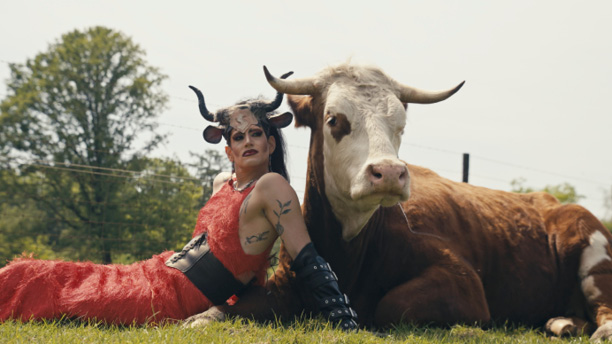
Fig. 6 Piet and Soya.
Photograph by De Transketeers.
From the film Piet & Soya: A Queer Interspecies Encounter (2025) by De Transketeers, documenting the encounter between Piet and Soya the Cow in Weert, the Netherlands, 11 May 2024. The film can be viewed below.
III
I — Louis — admit that I was apprehensive, even a little afraid, as I entered the meadow that day. I’ve always been wary of large animals. And I find drag queens rather intimidating too — as much as I admire them. So being there, among towering cows and alongside a bovine diva in full regalia, was not exactly my natural habitat as a performance scholar and care theorist. But then again, care, as I’ve come to understand it, rarely emerges from comfort. My work explores performance art as a mode of ethical worldmaking, engaging feminist, queer, trans*, decolonial, and ecological perspectives. I’m interested in how performance, particularly by minoritized artists and makers, both human and more-than-human, can challenge intersecting systems of oppression, generate counterpublic spheres, and cultivate a relational ethics of care oriented towards more just and liveable worlds. My questions are often theoretical, but my concerns are political, personal, and pragmatic — and both take shape through embodied practice, through performance as research.22 That day, I found myself lying against Piet’s warm back, feeling their breath move through me. A deep calm sank into my body, opening a space of love and grief — an attunement to a more-than-human presence both vast and particular. That moment stayed with me. It became a source of knowledge grounded in shared vulnerability, in staying present to what unsettles, and in yielding to what is unknown.
What does it mean to care for a more-than-human other? One of the most popular definitions of care, offered by Joan Tronto and Berenice Fisher, construes care as “a species activity that includes everything we do to maintain, continue, and repair our ‘world’ so that we can live in it as well as possible. That world includes our bodies, our selves, and our environment, all of which we seek to interweave in a complex, life-sustaining web.”23 When we extend this definition beyond the anthropocentric “we”, the question arises, whose worlds are we maintaining, and whose are we ignoring, extracting from, or destroying? Whose lives are sustained in the webs of care that compose the world and whose are considered exploitable, expendable, edible? These questions expose the limits of traditional frameworks of care when confronted with multispecies injustice, inviting us to rethink not only how care is practised but also who is recognized as worthy of ethical care.
Feminist scholars such as Josephine Donovan and Carol J. Adams have long taken up this challenge by extending feminist care theory to human–animal relations, arguing since the 1990s that an ethics of care must account for the lives, experiences, and suffering of nonhuman animals.24 Their work has helped establish feminist care theory as a critical intervention in animal ethics, offering an alternative to abstract moral reasoning by foregrounding empathy, responsiveness, and situated relationality.25 Building on this foundation, we might further reimagine care not as a strictly human or “species activity”, but as an interspecies or transspecies practice of sustaining life within more-than-human worlds — a shift towards what María Puig de la Bellacasa calls an “a-subjective notion of care”.26 In doing so, we open up possibilities for ethical relations that recognize the ontological interconnectedness and interdependence of all beings across species and ecosystems, while also queering — and trans-ing — the anthropocentric assumptions that continue to structure much of care theory, troubling normative boundaries between human and nonhuman, self and other, subject and object.
For Puig de la Bellacasa, this shift calls for a “speculative ethical imagination” — a mode of creative thought and practice that attends not only to human concerns but also to “the many ways in which nonhuman agencies are taking care of many human and nonhuman needs”.27 Interspecies performance — as a relational and embodied form of artistic inquiry — can, as our performance seeks to demonstrate, activate such a speculative ethics by critically reconfiguring uneven relationships of care and power, thereby creating pathways for imagining new, more egalitarian forms of coexistence and compassion in a multispecies world. Moreover, by approaching performance art as a modality of care, we challenge Tronto’s contentious claim that artistic creation — even when intended as care — “is not care”.28 Whereas Tronto positions the arts as marking “the limits of care”,29 we align with scholars such as James Thompson and Yuriko Saito in conceiving caring as inherently artful and artistic practice as potentially a form of care in itself.30 From this perspective, art and aesthetics — including everyday creativity — emerge as vital acts of care that sustain and weave together the more-than-human fabric of what Tronto calls “our world”.
Staging an interspecies encounter between Piet and Soya the Cow began from the premise that queer, nonbinary, and trans* approaches to both theory and artistic practice hold unique potential for cultivating what I call a trans*species ethics of care. As collaborators, we bring a range of positionalities to this work: Piet, an intersex bovine living in a multispecies sanctuary; Leonie, a white cisgender woman from Limburg developing nonhuman animal sociolinguistics; myself, a nonbinary, queer, third-generation Dutch-Indo scholar working at the intersection of performance, care, and aesthetics; Daniel, a white cisgender male queer drag artist and activist from Switzerland; and De Transketeers, a collective of predominantly white Dutch trans men whose filmmaking and advocacy work, both transgender-led, centres visibility, storytelling, and social justice. While we do not conflate queer, drag, intersex, nonbinary, and transgender perspectives or experiences, we see value in bringing them into alliance, particularly for how they unsettle normative boundaries between bodies, genders, and desires, and in doing so, embody “a human possibility that redefines what counts as human”.31
The asterisk in trans*species draws on the use of “trans*” to “open up the term to unfolding categories of being organized around but not confined to forms of gender variance”.32 As Jack Halberstam explains, the asterisk “modifies the meaning of transitivity by refusing to situate transition in relation to a destination, a final form, a specific shape, or an established configuration of desire and identity”.33 For Eva Hayward and Jami Weinstein, the asterisk — a “diminutive astral symbol miming a starfish’s limby reach”34 — is at once relational and ontological: relational in that it opens a suffixial space of encounter, reaching toward what trans* becomes with; ontological in that trans* names “the movement that produces beingness”,35 not a stable thing but the generative process through which life itself takes form as a transversal force that cuts across established categories and reknots the threads between bodies, species, and worlds that have been forced into separation. Such an expanded understanding makes it possible to articulate transness with other modes of embodiment — such as Piet’s and Soya’s — that are rendered less than human through the differentiated yet intertwined processes of dehumanization and animalization, whether externally imposed or, in Soya’s case, strategically and affirmatively embraced.
If the asterisk serves as a way of “holding space for multiple attachments while visually symbolizing radiant, multipronged means and methods of entrainment”36 — that is, modes of synchronization through which different bodies enter into relations of shared resonance — it also opens trans* onto the more-than-human entanglements that compose multispecies lifeworlds. Since transgender subjects “have never been fully human”,37 as Hayward and Weinstein observe, a trans perspective allows us to interrogate how humanness is differentially produced as a biopolitical norm — coded through race and gender while passing as the unmarked universality of white cis-hetero masculinity — and how animality remains bound up with the oppression of those human and nonhuman lives that exceed or unsettle that norm. Steinbock, Szczygielska, and Wagner gather these lines of inquiry under the sign of tranimacies, a term that aims to “provide a specifically transgender informed and conceptually trans* shaped commentary on the ‘animal turn’” in current scholarship,38 while asking: “What are the possible, imagined and visceral moments of intimacy between animal and trans studies today?”39 Since such trans*species intimacies are neither innocent nor peaceful, tranimacies names not simply a celebratory crossing, but the affective and political entanglements of transness and animality, always shaped within differential orders of liveliness — what Mel Y. Chen calls “animacy hierarchies”40 — and within the biopolitical and necropolitical ordering of bodies. Seen against the longue durée of racist, colonial, and speciesist violence through which humanness has been secured by animalizing racialized and gender-nonconforming life,41 any trans*species entanglement remains haunted by the very histories of subjugation and dispossession it may also help to unsettle.
I wonder how all this theory can reside in the body, how these dense conceptual vocabularies come to matter not only as abstractions but as felt orientations and disorientations within a lived more-than-human encounter, and how, from within that encounter, theory might begin to take shape as a transformative ethical practice. In our performance and film project, that practice unfolds as an open-ended and responsive artistic process: a trans*species aesthetics of care that resists “any sense of knowing in advance what the meaning of this or that gender variant form may be”,42 and instead invites a more expansive, experimental relation to gender and animality beyond anthropocentric and cis-heteronormative frames. Trans* and queer ways of knowing sharpen our awareness of the instability of human-made categories and the porousness of embodiment, revealing how real violence is enacted when such categories are treated as fixed or natural.43 At the same time, they disrupt the gendered, sexualized, and racialized structures that organize human-cow relations within capitalist regimes of extraction and accumulation, opening the possibility of a trans*species ethical imaginary grounded in practices of capacious care, fluid embodiment, and creative reconfiguration.
Piet’s nonbinary embodiment — as an intersex “bull” who remains the unnamed, perhaps unnameable, counterpart to the infertile kween/queen — renders them economically useless within the violent sorting mechanisms of the dairy industry and its rigid dichotomous logic of reproductive utility and disposability, marking this body, in Lucy Beech and Tamar Novick’s terms, as a “waste body”.44 Yet the very processes that turn queerness, transness, and animality into objects of regulation and control also make them sites of unruly embodiment, resistant becoming, and what Stacy Alaimo calls “insurgent vulnerability”45: the embodied grounds from which trans*species care and ethical worldmaking may emerge.
Set against the extractive logic that would render Piet killable, our performance stages an encounter between Piet and Soya — a kween of a different kind — bringing together divergent forms of queerness, transness, and species-being in an experiment in multispecies attentiveness and the intimacies of more-than-human kinship. This encounter does not seek to stabilize Piet or Soya within human identity categories, nor to treat queer animality as evidence of the naturalness of human gender variance, even if, as many scholars have shown, nonhuman life persistently defies binary conceptions of gender and sexual difference.46 The point is neither to enlist animal transness in the service of human liberation struggles nor simply to collapse animality and transness into one another, which, as Marianna Szczygielska cautions, would too easily allow nonhuman animals to be “exploited for human politics and once again used for making sense of human social relations”.47 It is, rather, to illuminate how more-than-human life is repeatedly drawn into the symbolic labour of naturalizing sameness and difference across hierarchies of gender, race, sexuality, and species, while also opening a different register in which multispecies relations — or what Szczygielska calls “transpecies intimacies”48 — can be apprehended otherwise. The encounter between Piet and Soya does not affirm equivalence; it stages relation across irreducible difference. It is there, in that space of asymmetrical attunement, vulnerability, pleasure, and responsiveness, that another ethics begins to shimmer into view: not one founded on human-centred virtues or moral values, but one sustained by a mutual willingness to move with, yield to, and care across the wide, wild differences of body, species, and lifeworld.
Through Soya, we encounter a playful yet profoundly political critique of anthropocentrism and gender essentialism as entangled systems of oppression. Yet when drag is performed with an other-than-human animal (Piet) and presented to a nonhuman audience (the herd), it unsettles the semiotic codes through which drag typically generates meaning for humans. The visual cues that animate drag’s gender play — and animal drag’s species play — such as Soya’s dress, shoes, makeup, and even her prosthetic horns, may be central to human accounts of transspecies drag, including McCartney’s,49 yet they carry no meaning for Piet. Piet’s sensory world, while certainly visual, is critically attuned to scent: to the hormonal signals through which cows register and respond to differences in reproductive and social status — bodily cues that only partially align with what humans construct as sex or gender. This sensory difference unsettles the politics of irony and parody that so often structures drag performance as a form of gender subversion, shifting attention away from drag’s citational critique of social constructs towards more-than-human modes of affective and relational attunement.
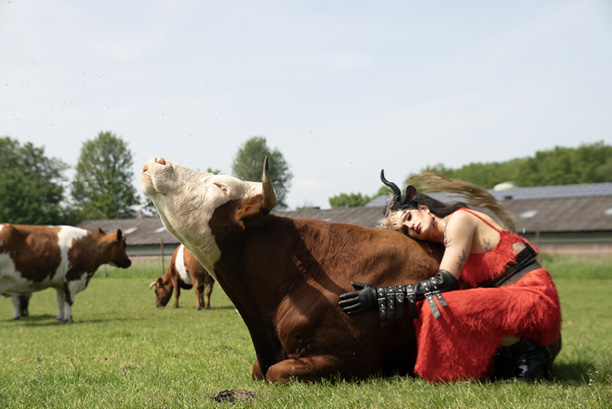
Fig. 7 Piet and Soya.
Photograph by De Transketeers.
As Judith Butler famously argued, drag, by imitating gender, can expose “the imitative structure of gender itself”,50 revealing gender’s performative and contingent character. Yet when the codes that render such imitation legible fail to translate across species, the parodic repetition of gender norms on which drag’s subversive potential depends is troubled, if not undone. In its place, something less decipherable but no less queer begins to stir: a trans*species aesthetics of embodied relation in which gestures of care, curiosity, and co-presence take precedence over human practices of parody, opening onto an ethics of encounter attuned to more-than-human modes of worldmaking. This is a queer ethics grounded not in a postmodern use of irony but in posthuman practices of care: it unfolds not through critique or critical mimesis but through affirmative acts of relation that traverse species difference. In this intimate encounter between humanness and animality, a trans*species care ethics arises, refusing the material and symbolic violence that wounds, and kills, not only queer and trans* humans but also the countless other animals whose lives and deaths remain excluded from the sphere of ethical concern.
Embracing queer and trans* modes of becoming — fluid, unfixed, resistant to normative closure — this essay advances an egalitarian ethics of care that is at once critical and creative, reflective and intuitive, deeply political, and alive to the unspoken, humming possibilities of becoming-with the more-than-human. Situated within webs of embodied, multispecies care and committed to non-innocent thinking, such an ethics demands, following Donna Haraway, “staying with the trouble”51 of our own complicities within the mechanisms of the animal-industrial complex and in the dense entanglements of life and death that structure a world seemingly beyond repair. This is the register of Daniel/Soya’s queer-feminist veganism: a practice of trans*species kinship that navigates uneven regimes of animal care — where, for instance, companion animals are cherished while “livestock” is rendered edible — and that contests a dominant meat culture in which caring for animals like Piet, up to and including refusing to consume them, is often framed as excessive, deviant, or out of step with convivial norms — that is, as queer. From this perspective, Maurice Hamington’s claim that “veganism represents a significant and exemplary step in a care revolution” gains traction. “Even the simplest of meals”, he writes, “can be a ritual of care that sets the tone for other relational practices”.52 If care begins at the table, then what we choose to eat becomes a situated act of attention and refusal, unsettling the distinction between who counts as “food” and who as “relation”.
Coda
“Caring”, writes Haraway, “means becoming subject to the unsettling obligation of curiosity, which requires knowing more at the end of the day than at the beginning”.53 That day in the meadow, we came to know more together, as care revealed itself in the intimacy of a trans*species encounter: a form of kinship based not on familiarity or likeness, but on bodily gestures — grazing, sniffing, licking, touching — and the attentive work of learning to be present with and for one another across difference. In that shared attunement, care appeared less as a species activity than as a trans*species practice of becoming-with — the “with, through, of, in, and across that make life possible”54 — and as a commitment to staying with the trouble of each other’s otherness.
Yet this encounter also revealed unexpected challenges. Early on, Leonie noticed that Piet was lying down unusually often, allowing us to sit against their back and permitting Soya to touch them while seated, rather than grazing with the herd. By the end of the afternoon, Piet lay down in an atypical posture — more like a dog than a cow — with their front legs slightly raised. Over subsequent visits, these subtle signs became more pronounced. Piet began shifting their hind legs from side to side, in a slow rhythm, as if struggling to stand steadily. After consulting veterinary experts in the Netherlands and Belgium, we learned that Piet likely suffers from a complex muscle disorder affecting not only the large muscles at the back of the lower legs, but also several muscle groups in the upper legs, making standing and walking difficult and painful. There is no available treatment, and surgery could worsen the condition.55 One veterinarian advised us to consider euthanizing Piet, while another suggested that, since Piet permanently resides in a meadow with soft grass and sand underfoot, it should be possible for them to stand up and lie down with the support of daily pain relief.
Piet’s condition appears to stem from rapid growth during their third year, correlated with Dutch breeding practices that favour straight, strong backs — an aesthetic ideal typically associated with steeply angled hind legs.56 These so-called “conformation traits”, widely recognized in modern dairy cattle breeding, are deeply gendered, associating norms of appearance with ideals of productivity, discipline, and what in industrial language is called dairyness,57 a highly objectifying measure of how well a cow’s feminized body conforms to expectations of maximum milk yield. Such practices reveal how breeding criteria are shaped not only by speciesist assumptions about physical functionality, but also by culturally constructed ideals that regulate and constrain gendered bodies — both human and nonhuman. There is a painful resonance between Piet’s condition and the ways in which human bodies, particularly those of women, have historically been shaped and constrained by aesthetic expectations that prioritize form over comfort and well-being. In a cruel — and queer — twist of irony, these norms are not merely culturally imposed but, in Piet’s case, literally written into their DNA: the steep hind legs causing their discomfort echo the same precarious, elevated postures that have long disciplined feminine bodies — for example through the wearing of high heels.
This convergence exposes how normative ideals of beauty and desirability, indifferent to lived experience and embodied vulnerability, inflict suffering not only across human genders but also across species lines, binding human and other animal bodies in regimes of pain that defy simple divisions of culture and biology. Resisting such embodied violence requires that we queer the very categories that sustain it — disrupting the human-animal divide as a tool of domination — and reclaim trans*species care as a radical practice that recognizes not only our shared vulnerability, but also our collective capacity for defiance.
Complicating care further, Piet’s status as a food-producing animal imposed legal barriers: the recommended pain relief medication, an anti-inflammatory drug called phenylbutazone, could not be administered because, unlike horses — which are not considered food animals and are allowed this treatment — cows bred for human consumption are prohibited from receiving it, as traces of the drug would render their meat unsafe for humans to eat. This regulatory framework transformed what began as an artistic inquiry into queer and trans*species ethics into a fraught navigation of legal and moral constraints surrounding animal care. Beyond medication, Piet’s classification also affects their end-of-life options: while horses can be cremated, Dutch law requires cows to be tracked by their ear tag and reported to official carcass disposal services, meaning Piet’s body would likely be rendered into animal feed. Calls to animal crematoria confirmed that cremating a cow is illegal in the Netherlands. These layers of regulation reveal how entrenched categories of production and consumption shape and constrain care for other-than-human animals in differentiated ways, reinforcing the need for a critical deconstruction — or queering — of the boundaries that determine which lives are recognized as lives at all, which losses are deemed worthy of grief and mourning, and which deaths remain “nameless and faceless”.58 After all, as Haraway reminds us, “queering has the job of undoing ‘normal’ categories, and none is more critical than the human/nonhuman sorting operation”.59
Piet & Soya, our collaborative performance and film, was as much an unexpected becoming together — by turns strange, awkward, funny, joyful, sad, moving, faintly absurd, and unapologetically queer — as it was a making of kin, even oddkin, in a seriously troubled multispecies world. Staying with the trouble, as Haraway writes, means making kin otherwise — for “we require each other in unexpected collaborations and combinations, in hot compost piles. We become-with each other or not at all.”60 Ours was no compost pile, but a damp Dutch meadow in spring — and yet something took root there. A trans*species ethics of care begins precisely in such places: messy entanglements, worldly attachments, and the slow, vulnerable work of staying close. It asks us to unlearn mastery, to sit with loss, to reach across species lines not in innocence but with accountability — and to rehearse other ways of living and dying together: in the mud, in the mess, at the table, as oddkin.
Acknowledgements
We wish to express our deep gratitude to the institutions whose financial and moral support made the performance and film Piet & Soya: A Queer Interspecies Encounter possible: the University of Humanistic Studies (Utrecht, Netherlands); NL-Lab, Royal Netherlands Academy of Arts and Sciences (Amsterdam, Netherlands); the Chair of Languageculture in Limburg at Maastricht University (Netherlands); and Association 3art3 (Zürich, Switzerland). We also extend our heartfelt thanks to the human animals Petra and Henk van de Ven, Luca Soudant, and all of Piet’s sponsors for their generosity and support.
Notes
This prologue is an instance of what performance scholar Peggy Phelan calls “performative writing” — a mode of writing that does not describe a performance event through signification but instead seeks to re-activate its affective force “as it plays itself out in an ongoing temporality”. Such writing embraces “the radicality of unknowing who we are becoming”, enacting what Phelan describes as “the death of the ‘we’ that we think we are before we begin to write”. Phelan, Mourning Sex, 12, 17.
Cornips and van den Hengel, “Place-Making by Cows”; Cornips, “Animal Turn”.
Briggs, Somebody’s Children.
Haraway, Staying with the Trouble, 2.
Beech and Novick, “Sex Panic”; Padula, “Freemartin Syndrome”.
Beech and Novick, “Sex Panic”, 1085.
Butler, Gender Trouble, 23.
Cornips and Wels, “Changing Bodily Practices”.
McCartney, “Animal Drag”, 265. Joshua Williams proposes the term “transspecies drag” to avoid reifying the human–animal divide that such drag practices seek to unsettle. See Williams, “Going Ape”, 70.
Seymour, “Alligator Earrings”, 261.
Seymour, “Irreverent Ecocriticism”; Seymour, Bad Environmentalism.
Sontag, “Notes on ‘Camp,’” 526.
Quinn, “Vegan Camp”, 915.
Adams, Sexual Politics of Meat, 20–22.
Adams, Sexual Politics of Meat; Adams, The Pornography of Meat.
Coulter, “Beyond Human to Humane”.
Gaard, “Postcolonial Milk Studies”, 612.
Gaard, “Postcolonial Milk Studies”, 612.
Joosten, “The ‘By-Product’”.
Mortimer-Sandilands and Erickson, “A Genealogy of Queer Ecologies”, 11.
Noske, Humans and Other Animals.
Arlander et al., Performance as Research.
Fisher and Tronto, “Feminist Theory of Caring”, 40.
Donovan and Adams, Beyond Animal Rights; Donovan and Adams, Feminist Care Tradition.
Donovan, “Feminism and Animals.”.
Puig de la Bellacasa, Matters of Care, 161.
Puig de la Bellacasa, Matters of Care, 161, emphasis in original.
Tronto, Moral Boundaries, 104.
Tronto, Moral Boundaries, 104.
Thompson, Care Aesthetics; Saito, Aesthetics of Care.
Butler, Who’s Afraid of Gender?, 253.
Halberstam, Trans*, 4.
Halberstam, Trans*, 4.
Hayward and Weinstein, “Introduction”, 198.
Hayward and Weinstein, “Introduction”, 196.
Stryker and Currah, “General Editors’ Introduction”, 189.
Hayward and Weinstein, “Introduction”, 195.
Steinbock, Szczygielska, and Wagner, “Thinking Linking”, 1.
Steinbock, Szczygielska, and Wagner, “Thinking Linking”, 2.
Chen, Animacies, 23–30.
Jackson, Becoming Human; Ko and Ko, Aphro-ism; Weil, “Trans*versal Animacies”.
Halberstam, Trans*, 4.
Hayward, “Transecology?”; Hengel, “Queer Ecologies of Love”; Seymour, “Queer Ecology”.
Beech and Novick, “Sex Panic”, 1074.
Alaimo, Exposed, 94.
Bagemihl, Biological Exuberance; Hird, “Animal Trans”; Roughgarden, Evolution’s Rainbow.
Szczygielska, “Hyenas and Hormones”, 62.
Szczygielska, “Hyenas and Hormones”, 62, 72–75.
McCartney, “Animal Drag”.
Butler, Gender Trouble, 137.
Haraway, Staying with the Trouble, 150.
Hamington, Revolutionary Care, 183.
Haraway, When Species Meet, 36.
Hayward and Weinstein, “Introduction”, 196.
The only surgical option involves severing specific nerves, but this procedure often results in serious complications. With normal muscle function lost, other, tighter muscles take over, making it even harder for the animal to stand after the operation. In many cases, the animal becomes completely unable to stand up, remaining propped on their chest with hind legs tucked underneath. This risk is further increased by the animal’s own weight, which adds pressure on already vulnerable limbs. Even in less complex cases, the chance of tearing a major leg muscle post-surgery remains alarmingly high.
CRV, “Good Confirmation [sic]”.
Bohlen, Butcher, and Ray, Evaluating Conformation.
Butler, Precarious Life, 46.
Haraway, “Companion Species”, xxiv.
Haraway, Staying with the Trouble, 4.
Works Cited
Adams, Carol J. The Pornography of Meat: New and Updated Edition. Bloomsbury, 2020.
Adams, Carol J. The Sexual Politics of Meat: A Feminist-Vegetarian Critical Theory. Continuum, 1990.
Alaimo, Stacy. Exposed: Environmental Politics and Pleasures in Posthuman Times. University of Minnesota Press, 2016.
Arlander, Annette, Bruce Barton, Melanie Dreyer-Lude, and Ben Spatz, eds. Performance as Research: Knowledge, Methods, Impact. Routledge, 2017.
Bagemihl, Bruce. Biological Exuberance: Animal Homosexuality and Natural Diversity. St. Martin’s Press, 1999.
Beech, Lucy, and Tamar Novick. “Sex Panic and the Productive Infertility of the Freemartin.” Technology and Culture 64, no. 4 (2023): 1071–92. https://doi.org/10.1353/tech.2023.a910995.
Bohlen, Jillian, Stephanie Butcher, and Lucy Ray. Evaluating Conformation and Growth of Commercial Dairy Heifers. Bulletin B1573. University of Georgia Cooperative Extension, March 13, 2025. https://extension.uga.edu/publications/detail.html?number=B1573.
Briggs, Laura. Somebody’s Children: The Politics of Transracial and Transnational Adoption. Duke University Press, 2012.
Butler, Judith. Gender Trouble: Feminism and the Subversion of Identity. Routledge, 1990.
Butler, Judith. Precarious Life: The Powers of Mourning and Violence. Verso, 2004.
Butler, Judith. Who’s Afraid of Gender? Allen Lane, 2024.
Chen, Mel Y. Animacies: Biopolitics, Racial Mattering, and Queer Affect. Duke University Press, 2012.
Cornips, Leonie. “The Animal Turn in Postcolonial Linguistics: The Interspecies Greeting of the Dairy Cow.” Journal of Postcolonial Linguistics 6 (2022): 209–31. https://iacpl.net/download/cornips-jopol-62022/.
Cornips, Leonie, and Louis van den Hengel. “Place-Making by Cows in an Intensive Dairy Farm: A Sociolinguistic Approach to Nonhuman Animal Agency.” In Animals in Our Midst: The Challenges of Co-Existing with Animals in the Anthropocene, edited by Berenice Bovenkerk and Jozef Keulartz, 177–201. Springer, 2021. https://doi.org/10.1007/978-3-030-63523-7_11.
Cornips, Leonie, and Harry Wels. “Changing Bodily Practices in Interspecies Communities with Dairy Cows and White Lions: Methodological Challenges in Co-Constructing Meaning.” Ethnography. Published ahead of print, November 4, 2025. https://doi.org/10.1177/14661381251383291.
Coulter, Kendra. “Beyond Human to Humane: A Multispecies Analysis of Care Work, Its Repression, and Its Potential.” Studies in Social Justice 10, no. 2 (2016): 199–219. https://doi.org/10.26522/ssj.v10i2.1350.
CRV. “Good Confirmation [sic]: Healthy and Productive Life.” Accessed March 16, 2026. https://crv4all.com/en/service/confirmation-and-linear-traits.
Donovan, Josephine. “Feminism and the Treatment of Animals: From Care to Dialogue.” Signs 31, no. 2 (2006): 305–29. https://doi.org/10.1086/491750.
Donovan, Josephine, and Carol J. Adams, eds. Beyond Animal Rights: A Feminist Caring Ethic for the Treatment of Animals. Continuum, 1996.
Donovan, Josephine, and Carol J. Adams, eds. The Feminist Care Tradition in Animal Ethics: A Reader. Columbia University Press, 2007.
Fisher, Berenice, and Joan C. Tronto. “Toward a Feminist Theory of Caring.” In Circles of Care: Work and Identity in Women’s Lives, edited by Emily K. Abel and Margaret K. Nelson, 35–62. State University of New York Press, 1990.
Gaard, Greta. “Toward a Feminist Postcolonial Milk Studies.” American Quarterly 65, no. 3 (2013): 595–618. https://doi.org/10.1353/aq.2013.0040.
Halberstam, Jack. Trans*: A Quick and Quirky Account of Gender Variability. University of California Press, 2018.
Hamington, Maurice. Revolutionary Care: Commitment and Ethos. Routledge, 2024.
Haraway, Donna J. “Foreword: Companion Species, Mis-Recognition, and Queer Worlding.” In Queering the Non/Human, edited by Noreen Giffney and Myra Hird, xxiii–xxvi. Routledge, 2016.
Haraway, Donna J. Staying with the Trouble: Making Kin in the Chthulucene. Duke University Press, 2016.
Haraway, Donna J. When Species Meet. University of Minnesota Press, 2008.
Hayward, Eva. “Transecology?” TSQ: Transgender Studies Quarterly 11, no. 4 (2024): 542–46. https://doi.org/10.1215/23289252-11421174.
Hayward, Eva, and Jami Weinstein. “Introduction: Tranimalities in the Age of Trans* Life.” TSQ: Transgender Studies Quarterly 2, no. 2 (2015): 195–208. https://doi.org/10.1215/23289252-2867446.
Hengel, Louis van den. “Queer Ecologies of Love: Ecosexuality and the Politics of Nonhuman Desire.” In The Routledge Companion to Gender, Sexuality, and Culture, edited by Emma Rees, 330–45. Routledge, 2022.
Hird, Myra J. “Animal Trans.” In Queering the Non/Human, edited by Noreen Giffney and Myra Hird, 227–47. Routledge, 2016.
Jackson, Zakiyyah Iman. Becoming Human: Matter and Meaning in an Antiblack World. New York University Press, 2020.
Joosten, Ties. “The ‘By-Product’ of the Dairy Industry: Three Calves Slaughtered per Minute.” Follow the Money, September 24, 2022. https://www.ftm.eu/articles/by-products-dairy-industry-dead-calves.
Ko, Aph, and Syl Ko. Aphro-ism: Essays on Pop Culture, Feminism, and Black Veganism from Two Sisters. Lantern Books, 2017.
McCartney, Nicola. “Animal Drag: The Critical and Conscious Performance of Animality.” Humanimalia 14, no. 2 (2024): 259–87. https://doi.org/10.52537/humanimalia.12928.
Mortimer-Sandilands, Catriona, and Bruce Erickson. “Introduction: A Genealogy of Queer Ecologies.” In Queer Ecologies: Sex, Nature, Politics, Desire, edited by Catriona Mortimer-Sandilands and Bruce Erickson, 1–47. Indiana University Press, 2010.
Noske, Barbara. Humans and Other Animals: Beyond the Boundaries of Anthropology. Pluto Press, 1989.
Padula, A. M. “The Freemartin Syndrome: An Update.” Animal Reproduction Science 87, nos. 1–2 (2005): 93–109. https://doi.org/10.1016/j.anireprosci.2004.09.008.
Phelan, Peggy. Mourning Sex: Performing Public Memories. Routledge, 1997.
Puig de la Bellacasa, María. Matters of Care: Speculative Ethics in More than Human Worlds. Minneapolis: University of Minnesota Press, 2017.
Quinn, Emelia. “Notes on Vegan Camp.” PMLA 135, no. 5 (2020): 914–30. https://doi.org/10.1632/pmla.2020.135.5.914
Roughgarden, Joan. Evolution’s Rainbow: Diversity, Gender, and Sexuality in Nature and People. University of California Press, 2004.
Saito, Yuriko. Aesthetics of Care: Practice in Everyday Life. Bloomsbury, 2022.
Seymour, Nicole. “Alligator Earrings and the Fishhook in the Face: Tragicomedy, Transcorporeality, and Animal Drag.” TSQ: Transgender Studies Quarterly 2, no. 2 (2015): 261–79. https://doi.org/10.1215/23289252-2867561.
Seymour, Nicole. Bad Environmentalism: Irony and Irreverence in the Ecological Age. University of Minnesota Press, 2018.
Seymour, Nicole. “Queer Ecology.” In Companion to Environmental Studies, edited by Noel Castree, Mike Hulme, and James D. Proctor, 448–53. Routledge, 2018.
Seymour, Nicole. “Toward an Irreverent Ecocriticism.” Journal of Ecocriticism 4, no. 2 (2012): 56–71. https://ojs.unbc.ca/index.php/joe/article/view/392.
Sontag, Susan. “Notes on ‘Camp.’” Partisan Review 31, no. 4 (1964): 515–30.
Steinbock, Eliza, Marianna Szczygielska, and Anthony Clair Wagner. “Introduction: Thinking Linking.” Angelaki: Journal of the Theoretical Humanities 22, no. 2 (2017): 1–10. https://doi.org/10.1080/0969725X.2017.1322801.
Stryker, Susan, and Paisley Currah. “General Editors’ Introduction.” TSQ: Transgender Studies Quarterly 2, no. 2 (2015): 189–94. https://doi.org/10.1215/23289252-2867437.
Szczygielska, Marianna. “Hyenas and Hormones: Transpecies Encounters and the Traffic in Humanimals.” Angelaki: Journal of the Theoretical Humanities 22, no. 2 (2017): 61–84. https://doi.org/10.1080/0969725X.2017.1322820.
Thompson, James. Care Aesthetics: For Artful Care and Careful Art. Routledge, 2023.
Tronto, Joan C. Moral Boundaries: A Political Argument for an Ethic of Care. Routledge, 1993.
Weil, Abraham. “Trans*versal Animacies and the Mattering of Black Trans* Political Life.” Angelaki: Journal of the Theoretical Humanities 22, no. 2 (2017): 191–202. https://doi.org/10.1080/0969725X.2017.1322837.
Williams, Joshua. “Going Ape: Simian Feminism and Transspecies Drag.” Performance Research 21, no. 5 (2016): 68–77. https://doi.org/10.1080/13528165.2016.1223452.