Of Aliens, Dinosaurs, and Talking Dogs
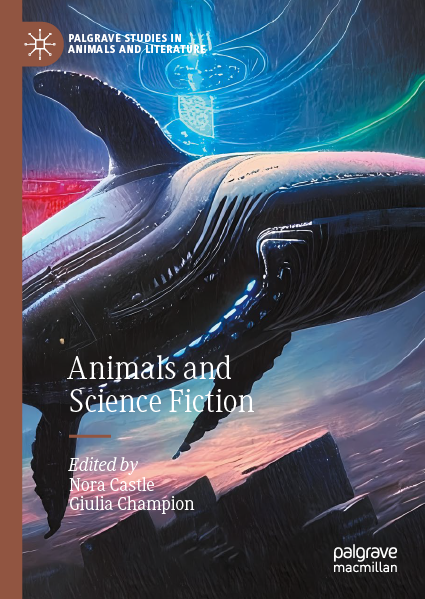
Review of Nora Castle and Giulia Champion, eds., Animals and Science Fiction. Palgrave Studies in Animals and Literature. Palgrave Macmillan, 2024. xxi + 373 pp. 4 b/w & 2 colour illus. $159.99 (hb). ISBN: 978-3-031-41694-1
Lotte Suardi is a recent graduate of the Research MA programme in Comparative Literary Studies at Utrecht University, the Netherlands.
Email: lotteintan@gmail.com
Humanimalia 16.2 (Summer 2026)
In the afterword to her short story “Bloodchild” (1984), Octavia Butler cites her fear of botflies as an inspiration for the Tlic, an alien species with whom humans develop a complex relationship. The Tlic depend on humans to host their eggs, while, in turn, the humans — who have, for unknown reasons, left Earth and settled on a new planet — rely on the Tlic for protection. “Writing ‘Bloodchild’ didn’t make me like botflies”, Butler confesses, “but for a while, it made them seem more interesting than horrifying”.1 “Bloodchild” is reflective of a broader tendency in science fiction, where questions of coexistence and alterity are posited through the representation of human–nonhuman interactions. The story demonstrates how science fiction reimagines our relationship with the nonhuman other, which Butler consequently uses to explore the complexities of symbiosis, parasitism, and power. While it is a poignant reminder of the systemic struggles of, for instance, bodily autonomy, slavery, or migration, “Bloodchild” also destabilizes colonial and anthropocentric assumptions of who the other is through the development of a human–Tlic interrelationship. But what if we also took speculative multispecies entanglements as opportunities to consider how we engage with nonhuman animals in the Anthropocene?
Nora Castle and Giulia Champion’s edited collection Animals and Science Fiction (2024) brings together science fiction (sf) and human–animal studies to engage in precisely this line of thinking. The collection contains eighteen essays from authors interested in nonhuman animals and sf in varying ways; the contributors bring in posthumanist, new materialist, and critical animal studies perspectives to sf’s representation of animals, while occasionally dipping into more sociological and scientific thoughts. Castle and Champion note that, in organizing this collection, they “have taken a broad view of what constitutes sf, what constitutes a text, and even what constitutes an animal” (3) in order to allow for its authors to highlight different elements of human–nonhuman relationships in sf. The essays are divided into five sections, based on themes “which create a sort of narrative arc” (4), ranging from the fictional construction of the nonhuman animal to their communication, corporeality, community, and hauntings.
Although Animals and Science Fiction announces itself as the first edited collection on the subject (2), it also acknowledges its debts to scholars such as Sherryl Vint and Joan Gordon. Indeed, Chapter 2 consists of an edited transcription of the editors’ interview with Vint, the author of Animal Alterity: Science Fiction and the Question of the Animal (2010). The collection thus takes as a foundational premise Vint’s justification for connecting sf and human–animal studies:
sf has a long history of thinking about alterity, subjectivity and the limits of the human which is precisely the terrain explored by much HAS, while HAS offers new and innovative ways to think about sf’s own engagement with such issues, situating it within a material history in which we have always-already been living with “alien” beings.2
Through this materially grounded lens, sf provides the creative avenue for scrutinizing and rethinking the dynamics of human–animal entanglements. Aside from the growing popularity of critical animal studies and science fiction studies, Castle and Champion find this research especially crucial within the urgent context of climate change (2). In Chapter 2, they further highlight the field by discussing with Vint her work in Animal Alterity, the evolution of animal studies and sf in the past decade, and their emerging intersections with other issues. This last topic, in which they pay particular attention to postcolonial thought, further contextualizes the urgencies pointed out by the editors. One of the strengths of the collection is Castle and Champion’s commitment to highlighting the impact of Western colonialism on various communities and human–nonhuman entanglements. As a result, the collection includes essays that attend to systemic inequalities, in which the exploitation of humans is understood in relation to the exploitation of nonhumans. As Vint explains, it is not a matter of making these struggles synonymous, but “of understanding a kind of western episteme, in which the project of humanization has been one of racialization, and so that we can’t think of anything around animal life and animal welfare and animal thriving without it simultaneously being a project of decolonization” (21). Colonialism blurs the categories of human and nonhuman, by dehumanizing marginalized groups. Its logic interlocks with anthropocentrism, wherein certain humans are privileged, while other humans and nonhumans are relegated to the bottom of this constructed hierarchy. Western colonialism is, therefore, understood here as a hegemonic structure linked to other exploitative systems such as capitalism and racism, while also playing a role in ecological violence. Reconsiderations of nonhuman animals in sf cannot be separated from these urgencies and histories, thus Castle and Champion claim this work as “an inherently decolonial project” (2). Going beyond the simplicity of the collection’s title, Castle and Champion aim to chart not just the representation of animals in sf but the way sf can unravel the dominant knowledge structures that have determined the planet’s hierarchies and entanglements.
Another topic of relevance in this conversation is Vint’s claim that the power of sf lies in its capability to make “animals subjects rather than objects” (26). While there are limits to assuming the nonhuman’s thoughts, the speculative vision of the genre means that one can narrate the perspective of the nonhuman animal in a way that produces an alternate logic of the (narrative) world and enables the reader to take seriously the nonhuman’s subjectivity. Vint claims that this encourages a more ethical practice, which can be crucial in the real world, where even de-extinction or rewilding projects often view animals as objects. Accordingly, the chapters in this book offer arguments for sf’s ability to consider nonhumans’ subjectivities in various ways by encouraging care and challenging anthropocentric ideas of futurity.
Part I, “Affect and Identity”, focuses on the narration of the nonhuman animal (which Castle and Champion term the “NHA”) in sf. Specifically, it aims to explore “the manner in which the NHA is constructed, created, told, and re-told, but especially the manner in which the NHA is unlearned” (4). The three chapters in this section analyse how sf imagines the subversion of anthropocentric hierarchies and encourages identification with the nonhuman, thus emphasizing the significance of human–animal interrelations in this reimagination. Hence, this section works towards demonstrating how speculative texts can unsettle human/nonhuman binaries to explore new understandings of the nonhuman animal.
This section begins with an interrogation of the colonial power that determines human and nonhuman statuses through Marta Mboka Tveit’s analysis of African speculative fiction (Chapter 3), namely, Edwin Okolo’s short story “When the Levees Break” (2022), and David Uzochukwu’s photography series Mare Monstrum/Drown in My Magic (2016–). Borrowing the term “critical embrace” from Joshua Bennett — a reconfiguration of the denigration of enslaved people to nonhuman animals — Tveit considers what emerges from the kinship between disenfranchised humans and fantastical nonhumans, who are both, through imperial logic, outsiders. Recognizing themselves in each other, they can find solace and begin to disrupt their own conditions. Consequently, Tveit puts forward the notion of a third position, a process of place-making, which creates “a home for the displaced with the nonhuman animal, the human, and the Land itself” (41). By deliberately assuming this position, she argues, the mutant marine animals (or Ekwenze) and Black merfolk in Okolo and Uzochukwu’s works challenge the European colonial binary of human/nonhuman and open up an alternative zone of “multi-being” (48), enabling a different way of interacting and moving in the world. Through the concept of the third position, Tveit demonstrates how African speculative fiction re-evaluates the production of the nonhuman and emphasizes the importance of multispecies co-existence in the Anthropocene.
In Chapter 4, Melissa Bianchi looks at how 2D video games provoke the player’s identification with nonhuman animals. Taking on the role of a frog (Frogger, 1981) or a fly (The Plan, 2013) as they navigate the natural and technological world, the player assumes a “playful becoming” (61) that subverts the anthropocentric human/nonhuman binary division. Frogger, for instance, is an arcade game where the player-as-frog must cross a busy road and river to get home. This game, as opposed to the more expansive 3D games, is limited in its gameplay, minimizing the player’s movements and actions to focus strictly on surviving until the end of the game; this also prevents the player’s total immersion, and therefore identification, with the frog. As a result, the player can empathize with the frog’s mortality in a human-dominated world, while also recognizing their alterity. Compared to some of the other essays in this collection that focus more heavily on interrogating systems of knowledge and power, this chapter may appear simplistic in its affirmation of sf’s power to enable an identification with nonhuman animals, yet it helps lay the groundwork for the discourses of human–animal entanglement that Animals and Science Fiction aims to represent.
In Chapter 5, Peter Sands reads the ideas about animals and technology brought forth in Philip K. Dick’s novel Dr Bloodmoney (1965). Introducing the concept of the species politics of risk — “the process whereby ecological relationships are rendered legible through the lens of nuclear threat even as this same threat marks the future of planetary ecosystems with radical uncertainty” (77) — Sands argues that the nuclear threat in the novel dissolves the interspecies hierarchy. That is, the nuclear threat destabilizes societal norms such that the division between humans and nonhumans becomes ambiguous; humans are reduced to their basic need for survival, while animals (mutated because of radiation) gain more human-like intelligence, such that humans are no longer the exclusive masters of language and technology. Although humans still appear to dictate the norms in a post-nuclear society, Sands views the novel as a utopian exercise in interspecies relations, where humans are not the masters of nonhumans, but where both are participants in a technologically- and ecologically changed world. For instance, in the absence of electricity and machinery, people have come to depend on horses again for transportation. Sands’ reading illustrates how, rather than unveiling our future, apocalyptic imaginaries provide a site to investigate and reimagine the power relations between humans, nonhumans, and technology. Concluding on this note, the first section can thus be seen as an introduction to the ways sf reflects on — and rewrites — how humans interact with nonhumans.
Part II, “Animal Communication”, explores how fiction imagines nonhuman animals’ communication in and across species membership, with each chapter “considering a different level and mode of communication” (6). As such, this section is interested in one of the central tropes of sf that intersects with animal studies; namely, the ability to understand the nonhuman. By exploring speculative interspecies communication, these essays consider how this trope can break down — or uphold — established forms of knowledge and interrelationships. While the scholars in this section are critical of sf narratives that continue to privilege the human mode of thinking, they also argue how imagining ways to enable the animal to communicate can provoke the dominant assumptions about their subjectivity.
Looking at the audiovisual medium of film, Jerika Sanderson (Chapter 6) scrutinizes the way Jurassic World: Fallen Kingdom (2018) uses dinosaur voices to solicit either pity or empathy from the audience. Comparing two separate human–dinosaur interactions, Sanderson argues that dinosaur voices “raise questions about various ‘power structures’ implicit in the relationships between humans and dinosaurs and encourage a recognition of nonhuman animal agency” (98). She suggests that, when appealing to the audience’s pity as the human protagonists abandon a crying brontosaurus, the film invites its viewers not to reflect on the dinosaur de-extinction project, nor to decode this as a metaphor for Anthropocene hubris, but rather to anthropomorphically project their emotions onto the nonhuman. However, when the humans rescue a velociraptor who is recognized as an individual with her own subjectivity, this dinosaur voice calls forth empathy; calling power into question, this encourages the audience to reflect on the impact of biotechnology on nonhumans. Analysing the construction of dinosaur voices in film, Sanderson indicates an innovative region of sf and human–animal studies by considering how this audiovisual technology can manipulate dinosaur representations and be utilized to conform to or subvert the concept of the Anthropocene.
Moving on to a different use of communication, in which settler humans learn to speak to nonhumans, Rachel Fetherston (Chapter 7) examines two texts of speculative ecofiction by Australian settler authors: Laura Jean McKay’s The Animals in that Country (2020) and Robbie Arnott’s Flames (2018). Fetherston investigates how, by producing communicative relationships with dingoes, seals, and even human–tree hybrids, the settler characters in these novels subvert notions of land possession and settler belonging. The initial, long-lasting disconnect between settler humans and nonhumans becomes problematized through these interspecies communications, pushing the way forward to a multispecies flourishing that will allow these communities to thrive. However, while these novels mark a shift from older settler narratives by challenging Western dualisms, Fetherston points out that there is a conspicuous gap in relation to Indigenous groups and knowledges, which limits the “decolonizing potential” of both novels (124). As such, by not properly attending to Indigenous epistemologies — even ignoring the people’s part in multispecies entanglement — the novels still perpetuate problematic ideas of settler belonging that centre a particular human’s part in this communication. In short, by investigating the representation of animal communication in these texts, Fetherston measures what this concept does to settler colonial belonging against which people are still left out of this dialogue. Similarly to Sanderson, then, she compares how sf fiction can problematize unequal human–nonhuman relationships while simultaneously upholding colonial, anthropocentric ideas of belonging.
In Chapter 8, Liza B. Bauer and Castle focus on the way Adam Roberts’s novel Bête (2014) interacts with the tropes of the “uplift” subgenre of sf, which “incorporates into its narratives the augmentation of NHAs to display (closer-to-)human-levels of intelligence” (131). Interrogating the human-centred approaches of assistive technology and bioengineering to give speech to animals such as dogs and lambs, Bauer and Castle argue that Bête challenges the notion that human speech is equivalent to intelligence, revealing how even within this form of communication, nonhuman animals have their own interiority and worldviews that are unintelligible to humans. They thus suggest the gift of human language alone is insufficient in cultivating interspecies connection, and that the nonhumans’ appropriation of speech disrupts totalizing anthropocentric knowledges. Bête thus appears as a fascinating case study that makes nonhuman subjectivity opaque by playing precisely with the tropes of the uplift genre. Scrutinizing the hegemony of human speech in interspecies communication, Bauer and Castle highlight how sf can subvert not only the human totality of language, but also its own conventions.
Connecting communication to animal embodiment, Iuliia Ibragimova (Chapter 9) traces the origins of spacefaring animals within sf narratives, examining the establishment of their agency and interactions with humans in five case studies across TV, novellas, and short stories (1989–2018). Spacefaring animals are aliens or cyborg terrestrial animals “whose anatomy allows them to travel through outer space and carry passengers inside their bodies” (149). Within a traditional paradigm of human–nonhuman relations, they were intended to suit the needs of humans, who exploited them and removed their agency. Yet, as porous bodies and assemblages of multispecies entanglements, Ibragimova argues, spacefaring animals in these texts have also come to emphasize humans’ dependency on them, distributing agency differently and providing new spaces for thinking about human–nonhuman relations. Especially the more recent texts, such as Nnedi Okorafor’s Binti series (2015–2018), challenge traditional dynamics, and more critically reflect on the spacefaring animal’s body as a site of various inter- and intra-actions. This chapter does not discuss animal communication as explicitly as the previous chapters do but it does bring attention to the role of communication in multispecies community, in which sf texts deconstruct anthropocentric norms of living by representing the interdependency of humans and nonhumans in their daily interactions. However, while Ibragimova provides an insightful overview of the spacefaring animal across the genre, she is constrained by the bounds of one chapter to consider the implications of these sf bodies as a site to renegotiate agency and coexistence in more depth.
Part III, “Bio-intervention and Corporeality”, builds on the themes of technology already introduced in the previous sections but pays more attention to the treatment of nonhuman bodies and corporeality. In other words, this section “explore[s] bio-intervention which not only brings humans and nonhuman animals into closer proximity, but actually implicates them in the lived experience of the other” (7). Reflecting on the interrelations between human and nonhuman bodies, the following four chapters interrogate the capitalist and scientific structures that uphold current inequalities, focusing on case studies that are critical of the way nonhuman bodies are commodified, exploited, or ignored.
In Chapter 10, Monica Sousa considers empathy and care in the face of body tourism, wherein humans can embody lab-grown animals. Turning to Emma Geen’s novel The Many Selves of Katherine North (2016), Sousa shows how the story of inhabiting the bodies of, for instance, spiders and whales, can inspire humans to think outside of frameworks that objectify nonhumans. The protagonist’s ethics of care as a researcher is contrasted with a consumerist industry which sees the technological embodiment of animals as a sort of tourism. Yet Sousa argues that, while the technology that produces this embodiment can be exploited for capitalist gains, the novel encourages the reader to see that, through the protagonist, there are more ethical practices that can be learned instead. Ultimately, exploring a technology that enables humans to see “the umwelt of nonhuman animals—their different embodiments and ways of being in the world—can cultivate empathy” (171). This chapter thus reflects on literal ways in which sf implicates the human and nonhuman in each other’s lives, deconstructing exploitative frameworks of embodiment to instead argue for the way that technology can bring humans and nonhumans closer through an empathetic worldview.
Katarzyna Ostalska (Chapter 11) presents the most scientifically engaged essay in the collection, considering how microbes — perhaps underappreciated nonhumans — are collaborators in Christian Bök’s poetry collection The Xenotext: Book 1 (2015). By working with genetic sequencing as a cypher in his poetry, Bök’s project shows that bacteria (and bees) are agents more deserving of scientific and aesthetic research. Drawing on astro- and theoretical physicists, Ostalka consequently wonders if they can be seen as the “aliens among us” (Paul Davies, qtd. 196) in order to urge a deeper understanding of the planet that we are already part of, instead of seeking something beyond it. In doing so, she provokes a deeper questioning of which nonhumans are overlooked in discussions, and how they can participate in meaning-making through poetry. As the only chapter in the collection that looks at nonhumans as collaborators in sf texts, Ostalka’s essay brings in a new element of nonhuman agency that attempts to evade exploitative interspecies relations.
In Chapter 12, Brianna R. Burke turns towards the factory-flesh-food system as the hyperreal in Bong Joon-Ho’s film Okja (2017). Burke states that it is more accurate to describe the film as speculative fiction, rather than science fiction; this is because the genetically modified flesh-as-food, the superpig, is situated in “a slightly different now” and, through its simultaneous recognizability and unrecognizability, evokes a sense of the uncanny in the audience (205). As such, contrasting this system with the kinship between the eponymous superpig and a human girl exposes the gruesome cruelty — concealed by simulacra — of the food corporations that commodify nonhuman animals. Similarly to Sousa in Chapter 10, Burke investigates how the speculative representation of capitalist uses of technology highlight how nonhumans can be abused for human gains. Yet, while Sousa’s essay aims to show how the representation of consumerist technologies in sf can inspire readers to be more empathetic — echoing several other chapters in the collection — Burke’s analysis of Okja stands out for its strong indictment against the capitalist exploitation of nonhuman animals. In juxtaposing this factory-flesh-food system to an empathetic kinship, Burke delivers the most confrontational chapter in the collection and demonstrates how speculative fiction aligns with reality to evoke a deep sense of discomfort in its audience.
Turning back to scientific themes of corporeality, Emma Trott (Chapter 13) looks at xenotransplantation to investigate Black posthuman bodies in Malorie Blackman’s children’s novel, Pig-Heart Boy (1997). Xenotransplantation disturbs the delineation between human and nonhuman; it opens the way for the young Black protagonist with a pig’s heart to engage in ethical responsibility and selfhood against the backdrop of Western medical systems that have historically exploited racialized bodies. Following a similar line of thinking as other chapters concerned with marginalized subjectivities, this chapter seeks “to consider how xeno medicine might intersect with other cultural systems of power” (217). Ultimately, while Trott questions the pig’s agency in this medical process, she praises the novel’s subversion of scientific racism and the dehumanization of Black corporeality, situating the Black body at the forefront of medical treatment. This chapter thus considers a two-fold medical intervention — of Black people’s bodies and nonhuman ones — and weighs different structures of power to understand how they are implicated in one another. Both Ostalka and Trott make scientific appeals, demonstrating how technologies and science can intertwine with artistic media to bring to the forefront those humans and nonhumans that are typically ignored. In doing so, they rethink the categories of human, animal, and alien, to question current scientific practices. To end, each chapter in this section interrogates how humans can exploit nonhuman bodies; nonetheless, they are hopeful and ask their audiences to cultivate different relationships with nonhumans, initiating the move towards multispecies kinships.
Part IV, “Community (Re)building and Entanglements”, turns towards texts “exploring issues of human–NHA belonging and community” (8). The three chapters in this section focus on the ways fictional and nonfictional texts imagine how humans and nonhumans build multispecies communities in the Anthropocene. Moreover, the fourth section is the one that is most centrally dedicated to problematizing colonial logics, aligning with Castle and Champion’s stated decolonial project. The chapters particularly highlight African and Indigenous knowledges, with the scholars finding in them a consideration of the nonhuman’s viewpoint which can go against harmful anthropocentric visions of futurity.
In Chapter 14, Frances Hallam foregrounds Africanfuturism in their study of entanglements and futurity, through the undersea in Nnedi Okorafor’s Lagoon (2014). In the context of the placement of oil pipelines in Nigeria, Lagoon explores the porousness and distributed agency of humans, the ocean, and marine animals (including aliens) by presenting a Nigerian future through the eyes of various nonhumans impacted by the movements in the undersea. Working from the premise that alternative imaginaries are needed to rethink human–animal relations in the Anthropocene, Hallam argues that Africanfuturist ecocritical texts show that “the human is in always already entangled proximity with our nonhuman world as a vision for more generative, ecological futures” (243). Through this investigation, Hallam points out the problem of working from a Western colonial framework that is concerned with how humans can return to a nature unaffected by ecological damage. Rather, Nigerian Africanfuturism produces an understanding that interspecies interactions are intricately tied in the past and indispensable for sustainable futures. Hence, while scholars like Fetherston in Chapter 7 highlight the politics of exclusion in these types of discussions, Hallam importantly pays attention to what these voices are and how they rethink community.
Through a close reading of Thomas King’s The Back of the Turtle (2014), Conrad Scott (Chapter 15) centres the link between nonhumans and humans as part of a community to argue that recognizing and cultivating this interrelation is crucial to communal healing after ecological disaster. In doing so, Scott considers the mode of Indigenous storytelling within the form and plot of the novel. Indigenous storytelling demonstrates the strength in multispecies and cultural entanglement by “extend[ing] the scope of what community can entail—not just by including humans and nonhumans, but by expanding to include multiple viewpoints and also more-than-local concerns” (268). This representation of multispecies kinship contributes to the decolonization of community and knowledge so that humans and dogs and turtles, as well as defoliants and the ocean, are all agents in communal healing. Both Hallam and Scott focus on novels which cultivate a simultaneously local and global vision of communal entanglements that break away from colonial structures. Together with Hallam’s claim that there is no vision of a pure, unaffected nature that we can return to, and Scott’s argument that recognizing and cultivating community is necessary in the aftermath of ecological violence, they emphasize the necessity of kinship and healing during the precarious time of climate change.
Turning away from fiction, Zoei Sutton, Adam Cardilini, and Kate Hall (Chapter 16) focus on a Melbourne 2050 development plan and uniquely combine their backgrounds in sociology, science, and creative writing to propose an alternative plan. They argue that urban design is a speculative endeavour that imagines which animals are allowed to belong to this multispecies community, relegating the undesirable others into invisibility. The Melbourne plan is built on an “anthroparchal” (human domination) and settler colonial logic that privileges human desires of nature over others, and must be unlearned. Consequently, the authors apply the exploratory form of sf to the development plan by interspersing urban animal-centred vignettes throughout the chapter, such as a scene of a stray cat who attempts to find food in the city and interacts with other humans and animals along the way. In this way, the authors aim to “re-visibilize” the nonhuman animal’s perspective in current multispecies conditions, so that they can present their vision of future cohabitation, which is more inclusive and affords all species “equal rights to thrive” (278). They aim to foreground animal subjectivity while also respecting Indigenous land to break away from an anthroparcal vision. This chapter can therefore be seen as a proposal to enact the move towards multispecies community as argued by Hallam and Scott, turning sf into action. In rewriting urban planning as explicitly speculative, Sutton, Cardilini, and Hall envision the decolonization of an Australian community shaped by settler colonial logic, although this does leave the question of whether this alternate plan will be brought beyond the bounds of an academic book.
In the fifth and final section, “(Future) Fossils, Ancestrality, and Haunting”, humans’ entanglements with nonhuman animals are analysed through a temporal lens. Here, “four chapters address the complex manners in which we understand our relations to NHAs via historical and fictional narratives as well as deep time” (9). Questions of the past and future are explored, in which the passing of time is used to explore humans’ (changing) relations to nonhumans, by bringing together different temporalities or imagining impossible conditions of relationality. However, while Animals and Science Fiction asserts the necessity of nurturing a different kind of relationship with nonhumans, this particular section attempts to tackle the question of how to do this when something is lost. Because of the imbalance this loss creates, Part V comes across as the most anthropocentric in the collection. Nonetheless, it offers different avenues for explorations of the role of nonhuman animals in sf.
The section thus begins with the struggle of ultra-rapid progress as Thomas Moran (Chapter 17) considers the role of digital animals in disrupting temporality in Jia Zhangke’s film A Touch of Sin (天注定 Tian Zhuding, 2013). He argues that, in the film’s context of contemporary China, digital animals in social media bleed into offline spaces, creating a sense of temporal simultaneity. Moran views the film as a work of sci-fi realism, in which it uses sf elements to express “the fragmented image economy of contemporary Chinese visuality in which animal symbolism rampages through the digital network and into the wider world” (303). As such, the film is able to represent a temporal disconnect, wherein tigers, snakes, and horses (Chinese zodiac animals) signify the unfulfilled egalitarian progress promised by socialist values. Although animals are argued here to have agency in China’s social and political climate, they are not necessarily being rethought in anthropocentric discourses or understood as forming different relations with humans. Moran’s chapter is more about the promises lost to ultra-rapid development — in which digital animals are disruptive symbols — than it is about human–animal entanglement.
Alice Fox (Chapter 18) turns toward absence to reflect on nonhuman extinction in the futurity of Horizon Zero Dawn (2017). This video game makes the player face a future in which most nonhuman animals have gone extinct; in their place are machine animals, which players can recognize as being inspired by real animals such as bears, but the in-world characters initially do not. Through a hauntological reading, Fox sees these machines — as the source of communication and information on extinct nonhumans — as assemblages of various temporalities, which “cultivates a sense of hope and encourages players to approach technology and nature as interconnected and related, rather than as binaries or opposing phenomena” (317). This, in turn, allows the player to reflect on a future in which ecological violence cannot be undone, and the possibility of our interrelationships with nonhumans are lost. Thus, although actual nonhuman animals are absent from the story world, Fox’s essay shows how video games can situate players in an undesirably human future that produces a utopian desire to cultivate response-ability.
In Chapter 19, Kathryn Heffner and Edward Guimont trace the presence of dinosaur–human interactions in popular fiction, namely, Christie Sims and Alara Branwen’s Taken by the T-Rex (2013) and Dino Park after Dark (2014), culminating in a feminist close reading of dinosaur erotica in eBooks. They argue interspecies sex between dinosaurs and human women subverts mainstream dinosaur narratives, in which women are objects to be lusted over and rescued by men from dinosaurs. Instead, in dinosaur erotica “the woman character engages in a sexually liberated act that is performed in spite of, and not for, the masculine gaze” (338), which would normatively set men up to be sexual heroes. Thus, Heffner and Guimont highlight how sf narratives can play with atemporalities to reconfigure contemporary social dynamics. Yet, like Moran’s essay in Chapter 17, this chapter appears quite anthropocentric, with Heffner and Guimont scrutinizing the presence of extinct species to comment on heteronormative human relationships. As such, the two chapters seem out of place in a collection that highlights the cultivation of care through multispecies entanglements. However, they do mark differing approaches to studying animals in sf, wherein nonhumans can also figure in the struggles of modernization and patriarchy.
Lastly, in Chapter 20, Vera Thomann contemplates human and nonhuman temporalities through Dougal Dixon’s speculative future evolution book, After Man: A Zoology of the Future (1981). Dixon uses factual scientific evolutionary principles to speculate on future evolution, while “paradoxically demanding a ‘paleontological’ perspective” on our current age (347). For example, he puts forth the Flooer, an animal from Batavia descended from modern-day bats, to explore one possible nonhuman evolution. Thomann argues that After Man challenges humankind’s science and temporality precisely because the nonhuman outlives humanity. A counterpart to Fox’s case study in Chapter 18, here human–animal relations are reconfigured to illustrate a radically nonhuman future. Both Fox and Thomann probe speculations of either human or nonhuman futures, in which it seems the possibility of nurturing human–nonhuman entanglements is gone; yet they suggest that imagining an atemporal relation is not useless. Rather, they invite a contemplation of how we live now, while humans and nonhumans are still alive. Fox emphasizes response-ability between humans, nonhumans, and technology, while Thomann breaks down the centrality of human temporality, highlighting the disconnect between species. Read in this way, the chapters in this section indicate that there are productive possibilities of forming relationships with nonhumans from the past and future through modes of sf. By doing so, we challenge current inequalities among both humans and nonhumans, and cultivate new relationships for the future.
Like Butler’s Tlic, the nonhuman animals discussed in Animals and Science Fiction provoke our assumptions about alterity and multispecies coexistence, asking the reader what knowledge systems they are shaped by, and what responsibilities they may hold, in the Anthropocene. Against the growing concerns around climate change and systemic inequalities, these essays demonstrate that the fantastical — and sometimes absurd — imaginaries of sf can offer a critical space to rethink the nonhuman and our real human–animal interrelationships. Presenting a large overview of the field, the contributors point to both the problems and potential of sf in interrogating historical and contemporary speculations of entangled futures. Castle and Champion further set loose parameters for defining animals and science fiction, which allows for a wider and more diverse exploration of the speculative potential of human–nonhuman entanglements. And indeed, some contributors interrogate the very connotations of sf, and its associative tropes and labels, in order to understand the form and function of this genre in relation to various nonhuman animals in the Anthropocene.
However, Animals and Science Fiction’s form as an essay collection means that some chapters struggle to go much further beyond the claim that sf subverts interspecies relationships and identification, making similar arguments to each other, but with different case studies. The book lays the groundwork for, or takes stock of, the current state of the field, in which scholars are still establishing that sf forms and narratives can evoke empathy or care for nonhumans. While this is undoubtedly an important element in reconfiguring our entanglements, future scholarship — as has already been initiated by several other essays in the collection — might further ground this interdisciplinary field by interrogating the various structures and knowledges that underlie the representation of the human and nonhuman in sf, and more critically examining how sf imagines the cultivation of human–animal coexistence.
The collection begins to bring this study of animals and sf further in this direction through its recognition of a decolonial project. While Castle and Champion take care to provide space for decolonial discussions that critique the colonial and capitalist structures that impact human–animal relations — along with the focus on Indigenous and African narratives — Animals and Science Fiction is still quite Western-centric in its presentation. Perhaps, then, as a further avenue of research, more attention can be given the representation of nonhumans in sf narratives from regions such as Asia and Latin America, which have their own sf traditions and, importantly, have made crucial contributions to decolonial thought.
Nevertheless, the collection’s intervention in both human–animal studies and sf studies mean there is an interdisciplinary appeal; those interested in human–animal studies can consider how our relations with nonhumans and the earth are explored through this speculative lens. Meanwhile those who are interested in science fiction (and perhaps genre fiction more generally) will find insightful close readings of the roles of animals in these imaginaries.
Notes
Octavia Butler, Bloodchild and Other Stories (Seven Stories Press, 2005), 31.
Sherryl Vint, Animal Alterity: Science Fiction and the Question of the Animal (Liverpool University Press, 2010), 2.