Game for the Challenge
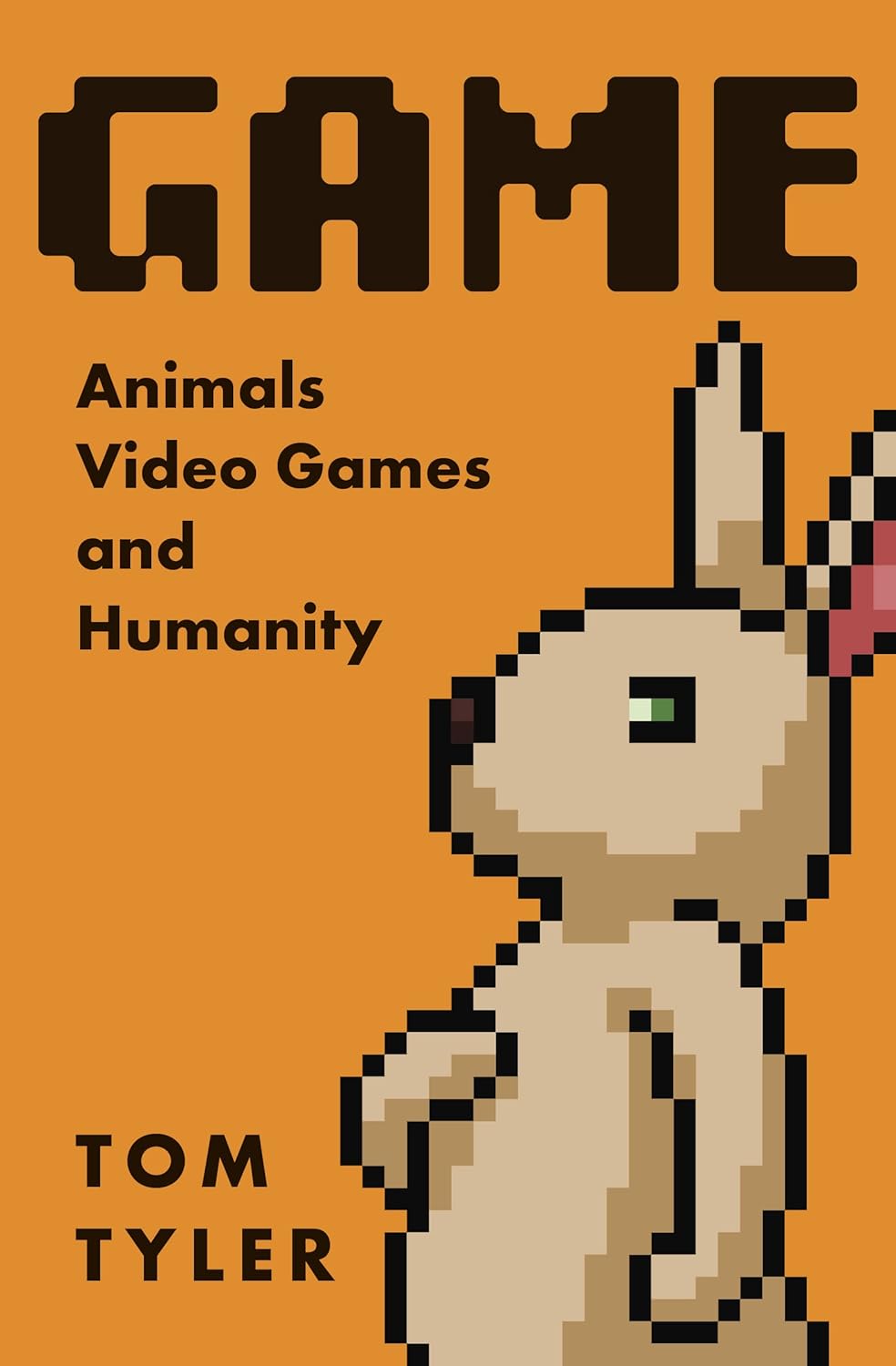
Review of Tom Tyler, Game: Animals, Video Games, and Humanity. University of Minnesota Press, 2022. 224 pp. 25 b&w illus. $25.00 (pb). ISBN: 978-1-517-91019-8.
Peter Sands is a Research Fellow in the Leverhulme Centre for Anthropocene Biodiversity and Department of English and Related Literature at the University of York, UK.
Email: peter.sands@york.ac.uk
Humanimalia 16.2 (Summer 2026)
In a letter written in 1753, the Fourth Earl of Chesterfield addressed some reflections on self-betterment to his twenty-year-old son. The best known of Chesterfield’s tips is the laconic and oft-repeated maxim, “whatever is worth doing at all, is worth doing well” (52). Chesterfield’s truism has attracted a series of detractors, including the art historian I. A. Williams, who in an essay on “The Importance of Doing Things Badly” cites fishing as a practice for which success might not be so desirable, since “one’s whole pleasure is often spoilt by having to kill a fish” (55). Against Chesterfield’s absurd commitment to perfectionism, Williams proposes that trivial pursuits, like the playing of games, ought to be done badly rather than not at all.
Take Ridiculous Fishing (Vlambeer, 2013), for example, a pleasurably repetitive mobile game in which the player is tasked with tilting and wiggling their phone so as to catch — and then machine gun — huge quantities of fish. To play this game well, Tom Tyler tells us in the seventh chapter of Game: Animals, Video Games, and Humanity, the player must commit to a form of attention-sucking completionism: compulsively snaring every kind of creature included in its gameplay — flying fish, jellyfish, eels, sea urchins, manta rays, turtles, and dolphins — and tediously exhausting all of its myriad extra features. Playing well, in other words, is an exercise in exhaustion, as the player exhausts their life exhausting the lives of fish. The joy of completing the game might thus be “spoilt”, as Williams had it, at the very moment the player recognizes that they are spending their time having to kill fish.
Perhaps the trick, then, is to play the game badly. Or, as Tyler puts it, “not to eschew the game or to play it exhaustively, but to fish judiciously” (63). For fishing is, Tyler reminds us, ridiculous. It not only causes fish pain and distress, but also deprives them of “the pleasures of play” (63): chasing one another, play fighting and blowing bubbles. Even methods of catch-and-release cause unnecessary suffering. Hidden not far beneath the chapter’s rehearsal of parables of perfection and pragmatism is the pithy (and yet still radical) argument that fish ought to be considered as ethical subjects. In this context, the virtual fishing of Ridiculous Fishing might in fact be the only kind of fishing worth doing — just so long as we play it judiciously, Tyler suggests.
Game is comprised of thirteen chapters that ask how “players of video games have been invited to encounter, understand, and engage animals” (3). The book’s argument is constructed, as such, via the double meaning of the word game that derive from its Old English origins: the activity played for joy, merriment, and entertainment, and the quarry of hunters involved in the particular game of catching and killing wild creatures (2). The etymology of Tyler’s title means that an ethical position on animals and their status as often automatically killable is implied from the outset. The imperative to think differently about our relationship with animals serves as a stealthy substrate to the book’s juxtaposition of often amusingly disparate sources. Indeed, throughout, Tyler adopts a practice that he calls “vejan” writing: a strategy, signalled by its portmanteau of “vegan” and “Trojan”, that smuggles vegan ethics into arguments that appear at first to be incidental to the lives and treatment of animals. Tyler’s vejan writing probes at the unlikely affinities found between his sources in ways that offer meditations on animal life and human–animal relationships. A diverse range of video games provide anchoring points for arguments that take pleasure in the insights that improbable associations can afford.
This method of reading is outlined in the book’s final chapter. Here, Tyler begins by pointing out how the handheld electronic game Trojan Horse (Gakken, 1981) mistakenly represents the siege of Troy as a full-frontal assault, missing the fact that the tale of the Trojan Horse is not one of a “massive siege engine” but rather “an ingenious stratagem devised to circumvent otherwise impervious defences” (143). The lesson of the Trojan Horse’s success, for Tyler, is demonstrated more astutely by the intellectual history of apologetics, defined as the practice of defending “a position robustly and without contrition”, and yet expanded, by the Christian apologist C. S. Lewis, into a strategy for lacing otherwise unrelated texts with values that emerge, “impenitent and assured, to shake and trouble” (144–50). Following both Lewis and the mythic horse, vegan apologetics is about articulating vegan ethics using stealth rather than assaultive tactics of argument. It hinges, as Tyler’s pleasing meta-commentary attests, on the adoption of a vegan lens when engaging any number of topics, from Ian Bogost’s satirical game Cow Clicker (2010; Chapter 8) to the zombie-themed endless runner Into the Dead (2012; Chapter 6).
Tyler’s strategy depends in this sense on a third meaning of the word “game” outlined in his first chapter: “the disposition or attitude of those ready and willing to try something new or challenging”, or in this case the invitation, posed by the unexpected dialogues staged by the book, “to encounter, understand, and engage […] animals and games differently” (4–5). For those game for the challenge of understanding video games through the rich and varied lenses of animal studies theory, Game provides plentiful rewards. The book serves as a compendium of the field’s most foundational theoretical arguments, from Umwelt theory to Matthew Calarco’s notion of indistinction, tracing these existing contours in ways both clear and incisive. Tyler conducts brief and pointed summaries of critical disagreements, at one point contrasting Donna Haraway’s criticism of veganism as a “moral absolute” and the rejoinder, articulated by Anat Pick, that veganism’s imperfection makes it a “labour of love and justice, no less worldly than Haraway’s multispecies earthly entanglements” (146). But he also sheds new light on ideas that are elsewhere often taken for granted. The second chapter, “A Singular of Boars”, includes a lucid rehearsal of Jacques Derrida’s notion of l’animot (or the animal-word) by way of the wild boars of Titan Quest (Iron Lore Entertainment, 2006), a role-playing game that includes richly rendered ancient environments and mythical creatures yet deploys repeated generic character models for its beasts. The experience of fighting hordes of uncanny digital doppelgängers, one familiar to most gamers, here unlocks the key to Derrida’s notion of the “general singular”, the specious logic that gathers the rich diversity of nonhuman life together under the sign “animal”. That this argument is mirrored once more in the collective noun for boars listed in the Book of St Albans — a “singular of boars” — is another of Game’s ingenious synchronicities. Elsewhere, Tyler brings Val Plumwood’s famous account of surviving a crocodile attack into dialogue with the “endless runner” genre. Here, playing like a loser (in acknowledgement of one’s inevitable death at the hands of hungry zombies) facilitates a mode of reading like a loser; a strategy for locating oneself, as Plumwood is forced to, “outside the human species altogether” (50).
In each of these instances, Tyler challenges received wisdoms old and new: that the idea of messy entanglements is itself an ethical endpoint; that animals are best understood as a “commingling of the singular with the general, the individual with the generic” (15); that the capacity to be edible, to be designated as “meat”, is reserved necessarily for nonhuman animals. Underpinning each of these arguments is the concept of anthroponormativity, an idea that Tyler defines, in his contribution to The Palgrave Handbook of Animals and Literature, as the dimension of anthropocentrism that takes human identity as self-evidently normal:
Where the ultimate dimension of human exceptionalism invoked an absolute difference, the final dimension of anthroponormativity calls, instead, upon a definitive, unquestioned identity. The normative assumption that the speaking or writing subject, as well as their audience, should identify as human is evidenced by a persistent series of first person plural pronouns, that is by invitingly axiomatic wes, ours and uses.1
Game offers a practical application and extension of this theorization, mobilizing the medium specificity of video games to further diagnose the latent adoption of a perspective that is assumed to be human. The book’s most conspicuous strength is the way its analyses attend to the particularities of the gaming experience in order to open questions about animal life that are often obscured by the terms of anthroponormativity — in ways that will be enduringly relevant to animal studies scholars interested in any medium and discipline.
Let me illustrate this by turning to two of the book’s chapters that tackle anthroponormativity head on. In “How Does Your Dog Smell?”, Tyler focuses on the game Dog’s Life (Frontier Developments, 2003) and its central mechanism of “Smellovision”, which allows players to assume the perspective of the protagonist canine and see the “brightly coloured clouds of scent” that constitute his world (19). The game appears to model Jakob von Uexküll’s theory of animal Umwelt, or the sensory worlds that make up the perceptible environments of other animals and allow for an understanding of forms of meaning and significance beyond the parochially human. The game’s representation of a dog’s perspective offers, of course, a limited approximation of the startling facts of canine olfaction, which Tyler takes the opportunity to outline with evident enjoyment. But the real obstacle is the game’s dependence on a default, third-person perspective assumed to be impartial and yet, owing to its smaller field of view and absence of odorous clouds, clearly functions as that of a human. “Alignment of the detached, dispassionate observer with an implicitly human point of view”, Tyler notes, “effectively normalizes the latter” (27). In video games, as in the work of scientists and philosophers who perform what Haraway once called the “god trick” of seeing the world from nowhere, the assumption of a by-default human perspective renders such an identity essential, universal, and unquestionable (26). Yet even as it normalizes the human perspective, Dog’s Life welcomes us into the dog’s world “and in so doing provides a conspicuously unfamiliar Umwelt as a counterpart to human perceptual norms” (28). The novelty of playing via a dog’s-eye-view reminds us that the human perspective is just one among many.
Where Tyler reads Dog’s Life as illustrating the operation of anthroponormativity as such, his analysis of Plague Inc. (Ndemic Creations, 2012) speculates an alternative to this logic. Like Ridiculous Fishing, Plague Inc. is another mobile game, but one that asks players to spread a deadly pathogen across the world and obliterate the human species. While the misanthropy of this objective seems evident, Tyler notes that the game fails to capture the historical figuration of the misanthrope as an individual who is “ruled by passion, their intense, emotional abhorrence of humanity the result of personal affronts or misfortunes” (106). From Shakespeare’s Timon of Athens to Molière’s The Misanthrope, the misanthropic individual is depicted as extreme, pathological, maladjusted and governed by excess. In these foundational representations, misanthropy is enunciated as an irrational derision of humanity-at-large, and therefore functions as part of a character’s “self-defeating impulse”, a form of self-hatred directed towards the very human collective to which they belong (111). In Plague Inc., however, contra to the assumed human perspective of Dog’s Life, players are asked to invest in the values of a virus. Doing so, Tyler argues, exposes the contradictions underpinning classic figurations of misanthropy, the characterization of which as a pathological state “is itself, of course, an evaluation, a particular, prejudicial depiction of the misanthrope and the object of their disaffection” (111). With its grisly yet calculated objective, the game institutes an “inhuman norm” by which opposition to humanity no longer functions as a form of self-hatred (112). Human extinction serves as misanthropic wish-fulfilment only if the human perspective is judged to be the norm — as opposed to but one subjective point of view among species and forms of life.
Critiques of anthropocentrism allow scholars in animal studies to trouble the ways in which human life is constructed as exceptional, superior, or central to accounts of historical, philosophical, or scientific forms of knowledge. What Tyler’s treatment of anthroponormativity achieves — in a subtle and yet significant divergence from this critical trend — is an acknowledgement of the epistemological humanism that subtends any given claim to universal neutrality, from the supposedly nonpartisan perspective through which we experience canine capers to the mythical figure of the Everyman, to whom Tyler turns in the twelfth chapter “Difficulties” via the difficulty settings of Half-Life 2 (Valve, 2004). It is in this sense that I would also characterize Game as a sophisticated example of posthumanist scholarship, insofar as posthumanism at its best involves the parsing of humanist logics in ways that reveal their internal inconsistencies. The fundamental insight of “Difficulties” could have been straightforwardly humanist: difficulty settings, Tyler notes, appeal to the figure of an “Everyplayer” in declaring their attendant games to be accessible to all, and yet in doing so obscure the potential requirements of “the particular gamers, in all their varied specificity, who wilfully subject themselves to the difficulties of playing a game” (130). Acknowledgements of unbounded particularity and diversity of experience are a mainstay of humanist inclusivity, which, as Cary Wolfe notes, displays a penchant for a pluralism “in which the sphere of attention” is “extended to previously marginalized groups, but without in the least destabilizing or throwing into radical question the schema of the human who undertakes such pluralization”.2
Yet Tyler shows us how video game playing causes such a humanism to falter, as he points out the extra-ordinary groups of nonhuman players who have, thanks to their status as companions, captives, and experimental subjects, already engaged in digital play but have not been the implied players for whom Half-Life’s difficulty settings are conceived. More than just unpacking the faulty universality of the Everyplayer, then, the chapter shifts to explore how certain chimpanzees are made to model the behavioural proclivities of their species in research facilities in which they have “had little choice but to play” (138). Accounting not for an Everyplayer, but for every player, involves paying attention to the “species agnosticism of the implied player”, or the fact that, no matter the intentions of its designers, “the role offered by a game can be taken up by anyone who is in a position to fill it” (134). Subhuman players, or players of any given species who are excluded by a game’s normal difficulty setting, trouble the construction of normative models of play that difficulty settings implicitly affirm. “It is vital that more players be implied”, Tyler concludes — but also, as with captive chimpanzees and other creatures, “that individuals not be expected to subject themselves to the challenges and difficulties of a game” (137).
Tyler’s analysis of anthroponormativity signals an animal studies indebted to the critiques of normativity developed in feminist and queer theory, critical race and disability studies. It provides critical tools invaluable for those working in the environmental humanities, whose consideration of ecological change must wrestle with the fact that designations such as the Anthropocene denote planetary futures that unfold in ways that cannot but trouble the normalization of the human. It also, significantly, maintains fidelity to a critique of the systematic exploitation of animals and their exclusion from ethical consideration across a host of contexts. What makes animal studies worth doing for Tyler is not only that this latter point can be smuggled in as a Trojan horse — but that thinking about animals opens a host of new ways to approach innumerable subjects, from the etymology of “bullshit” to the threat of human extinction. Game is refreshing precisely because of the expansive, eclectic, and approachable ways into animal studies it demonstrates. Such ways of rethinking our relationship with animals might transcend the virtual spaces of video game and philosophical treatise alike, Tyler argues, enabling us “to do things differently in what players and academics alike sometimes call ‘real life’” (6). For players, theoreticians, teachers, students, and curious animal advocates game for such a challenge, Game will remain an essential and enjoyable book to return to.
Notes
Tom Tyler, “The Exception and the Norm: Dimensions of Anthropocentrism”, in The Palgrave Handbook of Animals and Literature, ed. by Susan McHugh, Robert McKay, and John Miller (Palgrave Macmillan, 2021), 22–24.
Cary Wolfe, What Is Posthumanism? (University of Minnesota Press, 2010), 99.