Multispecies Politics Unleashed
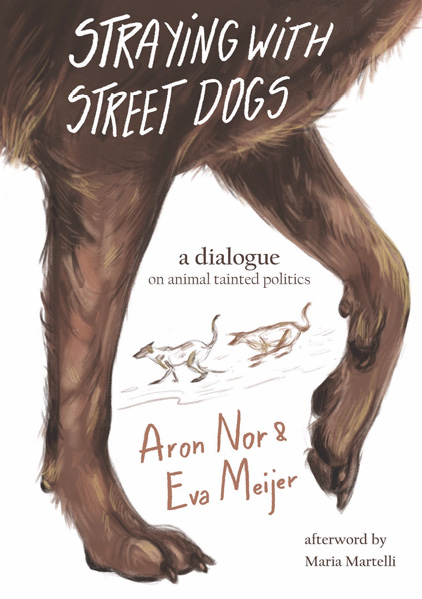
Review of Aron Nor and Eva Meijer, Straying with Street Dogs: A Dialogue on Animal Tainted Politics. Afterword by Maria Martelli. Active Distribution and Cărțile Pisicii Negre, 2025. 127 pp. £3.00 (pb).
Guillem Rubio-Ramon is a Postdoctoral Research Associate at the University of Edinburgh.
Email: G.Rubio@ed.ac.uk
Humanimalia 16.2 (Summer 2026)
When I started researching free-living dogs and multispecies health in India, one of the first (of many) things that I had to unlearn was the concept of “stray”. The trouble with calling a dog stray, I found, is that it suggests they are out of place.1 A stray dog is often understood as the bad opposite to the good dog who belongs, the beloved and more or less obedient pet. For me, then, the term “street dog” emerged as a more appropriate term for naming an animal who is unrestrained, whose street-belongingness forms a constitutive part of who they are. This is quite in line with how I would refer to urban free-living animals in Catalan—de carrer, “of, or from, the street”. Yet when reading Aron Nor and Eva Meijer’s recent book, Straying with Street Dogs, I found this line of argument productively troubled. Structured as a dialogue, the book’s conversation compels us to reconsider what is lost when we completely abandon the concept of the stray. Indeed, Nor and Meijer argue that we need to carefully revisit and — at times — fully reclaim or redefine strayness, not only as a vocabulary for more-than-human life but also as a grammar for multispecies thought.
For Nor and Meijer, to re-think strayness is necessarily to stray away from hegemonic ways of thinking about and with animal others. The authors’ dialogue is as much about strays’ knowledge as it is about straying from well-known human-centred epistemological paradigms. When it comes to knowledge of stray dogs, this can be understood in two separate, yet intertwined, senses. First, as Nor and Meijer suggest, humans need to pay closer attention to the multiple contexts and relations in which human and canine lives are entangled. Second, and perhaps more crucial, is considering street dogs as knowledgeable subjects with the potential to change (and resist) such shared worlds. In a context in which animal-centred politics mostly involves acting for, or on behalf of, animals, the authors’ approach insists that “the problem is not that stray dogs do not know what is best for them. The problem is that humans persistently do not allow them to act in their best interests” (36).
Meijer and Nor argue that we urgently need to let our knowledge stray so as to relinquish a misplaced faith in knowing what is best for dogs. And it is by learning from stray dogs, they tell us, that we might subvert and estrange — which is to say, to stray from — our epistemologies (35–36). Taking seriously the agency of stray dogs is to understand them as more than objects of (always mediated) human knowledge. Moreover, they are more than subjects of their own private thoughts — dogs can also be interlocutors in co-learning processes with both other dogs and “non-dogs” (63). Straying, therefore, is conceived as a mode of learning and redrawing otherwise anthropocentric epistemic boundaries. For Nor and Meijer, straying with others is a precondition for, as well as a consequence of, a political task: building more just multispecies worlds with (as well as for) animals (58). Building on their approach, I want to use this review to follow the book’s ideas and its animals. This means straying slightly from the conventions of a typical review, but I do so to acknowledge and respect the book’s own methods and arguments.
Kuna is a street dog who lives close to Nor in Romania. Nor first realized that Kuna had started living in his neighborhood after seeing her relaxing in the back entrance of his garden. He was initially unsure if Kuna would have the practical knowledge needed to navigate a (human-designed) space without coming to harm. Would she know when and how to seek out other humans? Perhaps more importantly, would she know when and how not to? Early on, though, Kuna proved her abilities, negotiating her place to avoid harm and soliciting care from human neighbours on her own terms. What Kuna affirmed, for Nor, is a fundamental insight: that “many so-called ‘strays’ know pretty well where they are” (26).
In Romania, Nor remarks, dogs are often the cause of arguments. The pet–stray binary structures a political debate between animal “haters” and “lovers”. One side cast street dogs as potentially dangerous beasts while the other see them as vulnerable and innocent beings who need to be rescued. This is similar to debates concerning free-living dogs in other countries, such as Turkey or India. However, what differentiates the Romanian consensus with these cases is that both sides agree that dogs do not belong on the streets, not only because they are not suitable for it, but also because they do not deserve it. Yet as Nor suggests, “strays have different conspecific and heterospecific relations in reality” (28). As Mariam Motamedi Fraser has also recently argued, dogs can be at home in multiple spaces and places, both public and private.2 Kuna navigates society by ensuring that she is safe, which often means acting in such a way that humans perceive her as safe: if she draws too much attention to herself, someone might call the dog catcher. Kuna’s home-making in Nor’s neighbourhood is thus interpreted as a sophisticated negotiation of social norms.
Lăbuș is another dog who lives in Kuna’s and Nor’s neighbourhood. She is quite social with humans, but also likes to have her own space and rest. As she does not wear a collar, Nor often vouches for Lăbuș when asked if she is dangerous. Nor describes this act of vouching as something different to other forms of “rescuing” which, however necessary they are in certain situations, often assume what the best life for a dog looks like. The trouble, though, is that Lăbuș spends significant amounts of time on land that is being turned into a construction site. Urban development threatens to reduce, enclose, and transform these open areas. This can make dogs and other urban animals struggle to find the space to “tend to their own affairs without trouble, without unrequested or uncomfortable attention from humans” (52). In order to do politics not about, but with dogs, physical as well as intellectual space for their visions and ideas is a precondition (52).
However, as Nor adds later in the book, with the example of another dog, Rani, this capacity to make their own decisions will not always mean a life away from humans. For example, different from Lăbuș, Rani clearly showed her preference (and comfort) in human company and care. Therefore, according to the authors, “it should not be about how we see them, but about how they see themselves and what lifestyle they choose to have, be it closer or further from us” (79–80). Species-level assumptions will not spare us from the work of listening to dogs’ thoughts and ideas — as well as responding in turn.
Elsewhere, Meijer writes about Olli, a former street dog from Romania. After being caught by dog catchers and moved to a private shelter in the Netherlands, Olli lived with Meijer in Amsterdam. Meijer explains that they did not always agree with Olli, as he was more flexible, “more willing to meet new people, to engage in friendly conversation” (61). For instance, Meijer witnessed Olli rapidly change his (previously negative) idea of humans a few weeks after they started living together. To Meijer this meant that multispecies politics should not be done without consulting nonhuman others. The possibility of doing and thinking politics with Olli, as opposed to forcing Meijer’s politics onto him, is a clear example of the book’s conceptualization of dogs as capable of politically affecting others. Meijer, drawing from their other work on multispecies assemblies3 — a modality of democracy that aims to include other beings’ political voices — further affirms that taking dogs’ politics seriously means not stopping at their individual perspectives or biological needs, but addressing structural issues as well.4 In order to do this, Meijer argues, a starting point is “to map the situation and formulate the common question to be discussed”, and to “begin in a specific place, where we can theorise from the ground up” (63).
Regarding Lăbuș’s preference for open spaces, Nor also emphasizes the importance of spatiality in multispecies politics. According to Nor, such a space, often found on the micro-scale, is crucial to resolving conflicts without them provoking human interventions. Meijer, responding to Nor, brings into the discussion recent work by Donaldson and Kymlicka in which they distinguish between society-based politics and place-based politics.5 As opposed to society-based politics — elaborated by their previous book, Zoopolis — place-based politics is configured through belonging and spatial attentiveness. Such an approach would necessarily attend to this multiplicity of scales, as “many different (partially overlapping) communities” can be found in a given area, human or otherwise (66).
According to Nor and Meijer, therefore, any politics we do with street dogs — as well as their domestic and non-dog counterparts — will need to treat and understand them as both knowledgeable individuals and part of their own political communities. Meijer affirms, for example, that throughout his life, Olli taught them that dogs are “capable of living in freedom and making their own decisions, while also being capable of reciprocal relations of trust” (68). This is not unlike other emancipatory political principles that we value in human communities.
This freedom to act upon one’s knowledge (canine or otherwise) highlights the need to reconsider how power is distributed. This is to ensure that the meaning of “a good life” remains open to interpretation (and pursuit) to multiple publics (75). If our ideas and knowledge are always situated and partial, so should our capacity to determine what kind of lives others can live. However, as both Nor and Meijer acknowledge, there remain uncertainties and limitations over the benefits and challenges of thinking and practicing such multispecies politics across different scales — from everyday encounters to global politics. For example, regardless of Lăbuș’s preference to live in open spaces, her life choices and preferences are increasingly limited by local real estate development and its global implications. Her life, as Meijer further argues, as that of other animals, is often greatly conditioned by the idea of property and the legal framework that enforces it (98).
This further raises a question that the authors could address in more depth in future conversations. In global contexts where animals’ lives are increasingly embedded in and controlled by violent human institutions and structures, such as industrial animal agriculture, what are the challenges of doing multispecies politics with animals in such settings? Can learning with street dogs teach us how to do politics with their counterparts in farms or labs, and if so, how?
Still situated within this framework of multispecies learning, I conclude by bringing yet another question into the conversation. While Meijer and Nor affirm that they might not always agree with the ideas held by other animals, I was left wondering what ethical and political mechanisms will be required to resolve arguments between humans about the meaning of dogs’ thoughts. What tools can ensure that listening to “strays” does not become reinscribed into the usual practice of speaking for them?
Perhaps, as both Nor and Meijer point out, the key here is to expand the idea of expertise beyond the human, especially regarding canine lives. In fact, this is a particularly welcome intervention in a global context in which deeply polarized visions on dog politics — as Nor also describes in Romania — have often been more concerned with implementing certain visions of a good life for dogs than with attempting to learn what dogs themselves think. Consequently, as the book forcefully argues, our role should be recalibrated, not to decide for or control dogs’ lives, but to “keep open the space for other realities to arise” (116) — particularly those that “we humans cannot foresee alone” (35).
Notes
See Krithika Srinivasan, Tim Kurz, Pradeep Kuttuva, and Chris Pearson, “Reorienting Rabies Research and Practice: Lessons from India”, Palgrave Communications 5, no. 152 (2019), https://doi.org/10.1057/s41599-019-0358-y.
See Mariam Motamedi Fraser, Dog Politics: Species Stories and the Animal Sciences (Manchester University Press, 2024).
See Eva Meijer, Multispecies Assemblies (Vine Press, 2025).
This is extensively explored by Marc Bekoff and Jessica Pierce in their book Unleashing Your Dog: A Field Guide to Giving Your Canine Companion the Best Life Possible (New World Library, 2019), which is the inspiration for the title of this review.
Sue Donaldson and Will Kymlicka, Animals and the Right to Politics (Oxford University Press, 2025).