There Is No Humane Meat
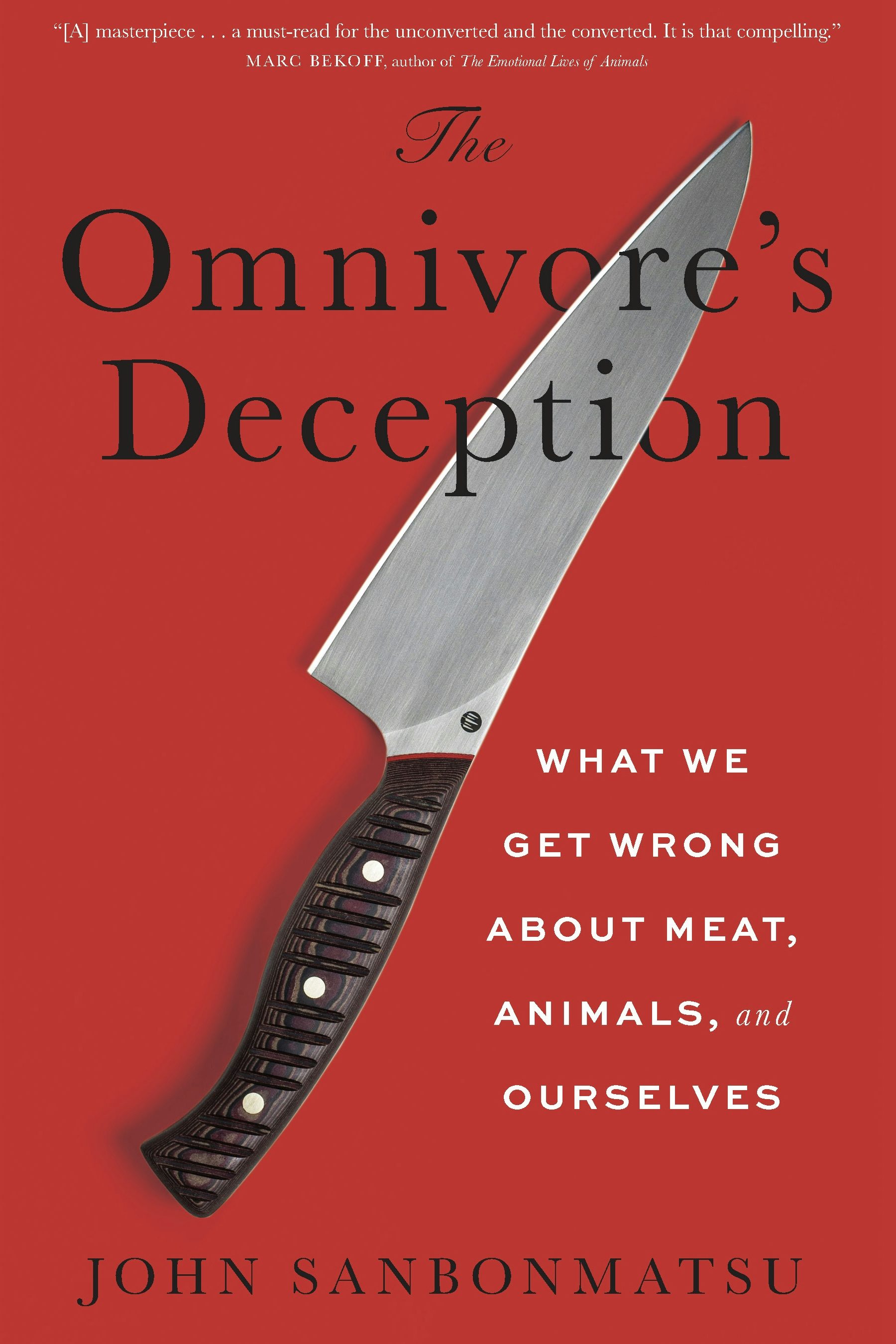
Review of John Sanbonmatsu, The Omnivore’s Deception: What We Get Wrong about Meat, Animals, and Ourselves. NYU Press, 2025. 347 pp. $30.00 (hb). ISBN: 978-1-479-82596-7.
Carol Gigliotti is Professor Emerita at Emily Carr University of Art and Design, Vancouver, BC, Canada.
Email: carolgigliotti@me.com
Humanimalia 16.2 (Summer 2026)
John Sanbonmatsu’s newest book, The Omnivore’s Deception, repeats a joke once told by the late David Foster Wallace: “One fish turns to the other and asks, ‘How’s the water?’ The second fish replies, ‘What is water?’” With that sly bit of humour used to hook the reader, Sanbonmatsu lands a compelling analogy to describe speciesism as the water in which we all swim. The same might be said for what Sanbonmatsu considers to be the other system that pervades our lives: capitalism. As he explains early in the first section of the book, “Like entwined strands of DNA, the two systems form not so much distinct processes as elements of the same total structure of biological annihilation, a double helix encoding the end of terrestrial life” (30). Early in the book, Sanbonmatsu argues that exploiting and killing other animals is morally indefensible and a civilizational error. The problem, though, is that we generally do not recognize it as such. We have organized our societies around slaughtering and butchering animals for food, but we “deceive ourselves that we can go on doing this without harming animals, wrecking the planet’s ecology, or ruining our souls” (2). We are, Sanbonmatsu implies, in a position similar to Foster Wallace’s fish: so accustomed to this dual structure of speciesism and capitalism that the appalling consequences are difficult to grasp and even more difficult to talk about.
The Omnivore’s Deception offers a deeply considered argument for rethinking our entire relationship with other animals. Recent works of animal studies scholarship have also elaborated on the entwined systems of speciesism and capitalism. Among these is Dinesh Wadiwel’s Animals and Capital (2023), in which Wadiwel sets out to provide a new conceptualization of how intensive animal agriculture works within a global system of domination. This interpretation of the cruel realities of life within the specific location of the factory farm identifies how those realities emerge out of our prevailing economic system — capitalism. Wadiwel explains: “My explicit goal in writing the book is to bring together the concerns of two different movements — animal advocates and anti-capitalists — which, as I suggest, are operating on structurally overlapping terrain.” He says that his aim is not to argue philosophically “whether our treatment of animals constitutes a moral wrong”. Instead, he asks us to consult the “many excellent texts in moral philosophy available to address the issues of conscience” surrounding our food systems.1
Though Wadiwel’s approach and style of writing is very different, he is continuing an argument that Sanbonmatsu has long made, from his influential 1989 Z Magazine article2 on why animals should matter to the Left to The Omnivore’s Deception today. The resistance of a majority of the Left to prioritizing animals has, as Will Kymlicka and Sue Donaldson argue, had a dampening effect on the progress of animal liberation’s goals.3 In his most recent book, Wadiwel quotes Sanbonmatsu on the “indifference” that still haunts the Left’s conception of social justice:
[T]he Left with few exceptions has historically viewed human violence towards other beings with indifference. In fact, […] it is one of the ironies of social thought that the views of leftists and rightists converge on the question of animal rights. Both sides affirm the sovereign right of members of Homo sapiens to exploit and kill other living beings as they wish; both view animal liberation as a danger to established human society.4
Wadiwel’s Animals and Capital and Sanbonmatsu’s The Omnivore’s Deception can be seen as two differing but powerful arguments for connecting the problems of speciesism and capitalism. When read together, they work towards a new social equality and economic order built on compassion for all sentient beings.
In The Omnivore’s Deception, Sanbonmatsu tackles what he sees as three modes of deception that need to be recognized if we are to change “the basic ideology around human supremacy and the centrality of animals in the human diet”.5 The first deception involves how the animal food industries successfully mask the violence that is their generating principle. In fact, “every 24 hours, between 3.4 and 6.5 billion animals are killed for food. That comes to a lower-end estimate of 1.2 trillion animals killed every year.”6 Readers’ eyes may drift over these kinds of counts despite, or due to, their staggering content. Sanbonmatsu graphically narrates the reality underlying these statistics, exhaustively linking them to the central mistake of civilization: that all other species are ours to use as we wish. Unless we want to continue this civilizational error, we have no choice but to agree with him when he writes that “we have turned a once thriving world into ash and bone. All in the defense of meat” (38).
But if, as Sanbonmatsu explains, three thousand years of moral arguments against meat-eating has not stopped our continual killing and eating of animals, other kinds of deception must be at play. And The Omnivore’s Deception is especially concerned with a recent trend of apologetics that—exemplified by the work of figures like Michael Pollan, Barbara Kingsolver, and Temple Grandin—has mounted what is now widely used as a defence of meat-eating. This is, for Sanbonmatsu, the second mode of deception. Between 1998 and 2003, Sanbonmatsu writes, vegetarian and vegan products and restaurants were increasingly available across the US. The growing research on climate change had pointed out that the raising and eating of animals was one of its most devastating causes. In 2006, however, Pollan published what became his bestselling book, The Omnivore’s Dilemma. And with that, as Sanbonmatsu observes, “meat suddenly got its game back” (59):
Pollan suddenly became the nation’s most sought-after speaker on food issues, interviewed on TV and radio and in documentaries like Food, Inc., where he was treated as a national sage. Universities and colleges assigned Omnivore’s Dilemma as required reading for incoming students. (63)
For anyone who has been involved in animal rights or liberation thought and action, Sanbonmatsu’s hard-hitting critique of Pollan’s work will be incredibly satisfying. When I was teaching Critical Animal Studies in 2007 in Canada, Pollan’s ideas were constantly popping up in class discussions. Although openness to other ideas is an important component of a healthy classroom, I wish I had had this book then to help me counteract the romantic assumptions that many people had wrongly inhaled when reading it. He details Pollan’s—and locavores like Kingsolver’s—commitment to small-scale farming and its seemingly bucolic answer to corporate agribusiness. Except, of course, that their small farming still ends up with the violent killing of animals for meat. There is no good in “good” meat. As Sanbonmatsu points out, both authors made a point of reporting on the dozens of birds and mammals they killed while researching their books, which underscores their belief that “animals have no value in and of themselves apart from the uses we make of them” (68).
Pollan’s book won high praise for his lyric writing about animal agriculture. In it, he described “one long, beautiful, and utterly convincing proof that in a world where grass can eat sunlight and food animals can eat grass, there is indeed a free lunch.”7 Sanbonmatsu corrects Pollan’s central theme by offering his own lyrical critique: “Far from being a virtuous and self-sustaining cycle, the practice of grazing cows is in fact one of the least efficient and most ecologically damaging ways to satisfy our dietary needs, a wasteful practice requiring massive amounts of water and deforested land” (89). Sanbonmatsu takes no prisoners, therefore, in placing blame on Pollan and his ilk. He lists their contributions to the staggering number of animals killed quoted above, arguing that their work pardons these systems, and thereby encourages millions of meat-eaters to “defend their right to consume other conscious beings after violently ending their lives” (40).
That Sanbonmatsu does all this in language so precise and uncompromising is what makes this, for me, the most significant book to address our planetary crisis since Rachel Carson’s Silent Spring. Like Carson, he encourages the reader to “raise the specter of systemic ecological collapse” (23), but this time in connection with the global meat economy. The Omnivore’s Deception stands as a significant book for critical animal studies not just in theory but in its call for activism in the public realm. “Perhaps the most remarkable thing about this mass violence,” he writes, “is how unremarkable it is taken to be, its very banality serving to confirm its imagined lack of moral or existential significance. […] Whether one animal dies at our hands or a hundred million is seen to make no difference—the lives of the other animals are as weightless and inconsequential as air” (8–9).
There is, though, a more fundamental deception that Sanbonmatsu wants to unearth: that there is not, and cannot be, “humane” meat. It is impossible, he says, to exploit and kill other beings “kindly”: “At the end of the day, the problem is that animals don’t consent to being used and brutalized by us. So long, then, as we choose to exploit and impose our will on them, it will always be necessary for us to wield violent force against them” (279). The idea that animals do not want to be killed is hidden by terms like humane meat. Sanbonmatsu deconstructs this cultural myth upon which not only our human, but much of our social, political, and cultural identity, is based. Animals must thus be recognized as persons, he argues, if we are to change course.
One of the most compelling connections Sanbonmatsu makes in the second section of the book, titled “Lies of Dominion”, concerns the links between reactionary politics and the locavore movement in the United States. Pollan has described those who do not eat meat as haters of tradition, and positions the US’s meat-heavy holiday food as a political vote for consumer freedom (102). If that sounds counterintuitive, so do many arguments from locavore meat-eaters who, as Sanbonmatsu explains, “misapprehended the nature of animal exploitation with the capitalist system, particularly the symbiotic relation between small- and large-scale agriculture” (103). If locavores thought they were supporting decentralized markets, closer farmer consumer bonds, and a more democratic USA, they were actually supporting the growth of multinational corporations who buy their “grass-fed” cows from Brazil, specifically JBS, “the largest beef producer in the world and the single largest driver of destruction of the Amazon—its suppliers are burning down the rainforest to graze cattle” (105).
Sanbonmatsu correlates Pollan’s rationalization that animals do not desire freedom with Aristotle’s arguments that slaves do not desire freedom. Both, he writes, are apologies for exploitation. Pollan, for his part, sees in meat production examples of mutualism and natural symbiosis between species. But as Sanbonmatsu responds, “power is not merely an idea, it is a relation” (114). And that relation, in meat production, is one of domination. He continues throughout the book to catch “meat apologists” like Pollan and Kingsolver, in similar statements that lay bare this and other kinds of contradiction. Comparing human–animal relationships with the histories of slavery and Nazism can be contentious in the wrong hands. Sanbonmatsu’s approach is well-researched, reminding us that slavery itself originated in ancient times and was used for both animals and humans: “This notion, that animals are our natural property, is ancient in origin, and it long served as the basis of slavery, an institution that for thousands of years was the norm throughout much of the ancient world” (110). It was Aristotle, he explains, who defended the slavery of humans. Aristotle believed in the Great Chain of Being that placed humans below the gods and animals below men. He saw social inequality and hierarchy as aspects of nature. One fulfilled one’s place in this system only when being put to use by one’s natural superiors. It was seen as natural for masters to dominate slaves. We also have Aristotle to thank for women’s place on that hierarchy as below men, like slavery, one that also lives on in various forms to this day. Wadiwel, too, dissects the deep roots of the animal’s place beneath that of humans, writing that:
[The] bond between the human who has lost its relation to justice and nonhuman animal life is all too apparent in Aristotle’s discussion of slavery, where the slave is understood as the human who is closer to the animals, as the human animal who has not developed that quality that marks it as a more perfect animal.8
Elsewhere, Sanbonmatsu engages with Sartre’s use of the term “bad faith” to explain the third mode of deception in his list: self-deceit. We know the truth, but we choose to hide that truth from ourselves:
The speciesist […] “knows” in advance of every fact that all animals are “the same”, i.e., inferior. If it is shown that animals use language, it will then be claimed that they can’t use syntax. If it is shown they can use syntax, it will be claimed they lack domain general intelligence. And so on. We move the goal posts to justify our prejudices. And at some level we know it. (210)
We could choose compassion, Sanbonmatsu reminds us, but instead we choose speciesism “and in doing so we choose ourselves, but for the worse” (217).
A major win for this book is Sanbonmatsu’s critique of both Peter Singer’s utilitarianism and Martha Nussbaum’s capability approach to animal rights. Sanbonatsu tells us that Singer’s view that “causing suffering to animals is worse than violently ending their lives” has become “the ‘go to’ argument for Michael Pollan, Temple Grandin, and other leading apologists for the animal system” (256). Nussbaum, in turn, makes the arbitrary decision to exclude fishes from her argument and denies that killing them harms them because they lack what she calls “temporally extended projects” (258). Setting aside the strangely detached quality of that turn of phrase, it is not a wise philosophical approach, nor is it helpful when speaking of justice to base an ethical claim about the killing of animals — of any kind — on their ability to have long-term projects. Sanbonmatsu points to both Singer’s and Nussbaum’s lack of “any meaningful conception of freedom or dignity” (259) in their approaches to human relations with animals. He argues that both resort to what he calls human “‘species right,’ or the right of every human to make violent use of every nonhuman” (259). Sanbonmatsu instead argues against their presumption that we have a “natural” right to do whatever we want with animals.
The last section of the book, “Beyond Meat”, contains answers to the questions posed by a speciesism that is embedded in the capitalist world-system. For the person who has not thought about animals as individuals with qualities such as intelligence, emotion, creativity, and cultural difference, the last chapters of this powerful, immensely important book offer literally hundreds of replies to those who still think that animals are no more than a bundle of instincts. Believe me, there are more than enough people who still do. I believe it is crucial for critical animal studies to continue to address those beliefs. Sanbonmatsu argues: “The spurious distinctions [drawn] between ‘ethical’ and ‘unethical’ forms of animal exploitation, between ‘necessary’ and ‘unnecessary’ violence and suffering, will forever remain distinctions without a difference” (280). We must demand ending not only the killing of animals for meat, but also the hundreds of terrible ways animals are used as nothing more than commodities, as things. Refusing to accept distinctions between reasons for killing animals is a powerful way of revealing those distinctions for the fallacies that they are. Sanbonmatsu reminds us that refusing to accept the killing of animals will also contribute to building a social order that considers all beings of value.
Notes
Dinesh Wadiwel, Animals and Capital (Edinburgh University Press, 2023), vii
John Sanbonmatsu, “Animal Liberation: Should the Left Care?” Z Magazine (October 1989): 101–10.
See Will Kymlicka and Sue Donaldson, “Animal Rights, Multiculturalism, and the Left”, Journal of Social Philosophy 45, no. 1 (2014): 116–35, https://doi.org/10.1111/josp.12047.
John Sanbonmatsu, “Introduction” to Critical Theory and Animal Liberation, ed. John Sanbonmatsu (Rowman & Littlefield, 2011), 13; qtd. in Wadiwel, Animals and Capital, 17–18.
Kim Stallwood, “The Omnivore’s Deception by John Sanbonmatsu: Author Interview”, Kim Stallwood’s Substack, 22 May 2025, https://kimstallwood.substack.com/p/the-omnivores-deception-by-john-sanbonmatsu.
Seth Millstein, “How Many Animals Are Killed for Food Every Day?” Sentient Media 30 July 2024, https://sentientmedia.org/how-many-animals-are-killed-for-food-every-day/
Michael Pollan, The Omnivore’s Dilemma: A Natural History of Four Meals (Penguin, 2006), 219.
Dinesh Joseph Wadiwel, “Three Fragments from a Biopolitical History of Animals: Questions of Body, Soul, and the Body Politic in Homer, Plato, and Aristotle”, Journal for Critical Animal Studies 6, no. 1 (2008): 17–31 (25–26).