So It Is the Old Meat After All
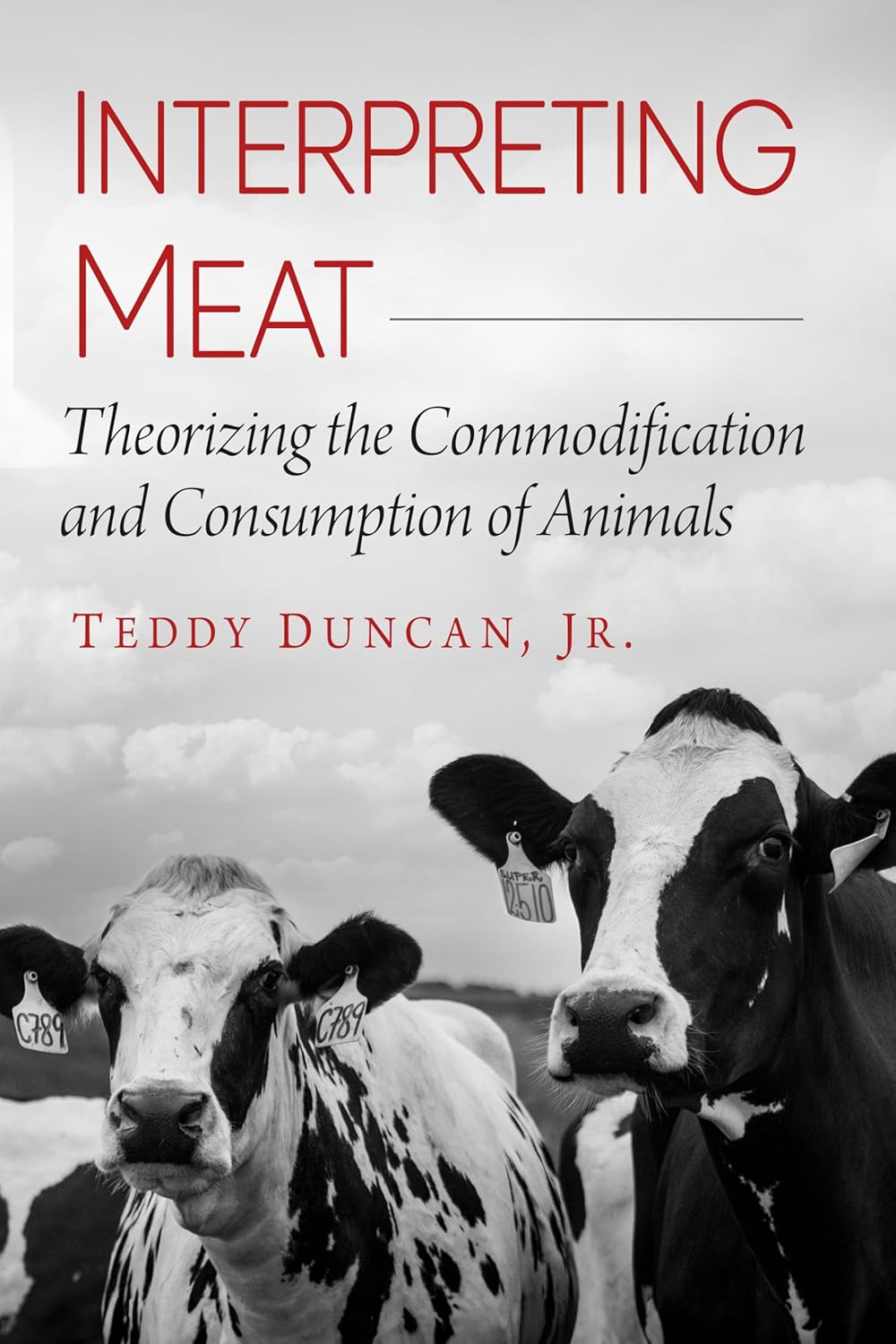
Review of Teddy Duncan, Jr., Interpreting Meat: Theorizing the Commodification and Consumption of Animals. Jefferson, NC: McFarland, 2025. x + 191 pp. $55.00 (pb).
Jamie Redgate is a Tutor in English Literature at the University of Glasgow.
Email: jamie.redgate@glasgow.ac.uk
Humanimalia 16.1 (Winter 2025)
The word “Lacan” should really be somewhere in the title of Teddy Duncan Jr.’s Interpreting Meat: Theorizing the Commodification and Consumption of Animals. Duncan’s admirable ambition is to get back to very first principles in order to theorize the existence of meat. And though he eventually arrives at what he confesses are “banally commonplace” (106) conclusions about meat that others have already made — one thinks of the work of Nick Fiddes or Melanie Joy, though Duncan does not — it’s in his journey towards those conclusions that Duncan successfully brings meat to the Planet Lacan, for the benefit of the scholars who work there. What this book offers to outsiders, however, is less tangible. The real strength of Interpreting Meat may be that, for a reader such as myself who is not very familiar with Lacan, Duncan’s account of the Lacanian “symptom” is so thorough and clearly argued that I now feel like an expert, which is no mean feat. The problem is that I don’t know anything more about meat than I did before I started.
Duncan begins by laying the Marxist foundation of his approach to meat. “Marxism”, Duncan helpfully explains, “is the most comprehensive mode to critically examine a commodity and its relation to the labor that produces it” (41). With that theoretical framework in place, he then works to fit animals inside it. Given that animals “do not suffer from exploitation (as humans do)”, however — rather, exploitation itself is the very “pre-condition of their suffering” (43) — Duncan asks, as Nicole Shukin and Dinesh Wadiwel have done, whether they can ever constitute “workers” in the Marxian model. The fundamental difference between us and them means that we need to adapt our language accordingly. In an exploitative system which untethers animals from what Marx might call their species-being, Duncan argues that they are, in fact, “not Marxian workers; they are Marxian subjects”, whose very “growth and living […] contribute to [their] value and consequently makes living a form of labor” (47). Duncan concludes that this information is “essential to our understanding of the meat-commodity”, not because it is “revelatory” — as he recognizes, anyone who has heard of factory farming knows that the profit-motive has facilitated the increasingly cruel use of animals — but because it has “implications which exceed [the] reality” of factory farming. What excites Duncan, in other words, is what all this means for our own “material and semiotic-discursive practices” (70).
From here, then, Duncan shifts into an account of Slavoj Žižek, Jacques Lacan, and the “symptomology” of the meat-commodity which functions within capitalism as a Lacanian “symptom” (73): that thing which reveals, by its existence, the amorality of the very system that subconsciously produces it. For the meat-eating subject, Duncan writes, “meat is a commodity that requires rationalization or justification — it is not something that is just passively consumed” (77). Because we know, as “a pre-ethical (empirical) fact” (78), that animals are “both object and subject” at the same time (92), meat therefore begs our excuses because it “‘sticks out’ [as] foreign to the ideological space which generated it” (84). Necessarily bound to the lives whose deaths produced it, we nevertheless insist that meat is a lifeless object (which is perhaps to say a deathless object), hence the “foundational anxiety” we experience when we consume it (86). Where Freud believed that the “recognition or interpretation of the symptom — an understanding of the unconscious activity that produces the symptom — could dispel it”, Lacan, on the other hand, “insert[ed] into the discourse the psychoanalytic fact that the subject’s attachment to the symptom through enjoyment inhibits them from truly allowing it to dissolve” (98). Note Duncan’s use of the word “fact” here, and the obviousness (to him) of the correctness of Lacan’s, and subsequently Žižek’s position, that the “apparatus that succeeds in upholding the symptom in the individual (reality-disavowal) is the same mechanism that succeeds in upholding the inter-subjective ideological symptom” (98). The acceptability of meat, in other words, is a fiction we prefer not to dispute, even as we recognize the lie for what it is.
The best concrete example Duncan gives of the meat symptom in the book — in fact the only example he gives that has anything to do with animals — is the 2023 Chick-fil-A advertising campaign which encouraged viewers to “save” the lives of cows by eating chickens instead. As Duncan notes, this is a sort of in-joke which does not explain itself to the viewer, but which nevertheless depends upon the audience’s knowledge that cows “have a preference in not dying” (87), and that “the meat-commodity is reliant on the death of a subject, […] and that all this renders the meat-commodity unlike any other commodity. In short, the consumer recognizes that meat is symptomatic” (88–89). As an example of the complex psychodrama involved in the eating of meat, this is a compelling example: not because it proves that Lacan’s theory of the subconscious is applicable to every consumer, which seems to me disputable, nor indeed that meat is “unlike any other commodity”, since consumption has all sorts of victims, but because it speaks at least to the dynamics at play in the cultural construction of meat, which individual consumers (and, indeed, individual advertisers) may or may not be consciously aware of. For Duncan, however, the fiction of meat is of secondary concern to the story Lacan himself has woven for us.
Though Duncan’s aim is to extrapolate from the example of meat a theory of the “amorality of commodification” (79) at large, it is surprising, in a book titled Interpreting Meat, that Duncan should not draw his other examples from the world of meat’s cultural (or literal) production. Duncan devotes three pages of an already slim book to “the term 9/11”, for example, which is said to represent the “residue of the Real” of that traumatic event (125), instead of making the same point about the Real with the “actual, living, breathing animal[s]” he eventually, though all too briefly, comes to consider (128). Likewise, Duncan’s explication of the Lacanian Other is arrived at through somewhat torturous Oedipal theories of the “desire of the parents becom[ing], unwittingly, the desire of the child through their efforts to be the object of the parent’s desire” (148), instead of what may have been a more relevant example; there are billions of dying others from which he might have taken his pick. Meat, however, is not so much a thing for Duncan to think about as a thing to think with. Very much to his credit, it would be unfair to call this his failing. That Duncan describes Derrida, on the first page, as having explained something “plainly” (5) gives a bad first impression, when Duncan himself gets into the weeds of esoteric debates with admirable clarity. Indeed, the book’s thorough explication from the ground up — Duncan explains to his reader, at one point, that the Old Testament is “the central book to Judeo-Christian Western religion” (6) — could well make it one of the clearest books I have ever read. There is a fundamental tension, however, between the book’s title and its subject, and it reads like a failure of focus when that clear eye keeps looking in what feels like the wrong direction. It is both a quality and a problem of the book that the sentence, “This is not to make any analogical argument between the death of George Floyd (or sneezes) and meat” (76), which out of context might seem absurd to the point of insensitivity, actually makes complete sense after three pages of thorough explication.
Duncan’s book has everything to do with Lacan and very little to do with meat. “To put it simply”, he writes, “[m]y book is not strictly about animals (which, to me, seems impossible)” (3). Setting himself against the kind of animal studies characterized by the work of Cary Wolfe, which “intend[s] to obscure the animal–human distinction by acknowledging that humans are a part of animality” (9), Duncan insists instead on the difference, and on the need to clarify, articulate, and unpack our private language games. Duncan agrees with Wolfe that the human is a “fantasy figure” and that we have, historically, pointed to an “X” (5) which marks the difference between us and them. Duncan disagrees, however, with the conclusion that “the category of humanity itself is false” (11). After all, it is only human beings who read and need Lacan. Likewise, against Matthew Calarco’s theory of indistinction — that we should try to reconceptualize ourselves as animals among others — Duncan argues instead that we should focus on “animal (and human) specificity” (14): we all have our X’s, and we’re stuck with them. Though I think Wolfe and Calarco are somewhat strawmanned here, I am sympathetic to the view that the boundary between us and animals remains impenetrable, and indeed that there is something unique about us that we should hold onto. Though meat itself might seem to connect us with animals, given that our flesh is also edible (as Val Plumwood, Julia Kristeva, Gilles Deleuze, and others remind us), our mass consumption of the meat commodity is, as Duncan implies, also a defining feature of mankind: the only industrial-slaughtering animal.
The irony here is that even as Duncan insists on human solidarity, he speaks a completely different language to other animal studies scholars, siloing himself inside his own X: critically speaking, he and I are practically different species. Duncan notes in an aside that he intends to avoid using well-established terms such as speciesism in order to “retain control of [his own] discourse” (26), presumably because Lacan did not use the term either. Indeed, Duncan’s issue with Wolfe seems largely to stem from the fact that Wolfe is “generally indicative of animal studies [sic] dismissal and neglect of psychoanalytic (and specifically Lacanian) theory” (140). One cannot help but wonder, however, whether this really constitutes a dismissal, if Lacan is simply not as helpful as Duncan believes he is. It is notable that Duncan is extremely generous to theorists he agrees with, especially Žižek, while at the same time he is somewhat ungenerous to non-Lacanian critics, at one point taking Christopher Lasch to task for offering us little more than what Lacan already, apparently, provides (164). Duncan seems completely surprised that others haven’t incorporated Lacan’s extraordinary insights into their own work. It is to Duncan’s credit, and yet also to the detriment of his argument, that he manages very well to communicate from his X to mine. He does not, however, make much space for other X’s in his.
A major thread in the book is Duncan’s disagreement with the “dreaded comparison”, which sees an equivalence between our treatment of animals and the Holocaust. Duncan’s argument (based on the assumption that animals and humans are completely different) is really with analogical thinking more broadly. We are wrong, he suggests, to “obscure the animal–human distinction” (9), and only when we recognize that error will we also understand that the dreaded comparison has “no real utility in understanding animal slaughter” (48). Isaac Bashevis Singer famously wrote that “in their behavior toward creatures, all men were Nazis”,1 but how can meat-eaters be Nazis, Duncan asks, when they lack the “semantic content of ‘Nazi’ — a belief in eugenics, antisemitism, racism, and the Third Reich” (33)? Duncan’s point that we should not rely on “reference to humanity as the beginning of all ethical discourse” (33) is important (and, I think, one with which most animal studies scholarship would agree, at least to some extent). Yet in making this point he neglects what I think is the actual intention behind such a comparison. While it’s certainly literally true that both factory farming and the Holocaust are “incomprehensibly torturous — but both are also incomprehensibly different” (40), they do not share nothing. The allusion to Nazis is not about the establishment of a literal Reich, but rather about Nazis as a basic reference point (we would hope, in civil discourse) not just for evil, but for evil committed by otherwise ordinary people. Likewise, the point of Marjorie Spiegel’s appeal to the dreaded comparison between our treatment of animals and slavery is that ordinary people (like those today to whom we might make the comparison) could so easily have been “master”,2 complicit in something they now recognize as inherently morally wrong. Whether making this comparison will actually convince anyone of the horrors of industrialized animal agriculture is another question, though Lacan could well have helped us there: the offence taken to the comparison, dare I say, speaks to some truth in it.
Duncan’s literal-mindedness on this point fails to account for the value of imaginative thinking. Interpreting Meat is less strong when it comes to the readings of fiction and poetry, but if I may volunteer my own X, it would be that human beings are, as the cliché goes, the story-telling animal, and in order to win the argument (if that is our goal) we may need to think in these terms: to fictionalize, to romanticize, and to imagine our way over what may always be an impassible barrier between our X and theirs. In a revealing note, Duncan celebrates Duchamp’s urinal for embodying a radical Lacanian gesture when it connected the hallowed halls of the museum to the excrement that underpins our civilization (7). But was it not also simply shit art? Meat is a fiction, and an extraordinarily effective one at that, not least because it has convinced a lot of people that it isn’t one. Pointing out what most of us cannot see is vital. But if we care about animals then what we are going to have to do is tell a more compelling story. That story needs a language. Reading Duncan’s detailed account of Lacan’s hermeneutics of suspicion and the utter inaccessibility of the Real — apparently “Lacan reminded his students over and over to stop trying to understand everything” (157) — one does start to wonder how many actual animals died while all this was being puzzled out. This is, of course, to be terribly ungenerous on my part, when Duncan is explicit about his approach being “theoretical, rather than purely empirical-ethical” (23). At the same time, Duncan’s refusal to commit to an ethic seems somewhat incredible given the great work he does to lay the foundation for other Lacanians to join the fight. “I am not here to impugn someone’s dietary habits” (64), he writes. Nor is he “making any ethical judgements” (79). “The purpose”, as he puts it, “is not to present an argument but rather to present a reading of meat’s text” (26).
This is not, I would argue, how reading actually works. As animal studies often reminds us, there is no reading without a body in the room, somewhere, reading, and there is therefore no reading without feeling. Duncan may claim that “you can never ‘truly’ articulate love or pain due to the alienating nature of the signifier” (128), but animals may need a little more than that. Duncan’s argument that what we need is for the subject to “come to realize that their desire for meat does not issue from a desire for the meat-commodity as an object, but rather emanates from the concealed, silent cause (of the Other’s desire)” (160), may well convince every Lacanian out there. I hope it does. But without an appeal to our simpler feelings, to our humanity and to the humanity (in that messy, analogical way) of animals, good luck.
As William Faulkner once wrote:
So it is the old meat after all, no matter how old. Because if memory exists outside of the flesh it won’t be memory because it won’t know what it remembers […]. Yes he thought Between grief and nothing I will take grief.3
Lacan may seem to lift us outside of the flesh, and to put up a wall of words between us and animals that neither we nor they can surmount. Ultimately, however, we reside in the same meat they do, and there where we find them we may also find love and the grief that attends the discovery. If a fiction writer knows one thing it is that language elevates us. If they know another thing, whether consciously or not, it is this: it may be our X that we can wish to see past the X’s we put up.
Notes
Isaac Bashevis Singer, Enemies: A Love Story, trans. by Aliza Shevrin and Elizabeth Shub (London: Penguin, 2012), 208.
Marjorie Spiegel, The Dreaded Comparison: Human and Animal Slavery (New York: Mirror Books, 1996), 103.
William Faulkner, The Wild Palms (London: Vintage, 2000), 273.