Love in the Disabilocene
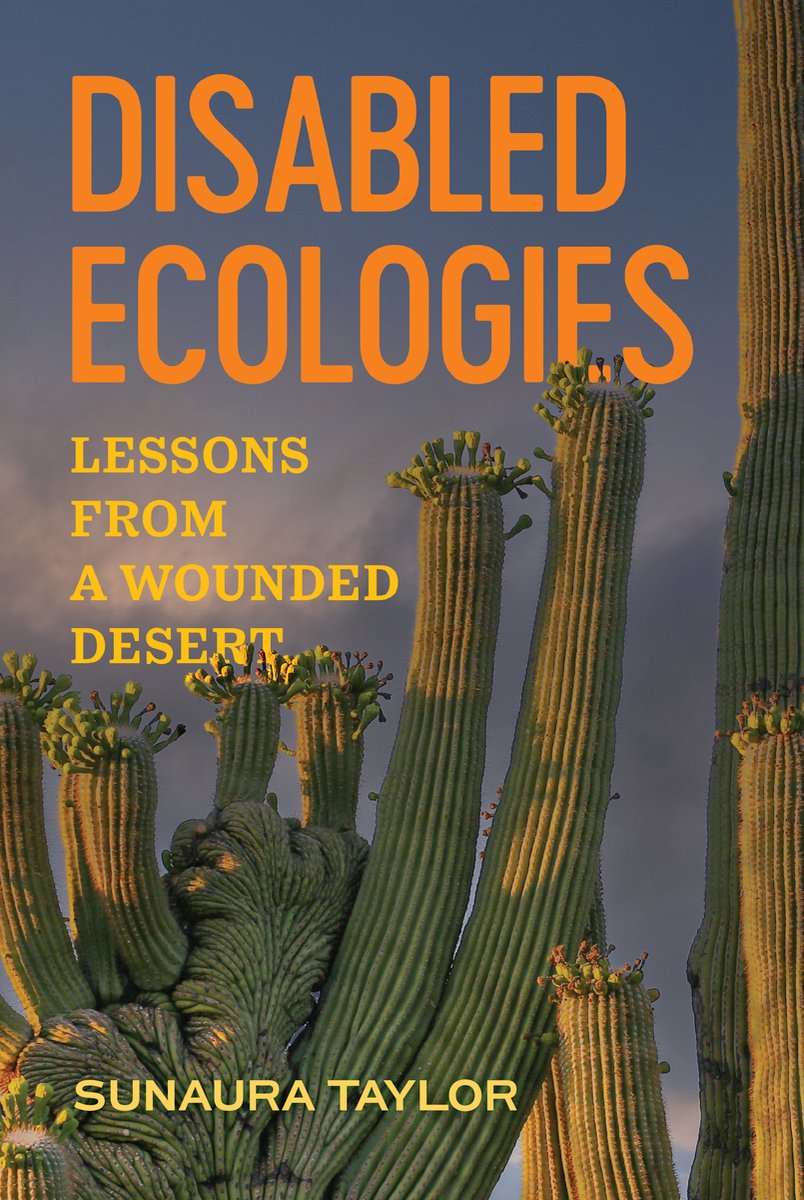
Review of Sunaura Taylor, Disabled Ecologies: Lessons from a Wounded Desert. Oakland: University of California Press, 2024. xviii + 348 pp. 27 b/w illus., 5 b/w maps. $24.95 (hb).
Chloë Taylor is Professor of Women’s and Gender Studies at the University of Alberta, Canada.
Email: chloe3@ualberta.ca
Humanimalia 16.1 (Winter 2025)
Sunaura Taylor’s first book, Beasts of Burden: Animal and Disability Liberation (2017), has been influential in the field of critical animal studies, providing a wide-ranging introduction to the ways that animal and disability oppression, and liberation, are entangled. Her new book, Disabled Ecologies: Lessons from a Wounded Desert (2024), is similarly groundbreaking in its thoroughgoing demonstration of the political links between environmental harms and multispecies disablement, and of the necessity for bridge-building and solidarity among environmental and disability scholarship and activist movements. Disabled Ecologies is structured by alternating keyword entries and chapters and also includes generous footnotes that Taylor analogizes to an aquifer: while the main text of the book is surface water, the notes are an underlying layer of groundwater-bearing material, the “vast network of relations and contexts that have allowed for what is written above to emerge to the surface” (5). As Taylor explains, her use of footnotes makes the book accessible in two ways. First, it allows the surface water to “flow more easily” for a variety of readers (6). Second, footnotes are easier to access than endnotes for people for whom physically flipping back and forth through pages is difficult.1
The Introduction to Disabled Ecologies is a tour de force, not only situating the author and the site of her study but also providing an overview of Taylor’s theoretical framework, including her conceptualization of disability as ecological. While the medical model of disability individualizes it as a problem of particular bodies and minds, and the social model takes a wider view by situating these bodies and minds in societies and built environments that oppress and exclude them, Taylor uses the case of military pollution in Tucson, Arizona to provide an even more expansive view of disability as a multispecies network connecting human and more-than-human worlds. Taylor focuses primarily on the impacts of the pollution in Tucson’s southside, demonstrating their embeddedness in local legacies of racism, colonialism, class oppression, ecocide, and more-than-human animal disablement and death. Taylor also underscores, though, that because the pollution derived from the US defence industry’s preparations to bomb North Korea, a transnational disablement is also an inextricable part of this history as well (7, 278). As Taylor explains, chemicals such as trichloroethylene (TCE), used in the 1950s to clean military jets destined to disable and destroy humans, animals, plants, and ecosystems in Korea, were dumped in unlined lagoons outside Tucson. These lagoons overflowed into the desert and seeped into private and municipal wells as well as Tucson’s regional aquifer. Early signs of the pollution included the sickening and death of nearby plants and wild animals who drank from the lagoons, spreading to humans and cattle on the San Xavier Reservation of the Tohono O’odham Nation, and entering city households in a working class, mostly Mexican American neighbourhood where houseplants and companion animals died, humans began experiencing high rates of illnesses such as rare cancers and lupus, and babies, including Taylor, were born with disabilities.
Official responses to this multispecies network of disablement were racist. When several white families complained about contaminated wells in the early 1950s, the city settled with them “quickly and quietly” (41). In contrast, city officials ignored early alerts to the pollution from members of the Tohono O’odham Nation, and Mexican American residents of Tucson’s southside were told by city representatives that they were ill and dying not due to contaminated water but because of their culture, lifestyle, and genetics (10). Although the concept of environmental racism was not yet available to them, Taylor describes how a movement of activists emerged in the impacted community that articulated the connections between racism and environmental harms (10). To our understanding of environmental racism, Taylor adds the concept of “ableist ecologies” to describe the view that some groups of people and ecosystems are dispensable (25). The ableist ecological worldview accepts “wastelanding” or “sacrifice zones” where the impairment and displacement of animals, plants, and bodies of water that make up ecosystems — and of the often racialized and impoverished humans who live in, near, or otherwise rely on those ecosystems — are deemed “inevitable to progress” (25). As Taylor highlights, ableist ecologies are not only entanglements of white and human supremacy and ableism but also of capitalism and colonialism, in which nature, animals, and certain humans are considered mere resources for exploitation.
Taylor observes that “environmental destruction is a story of disablement” (5). Disability is everywhere in environmental activism and scholarship because, as in the case of Tucson, it is often situations of disabling pollution that give rise to environmental activism and legislation. Expanding on the idea of an “environmentalism of the poor”, introduced by Catalan ecological economist Joan Martínez-Alier and Indian historian Ramachandra Guha to describe the political resistance of impoverished people to environmental harms that disproportionately impact them, Taylor calls this activism an “environmentalism of the injured” (25).2 Humans are injured in environments that are themselves injured, and Taylor observes that the language of impairment, so central to disability studies and activism, is also widely used in environmental literature to describe ecologies, such as “impaired waters” (94). Taylor argues that we live in a time of “mass ecological disablement” (5), a period in which ecologies are being impaired in unprecedented ways and at unprecedented rates. And yet, disability is rarely politically thematized in environmental activism and scholarship. Rather, because environmental pollution causes illness, disability, and death primarily in areas inhabited by poor people and people of colour, disability is folded into arguments about the environmentalism of the poor and environmental racism. In other words, disability is nearly always understood in environmental justice discourses as evidence of classism and racism rather than as a form of oppression in its own right, and rarely is it seen as something other than a harm, for instance a form of expertise and source of ethical insight.
In contrast, Taylor centres disability in her study, underscoring the ways that animals and ecosystems have been disabled by Tucson’s military pollution. Just as disability activists and scholars have demonstrated that disability is more than a symptom of injustice and may even be a source of pride, Taylor stresses that disability can be explored in environmental studies and activism not only as a negative impact of pollution but also as a resource for resisting, responding ethically to, and learning to flourish in the aftermath of environmental injury. Central to this claim is Taylor’s argument that disability communities, activism, and scholarship provide us with an ethics of non-abandonment, “a refusal to abandon those who have been harmed” (6), and examples of living well with illnesses and injuries. In the case of the disablement of Tucson’s desert ecology and the powerful environmental activist movement to which it gave rise, Taylor tells a story not only of suffering and death but of “alternative modes of connection, solidarity, and resistance” (7), demonstrating how disability has played a “generative role […] in shaping ecological thought” (250). While Taylor’s mother drank Tucson’s contaminated water while pregnant with her, her family would leave the southside, and later the state, not long after her birth (58). To write Disabled Ecologies, however, Taylor returned to the disabled ecology of Arizona, writing of the “pollution I came to the desert to be reunited with” (5) and her feeling of “solidarity” (3) with the water that came out of her tap there.
Given the pervasiveness of environmental disablement to the human and more-than-human world, Taylor suggests that we might speak of our current epoch as the Disabilocene or Age of Disability (29). The fact that she is the first to have proposed such a moniker after a decade-long debate about (re)naming the Anthropocene underscores her argument that disability is rarely explicitly thematized in environmental studies, despite its pervasiveness as instigator of environmentalist action and “cautionary tale” of what will happen if we do not protect the environment. Taylor is clear that the concept of the Disabilocene is not intended to displace names such as White (M)Anthropocene or Capitalocene,3 but should rather be thought with them (29). Unlike these other terms, however, Disabilocene stresses the impacts of the current environmental crisis rather than its causes, and in this sense has more in common with neologisms such as feminist geologist Jill Schneidermann’s Elachistocene, which emphasizes the current mass extinction event.4 Since Taylor underscores that disability is not just “evidence of crisis” but also “of connection”, and is not just “the consequence of injustice, but […] also the propeller of justice” (251), the Disabilocene can simultaneously be understood as an aspirational concept, like Donna Haraway’s Chthulucene and (pl)anthropologist Natasha Myers’s Planthropocene.5 We see this aspirational aspect when Taylor explains that naming the Disabilocene is “a way of grappling with mass disablement — not only to resist the violent systems that disable humans and ecosystems, but also to ask: How do we make life livable and vibrant for organisms living with disablement? How do we challenge ableist ecologies that attempt to abandon? How can we learn to live with disablement in ways that create both resistance and flourishing?” (30).
The book’s five paired keywords and chapters explore the history of military pollution, environmental racism, and environmental activism in Tucson between the 1950s and today. The first keyword is “Ecology”, which Taylor explains is etymologically linked to the concept of “home”. For this keyword, she describes being invited into the home of Henry and Alicia Vega, now elderly residents in Tucson’s southside, who make connections between themselves, Taylor, the southside community, and Mother Earth.
The “Ecology” keyword is followed by Chapter 1, “Desert Solidarity”, which recounts the reckless dumping of an estimated 1,250,000 gallons of toxic wastewater per week into ten acres of unlined lagoons outside Tucson in the 1960s and 70s, first to prepare aircraft for the Korean war and later for weapons manufacturing, until in the 1980s the city could no longer ignore the situation and began to shut wells even while denying that any humans or wildlife had been harmed. As Taylor explains, in the 1980s a series of articles appeared about the pollution and its health impacts, and activists formed Tucsonans for a Clean Environment — the acronym for which, TCE, is the same as the primary toxic chemical that poisoned Tucson’s water for decades. Tucsonans for a Clean Environment drew attention to the intersections between environmental harm, racism, and health, and successfully legislated for remediation of the contaminated water by the late 80s and 90s. The area was named a Superfund site and treatment facilities were built to remove hundreds of thousands of pounds of chemicals from the water and soil. Chapter 1 includes methodological reflections on Taylor’s role as a social scientist with ties to but who is also outside of the community she is researching. Finally, Taylor concludes this chapter by exploring her feelings of solidarity not just with the southside organizers whose lives, like her own, have been shaped by Tucson’s history of pollution, but also with the landscape itself and the aquifer “beneath [her] wheels” (65) – a phrase she will return to in the book’s final sentence (287). Expanding on this sense of solidarity with the aquifer, Taylor describes having “taken a bit of the landscape with [her] in the form of [her] body” (72), and situates the kind of nature writing in which she is engaging within the overwhelming ablebodiedness of nature writing generally.
The second keyword entry in the book, “Aquifer”, chronicles Taylor’s attempt to grasp the nature of aquifers, including her conversation with a geohydrologist from the United States Geological Survey. As she observes, aquifers are difficult to comprehend as they are so “deeply inaccessible to us” (76), being “not visible, and, importantly, not ‘navigable’, existing as they do in the deep underworld” (78). Working through likenesses such as a bathtub full of rocks and an unevenly iced layer cake, Taylor explains that aquifers contain “unfathomable amounts of ‘fossilized’ groundwater, literally thousands of years old” (78), even in regions such as deserts. Over her years living in Tucson as an adult, Taylor recounts awakening “to this great pleasure and mystery” and feeling a “crip intimacy” with Tucson’s aquifer (79).
Chapter 2, “Impaired Landscapes”, continues to focus on Tucson’s aquifer and the larger ecosystem of which it is a part. Taylor explains that members of the Tohono O’odham Nation and their ancestors understood that surface water (the Santa Cruz River), groundwater (the water in the aquifer), and rainwater needed to touch. For thousands of years they were able to harvest rain and irrigate groundwater sustainably, such that when European settlers arrived they saw lush fields of crops and the Santa Cruz River lined with trees. Once Europeans settled in the region, however, and acted upon their understanding of water as a resource to be exploited, the aquifer was rapidly depleted by ranching, agriculture, defence, and mining operations (88) until the Santa Cruz River ran dry much of the year. Thus, even before the aquifer was contaminated by military pollution, it was impaired in that it was too depleted to reach the surface water. The nearby Sonoyta aquifer, also on Tohono O’odham land, was also exhausted, and most recently was sucked dry to mix cement for Trump’s border wall (92). As a result, many species of animals who relied on springs from this aquifer, some of them endangered, became further imperilled. While settler ecologies impair ecosystems and then abandon them when they are no longer “productive” (112), along with the humans and other animals who are a part of or depend on them, Taylor contrasts this with the ethical insights of both Indigenous and disability communities. She cites Nishnaabeg scholar Leanne Betasamosake Simpson who argues that one should no more abandon impaired bodies of water than one’s sick mother (100), and disability activists who fight against the abandonment of disabled people during no-longer-so-natural disasters (101). An example of this ethics of non-abandonment is the long struggle on the part of the Tohono O’odham that resulted in the 1982 Southern Arizona Water Rights Settlement. As a result, the section of the Santa Cruz River that lies within the San Xavier Reservation flows year round again (117), enabling a return of plants and wildlife to its banks. Similarly, although they have not drunk water from this source for decades, Tucson’s Mexican American community has not abandoned their aquifer, but continues to fight for its protection and the restoration of its health (118).
An “Interlude”, titled “Speculative Aquifers”, follows Chapter 2, and includes Taylor’s artistic depictions of aquifers. Her six watercolour paintings and pen and ink drawing document her process of coming to understand how these subterranean ecosystems work, and in one of them Taylor conveys her crip identification with the aquifer by depicting dozens of her own arms and hands reaching out of the groundwater towards the surface water above (127). These arms and hands invoke the groundwater’s attempt to touch the surface water, and their inability to do so due to their environmental impairment. In interviews, Taylor has described how she “fell in love” with the aquifer, expressing her pleasure and sense of intimacy with Tucson’s subterranean ecosystem.6
The third keyword of the book is “Disability” and is followed by Chapter 3, “What Happened to You? (And Can You Prove It?)”. In these sections of the book, Taylor discusses the obtrusive expectation that disabled people will provide even strangers with “origin stories” or accounts of how they became disabled (129). Yet Taylor observes that when disability originates not in a congenital condition or apolitical accident but political violence such as pollution or war, speaking about this origin is a form of political expression that the powerful attempt to suppress. In these cases, an invitation to speak about how one became disabled may be desired, as it acknowledges that an injustice took place. Indeed, Taylor compellingly argues that refusing to provide origin stories can mean erasing “the undeniable relationship between disability and capitalist exploitation, colonialism, racism, war, and environmental destruction”, and that “disability studies’ long tradition of avoiding conversations of genesis has perhaps been a large part of why the field […] has had a difficult time developing anti-racist, transnational, and anticolonial conversations” (181). When stories of disability caused by political violence are told, however, Taylor observes that they are regularly met with the question, “Can you prove it?”, by states and industries that deny evidence and responsibility. Chapter 3 then summarizes decades of evidence proving that it was indeed military pollution that caused mass disablement to human and more-than-human communities in and around Tucson and that it was perpetrated by the military industry knowingly.
The fourth keyword of the book is “Treatment”, a word that is used to refer to remediation of both environmental pollution and medical conditions. Taylor’s argument is that ecosystem and human health are inseparable and so should be the ways we care for and protect them. What we need, then, is a “multispecies universal health care” (199), and in Chapter 4 Taylor demonstrates that this was and continues to be the political vision of Tucson’s southside activists, and is also characteristic of Indigenous philosophies of health (234). In contrast, Taylor shows how, since the 1970s, US governmental agencies responsible for environmental and human health were increasingly severed, and health studies (for instance in oncology) have focused on genetic rather than environmental factors (220). In concluding the chapter, Taylor considers how the discipline of One Health is again demonstrating the intrinsic connections between human and more-than-human health, albeit primarily in response to zoonoses and in woefully depoliticized ways (236).
The fifth and final keyword of Disabled Ecologies, “Environmentalism”, and Chapter 5, “Environmentalism of the Injured”, contrast mainstream environmental activism with “injury environmentalism” (245) or the environmentalism of the injured. Historically, Taylor shows, movements to preserve and protect wilderness areas have been strongly invested in colonialism and eugenics (246). Indigenous peoples were removed from their lands for the creation of National Parks, which served as the recreational sites and hunting grounds for able-bodied, middle-class white people. The legacy of “eugenics environmentalism” (275) continued throughout the twentieth century, with mainstream environmental organizations viewing disability as the “antithesis” of environmental goals and demonstrating little interest in conversations about environmental racism and the environmentalism of the poor (274). In the case of Arizona in the late twentieth century, for instance, mainstream environmental organizations were concerned with protecting saguaros from golf course development but took little interest in and even appeared ignorant of what was happening in Tucson’s southside (244). Taylor contrasts this with the environmentalism of the injured, again taking the example of the environmental justice struggles of Tucsonans for a Clean Environment. Taylor concludes this chapter by suggesting that contemporary environmental movements are increasingly coalitional, with “an environmentalism of solidarity overtaking the old guard” (273). Taylor’s own book makes a vital contribution to this coalition building, providing a rich language for thinking about disability, environmental, and multispecies justice together.
In closing, I would like to consider Cal Flyn’s evocative study, Islands of Abandonment: Nature Rebounding in the Posthuman Landscape, in light of Taylor’s ethics of non-abandonment.7 Both Taylor and Flyn provide studies of landscapes devastated by pollution, and both authors use the language of abandonment. They reach seemingly divergent ethical conclusions, however, with Taylor stressing the inseparability of human and ecosystem health and the need for coalitional politics, while Flyn emphasizes how even the most impaired ecosystems are better off without us. For Taylor, we should no more abandon landscapes that have been impaired than we should abandon disabled humans in disaster zones, but we must radically change the dominant ways in which many humans live in or relate to these landscapes. In contrast, for Flyn the abandonment of landscapes by humans is precisely what might yet avert a Sixth Extinction and reverse the climate change trajectory that we are on.
In each chapter of her book, Flyn explores a place that human society has already abandoned, in many cases only after polluting industries, wars, and nuclear disasters have left them so contaminated, or so saturated with chemical and other weapons, that the human communities that once lived there were obliged to leave. Flyn’s understanding of abandonment is not just that humans have physically left, but that, to the extent that this is still possible, they have left the place alone. In Flyn’s book, such abandonment, although done for the sake of humans and not that of nature, appears invariably to have been the best thing that humans could have done for these ecosystems. Islands of Abandonment documents that, however unforgiveable and tragic the damage that industries and warmongers have inflicted upon these areas, in the absence of human interference, nature has “rebounded” to an astonishing degree. In what Flyn is careful to call “reprieves” rather than “pardons”, she describes rapid reforestation and refaunation in “no man’s lands”, with animals once endangered or not seen in the area for a century returning, even when regularly blown up by landmines. She reports on extraordinary instances of phytoremediation, with hyperaccumulating plants removing arsenic and heavy metals from soil in post-conflict zones (198), and animals living with radiation and chemical pollutants in their environments and bodies — disabled but surviving and even thriving in numbers greater than when they had had to co-exist with humans.
In the area of Chernobyl, songbirds have cataracts and swallows have albinism and tumours, and animals, plants, fungi, and berries are all too toxic for human consumption, but they are still able to live, their radioactivity keeping humans at bay in a way that has transformed the area into an ironically safe haven for more-than-human life (105). As Flyn writes, if not for every individual animal, for ecosystems as wholes “the benefits of the absence of humans far outweigh the harm” of living with long-term radiation exposure (103). Flyn thus sees abandonment as “rewilding in a very pure sense, as humans draw back and nature reclaims what once was hers”, allowing for a “fresh dawn of a new wild” in which “nature has been allowed to work unfettered, providing invaluable insight into the wisdom of environments in flux” (5). As Flyn describes them, feral ecosystems might serve as more-than-human examples of what Taylor, citing disability activist Harriet McBryde Johnson, calls “the undeniable reality of disabled lives well lived” (33).
While several of the spaces Flyn explores have been deemed uninhabitable by governments and some are illegal to enter, in almost every instance she discovers that at least a few humans are still eking out an existence there. In some cases, Flyn finds that humans have remained, or set up camp, in “no go zones” because they have few other options, but in other cases they have chosen to live in impaired landscapes because they consider them home. As for the residents of Tucson’s southside and other notoriously contaminated areas where property values plummeted in the wake of pollution, not everyone is able or wishes to abandon their homes in the wake of ecological impairment. These might be examples of what Taylor calls as “an ethics of living with, of resisting abandonment” (29), and yet, in Flyn’s book, it seems to be a good thing when this ethics is acted upon only by a very few.
Significantly, in Flyn’s study this is true even when human intervention is intended to be ecologically beneficial. In the case of a former mining region in Scotland, for example, Flyn shows that animals and plants are more likely to prosper on the massive slag heaps left behind by the shale oil extraction industry when they are left alone by humans than when scientists attempt to restore them (33–34). Similarly, and fully aware of the havoc that introduced species can wreak in a minority of instances, Flyn suggests that it may be best to abandon ecosystems to already introduced newcomers, allowing old and new residents to develop “novel ways of co-existing” on their own, rather than for conservationists to intervene in usually futile and damaging attempts to recreate lost ecosystems (204). Even when the intentions of humans are good, Flyn urges us to recognize “the benefits of sometimes surrendering control” (324).
Flyn and Taylor are likely less at odds than the above account would suggest, with Flyn “for” and Taylor “against” abandonment. Flyn focuses on the afterlives of abandonments that occurred decades ago rather than considering what the most ethical course of action might have been in the moment of crisis, and likely she would not categorically oppose humans assisting animals in disaster zones or removing contaminants from water and soil. Likewise, Taylor’s ethics of non-abandonment is not generalized to suggest that humans should always intervene in every ecosystem on earth. Nonetheless the two books leave the reader with varied levels of faith in environmental interventions by humans, and different senses of hope. Flyn’s accounts of nature rebounding even in areas where humans have done their worst provides comfort in the knowledge that life on earth will survive humans, especially if our extinction comes sooner rather than later, but it leaves readers with a dark perception of humans as inherently detrimental to their environments. Like earth scientists Simon Lewis and Mark Maslin, Flyn discusses how, prior to 1492, even Indigenous peoples in the Americas had significantly impacted their environments through extensive deforestation for the purposes of agriculture, and that the apocalypse caused by European diseases, like the earlier waves of Black Death in Europe, resulted in extensive reforestation that caused a temporary cooling of the planet (87).8 As Flyn describes, European diseases spread across the Americas more rapidly than settlers themselves, such that many of the landscapes Europeans encountered and perceived as “arcadian dreamscapes” and “forests primeval” were, in fact, other examples of nature rebounding in recently posthumanized landscapes.
Although it is clear that pre-contact Indigenous peoples had vanishingly small environmental footprints compared to white settlers (then and exponentially more so today), Flyn’s book suggests that ecosystems are almost always better off without humans. In contrast, Taylor’s discussion of the Tohono O’odham and their ancestors the Hohokam, who existed sustainably in their ecosystem for millennia (88), and of Tucsonans for a Clean Environment’s successful campaign to make the US government remove vast quantities of toxic chemicals from the aquifer and land, is more fundamentally hopeful, allowing for the possibility of ecosystems “living well” despite, and in some cases even thanks to, humans not abandoning them.
Notes
Clayton Jarrard, host, New Books in Environmental Studies, podcast, “Sunaura Taylor, Disabled Ecologies: Lessons from a Wounded Desert”, New Books Network, 21 May 2024, 9:30–11:30, https://newbooksnetwork.com/disabled-ecologies.
Ramachandra Guha and Joan Martínez-Alier, Varieties of Environmentalism: Essays North and South (London: Routledge, 1997).
For White (M)Anthropocene, see Giovanna Di Chiro, “Welcome to the White (M)Anthropocene? A Feminist-Environmentalist Critique”, in Routledge Handbook of Gender and Environment, ed. Sherilyn MacGregor (London: Routledge, 2017), 487–505. For Capitalocene, see Anthropocene or Capitalocene? Nature, History, and the Crisis of Capitalism, ed. Jason Moore (Oakland: PM Press, 2016).
Feminist Geologist Jill Schneiderman coined the concept of Elachistocene in a 2014 blog post: “The Elachistocene Epoch of the Chthulugene Period of the Ecozoic Era”, earthdharma.org, 26 November 2014, https://earthdharma.org/2014/11/26/the-elachistocene-epoch-of-the-chthulugene-period-of-the-ecozoic-era/.
For Chthulucene, see Donna Haraway, Staying with the Trouble: Making Kin in the Chthulucene (Durham, NC: Duke University Press, 2016). For Planthropocene, see Meredith Evans, “Becoming Sensor in the Planthroposcene: An Interview with Natasha Myers”, Fieldsights, 9 July 2020, https://culanth.org/fieldsights/becoming-sensor-an-interview-with-natasha-myers.
Mallika Nocco, Faith Kearns, and Sam Sandoval, hosts, Water Talk, podcast, season 5, episode 64, “Disabled Groundwater”, 13 December 2024, https://www.watertalkpodcast.com/episodes/episode-64 (25:05).
Cal Flyn, Islands of Abandonment: Nature Rebounding in the Posthuman Landscape (New York: Penguin Random House, 2021).
Simon L. Lewis and Mark A. Maslin, “Defining the Anthropocene,” Nature no. 519 (2015): 171–180. https://doi.org/10.1038/nature14258.