Human–Animal Relations in a Minefield
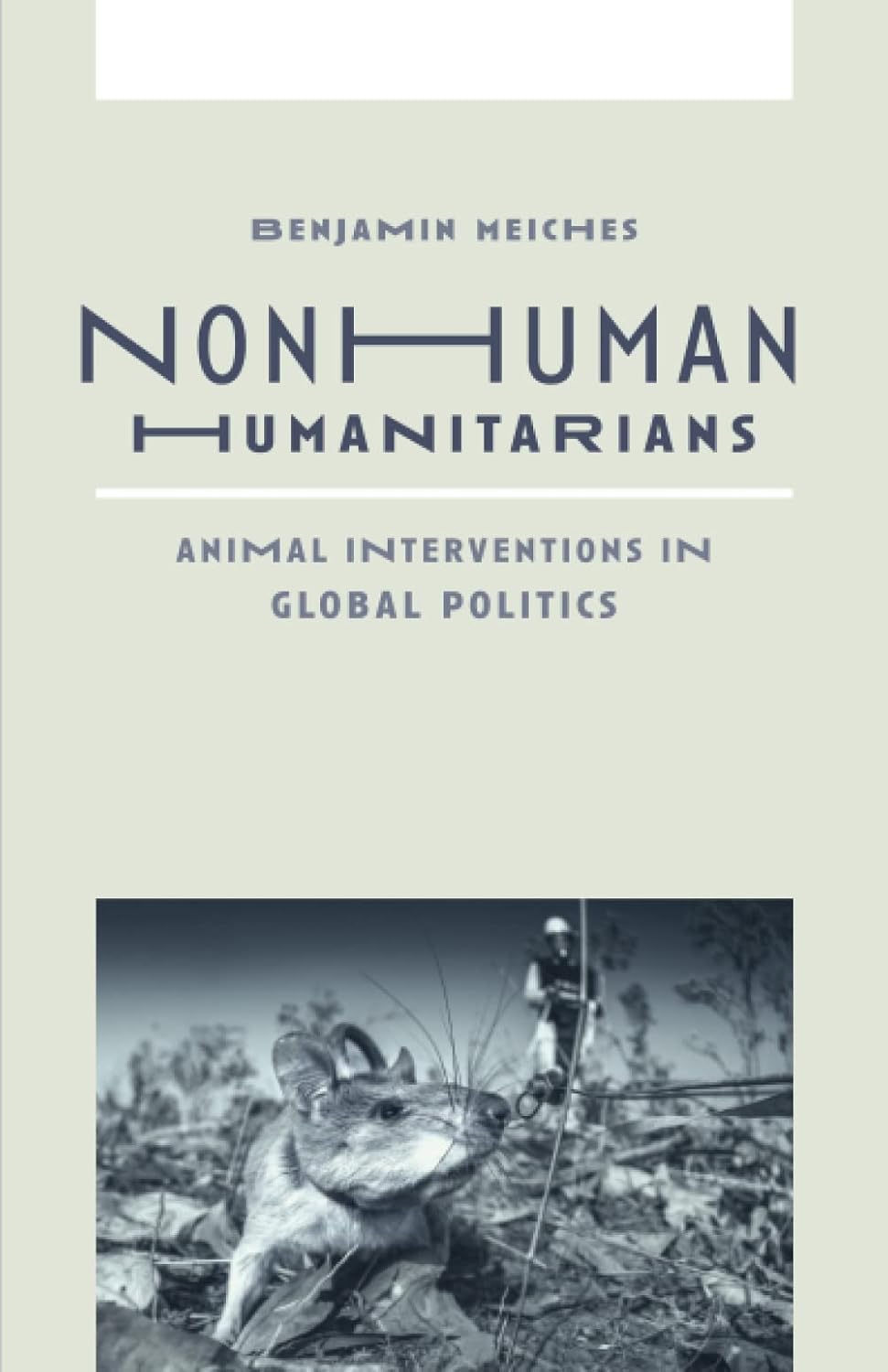
Review of Benjamin Meiches, Nonhuman Humanitarians: Animal Interventions in Global Politics. Minneapolis: University of Minnesota Press, 2023. viii + 235 pp., 8 b&w illus. $25.00 (pb).
and
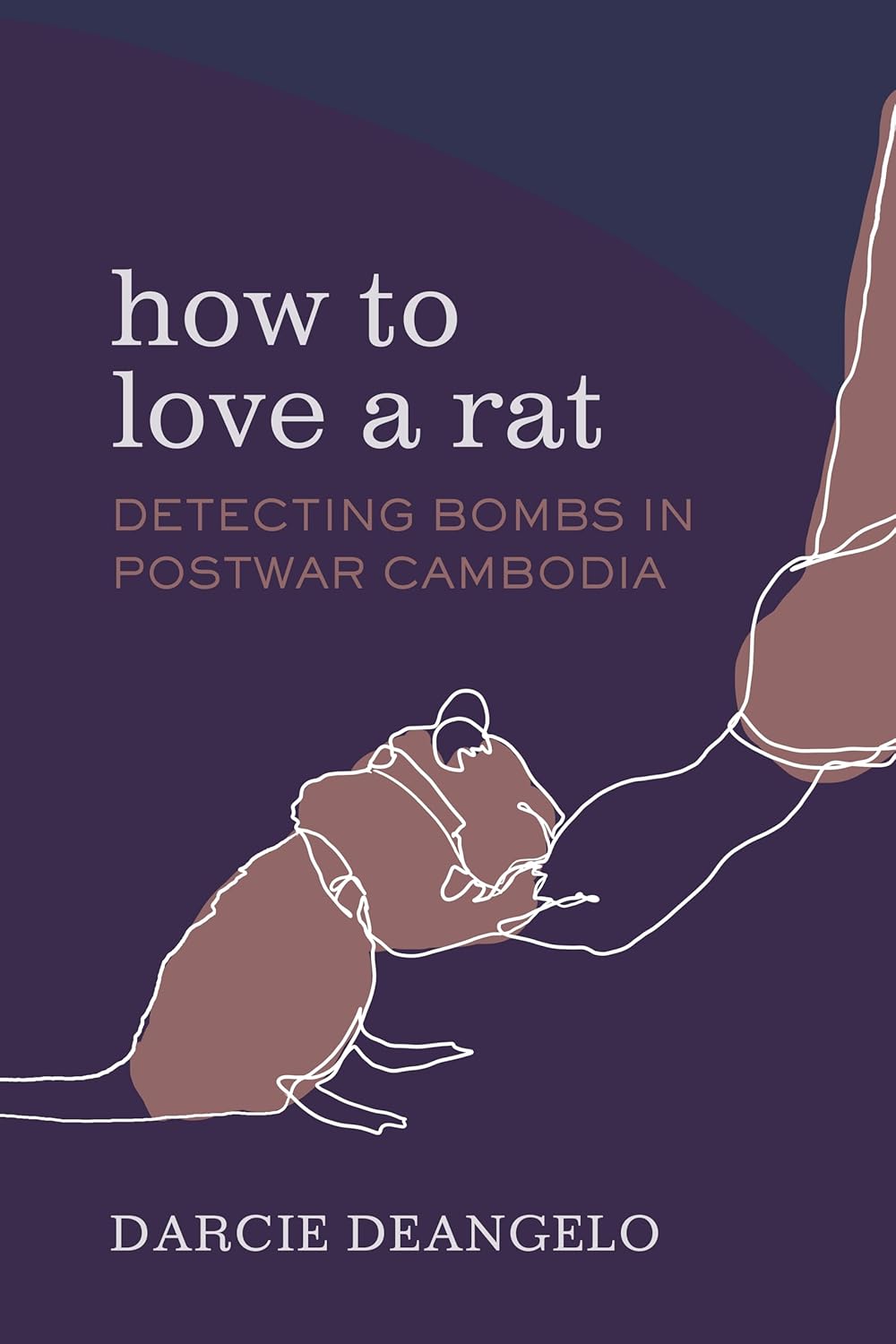
Darcie DeAngelo, How to Love a Rat: Detecting Bombs in Postwar Cambodia. Atelier: Ethnographic Inquiry in the Twenty-First Century. Oakland: University of California Press, 2024. xvi + 179 pp., 10 b&w illus., $29.95 (pb).
Sara van Goozen is a lecturer in Political Philosophy at the University of York
Email: sara.vangoozen@york.ac.uk
Humanimalia 16.1 (Winter 2025)
Both of these books encourage the reader to reflect on the interactions between animals and humans in humanitarian and postwar contexts. Meiches takes a more theoretical approach, whereas DeAngelo’s study is a detailed ethnographic study of deminers working with rats in Cambodia. Reading them alongside each other illuminates the advantages and limitations of their respective methodologies, and provides valuable insights into the study of human–animal relations. In this review I will briefly outline both books before then considering them alongside each other.
Meiches starts his book with a story told by Emmanuel Levinas, the renowned philosopher and Holocaust survivor. Levinas recalls a brief period during his imprisonment when a stray dog spent a few weeks visiting the camp before he was chased away by the guards. The camp named him Bobby, and he was, Levinas says, in a gently mocking tone, “the last Kantian in Nazi Germany, without the brain needed to universalize maxims and drives”. The passage is puzzling, Meiches notes, because in general Levinas is one of the strongest proponents of humanitarian principles — yet he seems to struggle with the idea that Bobby is behaving in anything other than a thoughtless, instinctual way. “In making this claim”, Meiches writes, “Levinas echoes a strong tradition of dismissing the nonhuman animals as self-aware, ethical agents” (5).
As Meiches goes on to show, however, there are several ways in which animals can be thought of as agents in humanitarian enterprises. He looks at a number of case studies: how dogs are taught to sniff out mines; how rats are used to demine and detect diseases; and how cows and goats are provided to smallholder farmers in low- and middle-income countries by groups like Heifer International. By considering these cases, Meiches develops several related theoretical ideas. Most prominently, he aims to challenge the anthropocentric reason at the core of the mode of thought that characterizes work on animals in humanitarian operations and epistemologies (15). For humanitarian organizations, animals are considered useful or disposable instruments exclusively for human ends. Their labour, body, life, and vitality are taken to be valuable only to the extent that they serve discretely human purposes.
Studying demining dogs helps unsettle anthropocentric reason in a number of ways. Mainstream discourses about demining dogs help to reinforce and normalize — or naturalize — control over dogs’ breeding, upbringing and exposure to danger (60). People in the demining field sometimes describe dogs as “natural deminers”, or as having inherent propensities for this type of work. What this obscures is the fact that these dogs’ abilities are not simply the result of nature but are potentialities that have emerged through historically contingent actions that are the result of force and control — including the historically contingent existence of the minefields themselves.
At the same time, Meiches says, dogs do seem to gain pleasure and enjoyment from their work — the use of their senses, the interaction with their human handlers — and the little bit of joy and companionship they bring to minefields help to unsettle what he refers to as the “explosive ecologies” of the minefield (40). As a consequence, Meiches argues that humanitarian practices consist of “weird encounters; playful expeditions; and new meetings between dogs, humans, and other nonhumans that cannot be fully synthesized by human sense experience” (74). This important point challenges dominant approaches to understanding demining as a practice of human–animal relations. Dogs, as Meiches demonstrates, are not merely tools in this process, but are agents who, in their own subtle ways, unsettle and change how we view these areas. Dogs “interact with these weird ecologies as a zone of joyful exchange”, which affects wider demining operations: “The dog’s presence in demining operations not only makes it more effective according to the values of anthropocentric reason and labor efficiency but works on the underlying disposition of humanitarian operations” (75).
Next, Meiches discusses the increasing use of rats for humanitarian purposes. Historically viewed with suspicion, rats are now being recognized for a range of useful skills. Most importantly, their sense of smell is exceptional and they’re relatively easy to train. Meiches focuses in this chapter on APOPO (which stands for Anti-Persoonsmijnen Ontmijnende Product Ontwikkeling — “Anti-Personnel Landmine Detection Product Development”), a Belgian NGO that has pioneered the use of rats in humanitarian contexts. It was founded in the 1990s by Bart Weetjens, initially with the idea to train rats to find landmines. Though larger than their familiar cousins, the Gambian Pouched Rats used by APOPO are still light enough that they will not trigger landmines. More recently, their “HeroRATs” are also being studied for other uses, most notably their ability to help detect diseases, including TB. Though they are used in similar ways to dogs, using rats in these humanitarian contexts is more fraught because they “exist in a liminal zoological and political space: effective at humanitarian work but confronting much more consolidated, if culturally specific, phobias” (80). The use of rats by APOPO challenges some of these biases and to some extent admits them into a realm of objects of care (107). Yet in their attempts to make rats seem relatable and non-threatening, they also reproduce a certain type of anthropocentric reason by anthropomorphizing them and foregrounding their utility.
To conclude his discussion, Meiches turns to Derrida’s writing idea on the gift to better understand the role of rats in humanitarian environments. While Derrida claims that there is an impossibility in gifting — at the moment of giving, the gifting becomes an exchange — there is a sense in which rats’ relationship with the humanitarian organizations that use them is precisely a kind of impossible gift (106–7).
The idea of the gift returns in the next chapter. Here Meiches discusses Heifer International’s Heifer Project and other programmes that claim to support smallholder farmers in developing countries including through — but not limited to — the donation of cows and goats. Heifer International uses the language of gift giving liberally. For example, it claims that “[p]assing the gift” is its first institutional “cornerstone” (141). The cows and goats gifted help communities overcome subsistence in a way that many traditional methods of aid fail to do (or so it is argued). At the same time, the approach of Heifer International does not question the violence inherent in the relationship between humans and cows. In a sense, the “gift” of milk — or to be more precise, the gift of the being who produces the milk — may well be closer to “what Derrida calls the ‘worst’, a form of erasure that entails the destruction of nonhuman life for the benefit of human well-being, in which nonhuman protests are treated as simply nonexistent” (144).
The relationships that exist between animals and humans — relationships of care, of gifting, of joy — are fundamental to Meiches’s analysis. While his discussion of dogs and rats sheds light on the types of humanitarian relationship that can emerge between humans and animals in contemporary humanitarian practice, his discussion of Heifer International introduces an important limit to development of relationships between humans and animals. The cows and goats never really become partners in humanitarian enterprise. Indeed, part of the “gift” provided by a cow is her flesh. The violence done to farmed animals creates a paradox, according to Meiches: “this model of humanitarianism both makes nonhuman animal bodies the substance of a gift and positions these same nonhumans as emotive, companions cooperatively building new possibilities for life” (144).
While dogs and rats are celebrated for their humanitarian work even while they may have relatively little awareness of what they are doing (a dog or a rat is unlikely to understand the concept of a landmine), cows and goats are commonly all-too-aware of their milking and eventual slaughter. Here, the anthropocentric and sentimental aspects of humanitarianism “blend together to demonstrate how the existence and contributions of nonhuman animals matter, producing important shifts in the conditions of life and treatment of nonhuman animals, but persisting in practices of exploitation and slaughter” (146). Indeed, the approach of Heifer International presents these inherently violent and domineering practices as emancipatory for the humans they assist, by linking them to economic development and self-sufficiency.1
If Nonhuman Humanitarians offers breadth, Darcie DeAngelo’s How to Love a Rat offers depth. DeAngelo has studied the first arrival of APOPO demining rats in Cambodia, and provides important insights about human–animal relations, tensions in “postwar” Cambodia, and the challenges facing humanitarian organizations that have to negotiate state agencies and local communities.
DeAngelo begins by discussing the history of APOPO and the wider historical contexts of demining in Cambodia. As DeAngelo describes it, Weetjens was inspired by research that showed that gerbils were able to detect TNT, and decided to find out if rats could be trained to do the same. APOPO initially operated in Mozambique and Tanzania, selecting Gambian Pouched Rats as their preferred rat species because of their size and large populations across sub-Saharan Africa. In 2014, APOPO started up operations in Cambodia. DeAngelo was already in the country for a prior research project, and was therefore able to get access to APOPO’s operations from a very early stage. This means she is able to offer a great insight into the various challenges facing the operation, including the strained relationship with the Cambodian Mine Action Center, run by the Cambodian army, and the environmental and social issues with introducing African rats to their new home in Cambodia.
One particular strength of DeAngelo’s study comes from her familiarity with Cambodia’s history and language. This means that while her focus is trained on one team of deminers, her study also becomes about the often unresolved tensions between different actors in a (tenuously) post-war Cambodia, including the European and African employees of APOPO.
Her study also presents valuable insights into how humans can come to see animals as partners. Over time, the deminers find ways to relate to the rats, as much by mutual dependence as genuine interspecies companionship. One rat, Frederic, kept trying to build a nest in his wire cage; another, Merry, squeaked in his sleep, which one deminer inferred to mean he had nightmares. And Simon, the biggest of the rats, earned himself the nickname “Little Sister”. When asked why she referred to him with that name, Simon’s handler, Moch, says: “Love. I know he’s an animal and that he is male, but I just feel like he is my little sister” (18). As the human deminers develop relationships with the rats, these relationships also provide a model for relationality between the human deminers.
Love, a bit like Meiches’s use of the gift, is a recurring theme in DeAngelo’s study. She dedicates a chapter to the Cambodian conception of metta [មេត្តា] — sometimes translated as “compassion” or “loving kindness”, but more strictly speaking a specific type of love: “pity-love”. Metta is present between the deminers and their rats, and between the various humans in her study as well. According to DeAngelo, metta enables a loving relationship between the humans and the rats. The connection to the rats helped redefine agency in the minefields as “mutual and accountability as shared — a reflection of the ambiguous agency of violence and the diffuse sense of ghostly persons in the postwar ecology” (111). However, these relationships inevitably entail the transgressing of boundaries and the reinforcing of hierarchies:
The rats, for example, had not consented to being taken from the wild, bred according to their scent-detection talents, and forced to work during the day although they normally would be awake only at night [which poses health risks to them, too]. The introduction of the rat was itself a transgression, and along with this transgression came a new choreography of the landmine-detection-rat technique (111).
In light of the persistent hierarchies between deminers and rats, DeAngelo says she has been faced with concerns from colleagues about animal welfare, and questions about the extent to which the rats could be considered to love the deminers in return. To some extent, DeAngelo suggests, this may be motivated by a particularly Western understanding of love: “historicizing Western-centric ideas of love as requiring individuals who stand on equal footing with each other helps undo the assumptions that the rats and humans cannot really love each other — in the postwar ecology of the minefield, love for landmine-detection rats was both relational and hierarchical” (112).
DeAngelo’s discussion of metta is especially interesting when read alongside Meiches’s conceptualization of “nonchalance”. Meiches’s concluding chapter turns to nonchalance in order to capture the apparent indifference of most animals roped into humanitarian work. While some animals — like dogs or cows — may express joy or protest, many do not seem to communicate with humans at all. This could be read, Meiches notes, as a failure to interpret animal communication, or perhaps as confirmation that animals have no comprehension of anything beyond their immediate burdens. However, Meiches argues, it may be more helpful to think of animals’ attitudes towards the humans they work with and the projects they work on as one of nonchalance, rather than indifference or ignorance. The difference here is that to brand animals as indifferent turns their lack of communication into a form of passivity. Nonchalance may appear like indifference but its “ambivalence entails a more complex consideration of the situation and has more in common with the activity of quiet contemplation than unaware complacence” (164). Meiches thus theorizes nonchalance as a specific type of ambivalence that arises in response to the “predicament of being affected by plural forces when these forces are not immediately comprehensible” (165).
Her discussion of metta enables DeAngelo to question the (mostly) Western-assumption that love cannot really exist across hierarchy since metta does allow for hierarchical love. This is how she is able to understand the relationship between humans and rats as being a loving one. Even so, the relation she describes remains from the human perspective. Humans may experience love of some description towards the rats, whereas Meiches reminds us that from the animals’ point of view, the relationship is likely to be as much one of nonchalance.
While both books are worth picking up, I do want to end by highlighting a few issues. DeAngelo’s study is a focused, anthropological work. I highly recommend it, but at the same time the reader is sometimes left wondering about both the implications and wider context of her work. For example, while she spends some time discussing the history of APOPO, more information about the organization could have been provided. There are some fascinating titbits about the organization’s spread throughout the book — from their use of lab rats to develop their methodology because the Gambian rats refused to procreate in captivity, to snapshots of how they run their visitor centre in Cambodia — but this is all fairly fleeting.
On the other hand, the issue with Meiches’s study is, arguably, the opposite. Both theoretically, and in terms of his case studies, he covers a lot of ground: Levinas, Derrida, Deleuze and Guattari, Agamben, Haraway, Butler and many, many others are brought to bear on his cases in a way that sometimes feels a little disjointed. At the same time (or perhaps as a result) his case studies are broad too. There are a lot of very useful insights here, to be sure. But this does mean that, in places, they come across as more general overviews of the various organizations’ work. In fact, sometimes Meiches treads a very thin line between analysing the discourse of these organizations, and simply repeating their marketing materials. He repeats fairly uncritically, for example, APOPO’s claim that their rats get a good “retirement” when they’re too old to work. Yet DeAngelo’s closer ethnographic work reveals that, at least at the NGO’s headquarters in Tanzania, the rats are (or were) euthanized (“Oh, it’s very sad to see the pile of rats when they are retired”, one interviewee is quoted as saying) (148).
In his discussion of Heifer International, Meiches also seems to want to draw a line — albeit a fuzzy one — between the industrial animal agriculture of the global north, and the smaller scale enterprises supported by nonprofits like Heifer International (where the latter doesn’t warrant the same level of condemnation). Though Heifer International does not directly encourage the development of industrialized animal agriculture, they do seek to provide what their website calls “technical training to help farmers grow abundant crops and raise more productive livestock” and to “facilitate market connections to strengthen rural livelihood opportunities and advance economic development”.2 Put differently, Heifer International’s agroecological programme materially benefits the expansion of industrialized practices of animal production, and presents core elements of the industrialized mode of agriculture as aspirational. Elsewhere on the website, they write enthusiastically about their work with Nepal’s National Livestock Breeding Offices, where bulls “are being leveraged to increase the quality and reach of artificial insemination services for dairy farmers across the country to improve the national dairy cattle herd.” This similarly posits industrial farming practices as normative guarantors of progress and modernity, and quite explicitly reproduces the anthropocentric reason that Meiches otherwise sets out to question.3
In conclusion, both books present fascinating and important studies on the use of animals in modern humanitarian endeavours. As noted, there are limitations to the analysis offered in each book, but both Meiches and DeAngelo shed important light on the relationships between humans and animals that develop in humanitarian contexts in highly complementary ways. Animals play many roles in humanitarian work, indeed are made to play many roles, and this has massive impacts on the shape that this humanitarian work takes. Both books provide an important starting point for understanding these dynamics better.
Notes
To build on the point developed by Meiches, in their own words, Heifer International “works with partners to support farmers in sustainably addressing hunger and poverty in their communities while caring for the Earth” — but the organization’s approach continues to involve and even promote violent exploitation of cows, goats, pigs, chickens, fish, crustaceans, and others as a necessary component of doing so. See “Approach”, Heifer International, accessed 12 Oct. 2025, https://www.heifer.org/our-work/approach.html.
“Food Security”, Heifer International, accessed 12 Oct. 2025, https://www.heifer.org/our-work/focus-areas/food-security.html.
“The Milky Way Program: Transforming Nepal’s Dairy Sector”, Heifer International, Sept. 2024, https://media-refresh.heifer.org/wp-content/uploads/2024_Milky_Way_Brief-3.pdf.