From Farm to Fame
The Ideology of Animal Biography in Post-War Agricultural Discourse
DOI: http://doi.org/10.52537/humanimalia.19646
Keywords: Animal history, Animal biography, Breeding discourse, Agrilogistics, Biopolitics of animal agriculture, Animal Sexuality, Post-war Eastern Europe
Email: gabriela.jarzebowska@al.uw.edu.pl
Humanimalia 16.1 (Winter 2025)
Abstract
This article explores the biography of Geeltje’s Adema, a prominent breeding bull in post-war Polish agricultural discourse, to examine the ideological dimensions of animal biographies within the context of human–animal relations and agricultural modernization. Situating Adema’s narrative within the transition from small-scale farming to industrialized agriculture, the study highlights how notions of productivity, “biological progress”, and breeding discourse shaped representations of farm animals. The analysis draws on Timothy Morton’s concept of agrilogistics and biopolitical frameworks, revealing how animal biographies can simultaneously emphasize individuality and obscure systemic violence by embedding lives within anthropocentric narratives of utility and genetic optimization. Adema’s life serves as a lens to investigate the intersections of individuality, commodification, and sexualization in pre-industrial agricultural practices, contrasting them with the depersonalization inherent in industrial farming. The study underscores the role of animal biographies in normalizing exploitation while contributing to broader discussions on human-animal relations, ethics, and historical representation.
A 1959 issue of the Polish magazine Przegląd hodowlany (Breeding Review) features a peculiar headline: “Breeding bull Geeltje’s Adema is dead.” Below is a photograph of the handsome creature’s head in profile, a metal ring through his nostrils, while the trained eye will further make out farm buildings in the scarcely visible background. The image is captioned: “The veteran Geeltje’s Adema 1601 G/KPz”. Next to it, we find a full-page account of the breeding bull’s life presented as an obituary: a tribute to the animal written in a radically different style from the other articles in this zootechnical industry periodical.1
What was it about this particular bull, a representative of a species exploited and killed in its millions, that led to a eulogy that resonated in the breeding discourse, otherwise so unfriendly to animals? How was it that the story of this animal was singled out from millions of others to become the canvas for an intricate fable? What are the ideological paradigms into which such a biography is woven? What does this story accentuate, and what does it conceal? These are the questions I seek to touch upon in this article. Moreover, they are connected to a broader theoretical problem, associated with the ideological dimension of biographization of the life of an animal in the breeding discourse.
I examine the biography of Geeltje’s Adema, a celebrated breeding bull in post-war Polish agricultural discourse, in order to explore the ideological dimensions of animal biographies. This analysis bridges two distinct yet interconnected issues within animal studies: (1) the problem of animal biography, and (2) the ideological ramifications of livestock modernization. I argue that the former may provide the conceptual and narrative foundation for critically examining the latter. The primary aim of this study is thus to analyze the relationship between the biographization of animal life and the post-war transition from small-scale farming to industrialized agriculture. In particular, I employ the case of an animal biography to trace the frictions and discontinuities that characterized the shift toward modern animal husbandry. I argue that the narration of Geeltje’s Adema’s life is closely tied to a specific historical moment in animal agriculture and is deeply embedded within the broader socio-historical context of that period. I also contend that while animal biographies can emphasize individuality, they often obscure systemic violence by embedding animal lives within anthropocentric frameworks of utility and genetic optimization. By applying Timothy Morton’s concept of agrilogistics and the robust discussions on the ideology of breeding discourse, I explore how the lives of farm animals may have been conceptualized in the period immediately preceding the advent of factory farming, with particular emphasis on the significance of animal sexuality. I suggest interpreting the history of Adema as a telling example of how the breeding logic functioned during a period when industrial farming had not yet reached full development and animals, despite being commodified, still retained a degree of individuality.
The article begins with Part 1 (A Breeding Bull’s Story: Literature and Methodological Remarks), which provides an overview of the research problems and situates in the existing literature of animal biographization and livestock modernization. In Part 2 (Geeltje’s Adema: A Case Study), I present Geeltjes’ life story based on available accounts. Parts 3, 4, 5, and 6 serve an analytical purpose. In Part 3 (Narrating a Breeding Bull), I analyse Geeltje’s’ biography at both narrative and linguistic levels, examining how and through what means his life is described. I also reflect on how good breeding practices—specifically practices of care—were understood and represented during this period. Part 4 (Animal Farming in Transition) contextualizes the story of Adema within a specific historical moment, namely the period just before the introduction of factory farming in Poland, a development that dramatically altered interspecies relationships and their accompanying discourses. Part 5 (Breeding Value and Biopolitics) introduces and explores two pivotal concepts, agrilogistics and breeding value, analysing how these frameworks manifest in the context of pre-industrial farming. In Part 6 (Commodifying Sexual Fitness), I argue that animal biopolitics in the pre-industrial era, prior to the establishment of well-developed industrial farming, was characterized by a profound sexualization of animal subjects. Finally, Part 7 (Productivity, Progress, and Animal Histories) examines the biography of Geeltje’s Adema as a lens to explore the complexities of animal representation during a pivotal historical transition, revealing the interplay of individuality and commodification.
Part 1. A Breeding Bull’s Story:
Literature and Methodological Remarks
Though this article attempts to rectify a relative lack in scholarship about commodification in socialist contexts, it is enriched by more in-depth use of existing foundational scholarship. Specifically, Thomas Fleischman’s Communist Pigs is an essential precedent for considering how animal life was operationalized under socialist regimes in terms of biopolitical regimes of control and production.2 Fleishman’s close history of East Germany’s pig farming highlights how animals were not just productive units but infrastructural elements in state-making projects—insights that translate closely to the Polish context. Using his conceptual model explains how post-war Polish breeding programs, though conditioned by local particularities, were part of larger socialist imaginings of control, abundance, and biological advancement.
Also, by drawing on environmental history, I demonstrate an enriched treatment in this article on modernizing livestock. From scholars like Harriet Ritvo, we have seen that historically, practices in animal breeding mirrored not just economic rationalities but also social structures and symbolic constructions of nature.3 Likewise, Richard White’s call for recognition of the cultural significance in terms of meaning in ecological transformation complicates simplistic models of technoscientific progress.4 Gregg Mitman and Peder Anker both further suggest that ecological thought was not just scientific, but also ideological.5 Their works demystify the ways in which breeding infrastructures were not just scientific projects, but tools for governing that were tied to ideals for order, health, and futurity. Such interpretations offer an important lens for reconceptualizing the Polish case—not as merely a history about animal productivity, but one about nature, power, and ideology. By entering more directly into these comparative and conceptual contexts, this article seeks to relocate the biography of Geeltje’s Adema into an environmental and historiographical context. Not simply an account of one animal’s life, but also an opening onto intersecting discourses about productivity, state formation, and remaking landscapes ecologically in mid-century Eastern Europe, it allows for a more subtle reading of breeding as infrastructural governance and of animal bodies as spaces in which the ideological demands of modernity, science, and state-ness intersect.
However, my analysis should also be situated within the context of animal biographies, which it critically engages with. Although the issue of animal biographies has been addressed by scholars in animal studies, the concept itself presents significant challenges. It is telling that the only book in English dedicated to animal biographism6 lacks references to the actual lives of agricultural animals. This omission is unsurprising, as such accounts are typically dependent on agricultural literature, which, as Ariel Tsovel aptly points out, addresses animals in an overtly objectifying manner, disregarding any experiential aspects of their lives beyond “‘productivity’-related” concerns.7 This mode of narrativizing nonhuman animal lives stands in stark contrast to the concept of historical biography, which, as Erica Fudge observes, requires essential details about the life of an individual: name, full dates of birth and death, physical appearance, character traits, family background, and career.8 While these elements may be known in cases of historically significant animals (for instance, those belonging to prominent individuals), they are nearly impossible to ascertain for individual farm animals.
My contention, however, is that the ideological implications of writing animal biographies are more complex and extend beyond methodological issues such as insufficient data. While writing an animal biography may reveal animal agency by recognizing animals as individuals,9 it may also paradoxically obscure this agency by emphasizing only those aspects of the nonhuman protagonist’s life that serve anthropocentric ends. In this respect, my analysis aligns with Éric Baratay’s concerns regarding the anthropomorphizing risks inherent in animal biographies.10 With my case study, I aim to demonstrate that the method of animal biography, along with its accompanying anthropomorphism, may actually obscure the violent practices inflicted upon the animal protagonist by embedding them within an anthropocentric, agrologistic ideology.11
It is important to emphasize that this case concerns a unique historical moment: the transformation of the functioning of these relations within small-scale peasant farming production towards industrial-scale breeding, something I elaborate on in Part 4. Based on one of few farm animals of the twentieth century whose life was covered in written sources, I will therefore reconstruct the discursive models in which animal biographism is inscribed. In other words, the history of a once-famous breeding bull provides a pretext for investigating the potential uses of construction of biographical stories about nonhuman life, and what they can tell us about changes in the perception of interspecies relations in the times of mature modernity.
Finally, the study is also indebted to the field of Science and Technology Studies (STS) by foregrounding the role of nonhuman actors—specifically livestock—in the co-construction of agricultural modernity within socialist regimes. By tracing the biography of Geeltje’s Adema, it aligns with key tenets of Actor-Network Theory (ANT), which emphasize the agency of both human and nonhuman entities in shaping sociotechnical systems. The animal body, in this context, emerges not merely as a passive object of human intervention but as an active node within a network of scientists, breeders, institutions, and technologies. This approach enables a more distributed understanding of agency, where the dynamics of livestock modernization are seen as the outcome of complex, relational processes rather than top-down policy alone.
Before proceeding, I would like to make two important methodological remarks. Firstly, my research is founded on very specific materials, namely from early post-war Poland. This decision was based on my reflection that historical accounts on animal production within the field of human–animal studies are either concerned with deep historical investigations on the symbolic role of meat in human cultures12 or focused on the role of industrial farming in Western (mostly North American) culture.13 Critical research on the transformations of animal exploitation in food production in the semipheripheral regions (the Eastern Bloc included) which followed their own modernization processes in food production, has been virtually non-existent. The reason for this gap may be that the origins of contemporary meat and dairy production are closely related to the logic of capitalism and its commodification of animals. With the notable exception of Fleischman’s work, the fact that the industrialization of animal farming occurred not only under Western capitalism, but also in socialist countries, which went through similar processes in the second half of the twentieth century, has been largely overlooked so far.
Secondly, I deliberately focused my analysis on zootechnical discourse, specifically examining issues of Przegląd hodowlany, one of the most prominent Polish zootechnical periodicals. This decision was made to explore the representation — or lack thereof — of individual animal histories within an institutional and official framework, as opposed to the more personal and intimate perspectives found in documents such as memoirs. While personal accounts might illuminate the nuanced relationships between humans and nonhuman animals, my aim was to investigate how official discourse constructs these histories linguistically, the kinds of contradictions or aporias that arise within these narratives, and the ethical and theoretical challenges they present to the reader. By concentrating on this formalized, professional discourse, I sought to uncover the ways in which animal individuality is acknowledged, ignored, or subsumed under broader zootechnical goals, and to understand how these processes reflect the cultural and ethical assumptions underpinning such representations.
When setting about searching for animal heroes in the pre-1989 breeding discourse, I expected to find, at best, snippets of such stories. Yet to my surprise, there were quite a few. In the first decades after the war, the individualization (and sometimes even anthropomorphization) of farm animals had not yet become a rarity. I managed to collect fragments of histories from the lives of individual animal subjects — mainly horses, but also cows and pigs, and, in individual cases, also rams and hens. Usually, however, these were fragmentary and anecdotal, in Stalinist times commonly incorporated into the discourse of “socialist emulation”, i.e. competing to achieve high production goals (“record-breaking” cows). In most cases, these are not complete biographies according to the template identified by Erica Fudge, but rather scraps of information about the lives of the animals they describe — the information deemed important by the authors (temperamental traits, physical appearance, significant events from their lives in terms of breeding). These always concern animals that made a name for themselves through their superior production results or extraordinary fertility.
Nevertheless, Geeltje’s Adema is one of few livestock animals (apart from thoroughbred horses) who, in the breeding discourse, have been the subject of what we could call a biography in the strict sense. According to his contemporaries, the bull was “undoubtedly a valuable specimen”,14 “meriting particular attention”,15 and “known to all breeders in the country and distinguished”.16 One “biographer”, Jan Głowiński, states outright that he was providing details from Geeltje’s Adema’s life since “this breeding bull had a major impact on the rearing of black-and-white lowland cattle in Greater Poland, and through his progeny throughout the country.”17 The significance of this specific animal and the reasons for which it piqued the interest of influential people in the livestock sector were therefore closely connected to the specific nature of breeding practice, meaning an area of human activity associated with maintaining, reproducing, and transforming the animal population by controlling their genetic changes and meeting a set breeding objective. As I aim to demonstrate, situating the trajectory of Geeltje’s Adema’s life within this specific domain of human activity is essential for understanding how it was represented and functioned within public discourse.
Part 2. Geeltje’s Adema: A Case Study
Geeltje’s Adema was born on 23 March 1943 in Dutch Frisia, on the farm of the “well-known breeder” Y. C. Jepma.18 The sources make it clear that this was a bull born of noble blood: “Geeltje’s’ great-grandfather on his father’s side was Bontje’s Adema 24674 FRS preferent B son of the famous Adema 197 22231 FRS preferent A”.19 In a separate article, Głowiński adds anecdotally that the bull’s great-grandfather was apparently killed during wartime operations in 1945.20 Born into nobility, Geeltje’s was also recognized at an early age; on 2 April 1944 he was a prize-winner at a local show. When the bull’s breeding licence was issued, he received seventy-five points for build (here, Głowiński adds: “a relatively high score!”21). Probably soon after the show in question, he was bought for five thousand guilders, before being deployed to Greater Poland and added to the breed registry of the Cattle Breeding Association in Poznań.
A gap of several years in the hero’s story then follows: “all that is known from then is that for the whole time he was mating in the cowshed in Łagiewniki.”22 However, the conditions in which he was kept were unlikely to be adequate. When the breeding bull was found in 1947 by Włodzimierz Raczyk, inspector of the National Board of State Land Properties in Poznań, he was being used for yard work and was in a terrible state. As Raczyk put it, Geeltje’s Adema was
utterly neglected, with serious lameness, he struggled to haul water around the yard, dragged carts carrying manure, etc. He had been selected for cull and was to be sent for slaughter in autumn. Based on a more careful evaluation of the exterior and assessment of his progeny […]. I concluded that this was undoubtedly a valuable specimen.23
In a pile of post-German papers, Raczyk finds the breeding bull’s original Dutch lineage together with a photograph, on which basis he ascertains the animal’s identity (adding that the nose ring used for identification had been lost). He takes him from Łagiewniki to breed at a “well-known cowshed”, Przyborówko. Raczyk concludes, “after a short time, thanks to the right diet and excellent nurturing, he returned to form.”24 The author uses this story as a pretext to infer a moral: we should not make hasty decisions on removing animals from breeding and sending them for slaughter, as a seemingly inconspicuous specimen could turn out to be an individual with above-average breeding value.
But let us return to the fortunes of Geeltje’s Adema. He remained in Przyborówko until either 1952 or 1953, depending on the source. There, he “left behind a very beautiful brood of his daughters and made a considerable contribution to increasing the milk yield and fat content in the cowshed.”25 He was then transferred to the Kosowo Artificial Insemination Centre, where he was “evaluated as elite”26 and used for breeding purposes until 9 October 1958. As one author eagerly enumerates, the bull’s semen was used to inseminate 11,000 cows.27
Adema’s biography is completed with a description of his old age and increasingly ailing condition. To return to Głowiński’s account:
In summer, probably because of the heat, signs of extreme weakness appeared. The bull could no longer mount, and when taken for a walk he heavily shuffled his feet, his movements were uncoordinated, and his heart rate was markedly accelerated even at rest. A council of veterinarians expressed concerns that, owing to his advanced age, it might no longer be possible to save him […]. Geeltje’s’ condition was very serious, but thanks to the efforts of the veterinarians […] in October 1957 he returned to semen production […]. Despite his age, he shows normal libido, mounts v. willingly, delivering vital, thick semen into the artificial vagina. On 23 March he turned fifteen and is still being used for semen donation, which is phenomenal.28
As Głowiński notes, however, despite his return to health, the bull no longer has the same energy, and this is reflected in his siring duties: “after mounting, Geeltje’s now finds it hard to stand on his hind legs, and it also often happens that ‘Grandpa’, as he is known in Kosowo, having delivered his semen sits down on his haunches from the exertion”. Here, Głowiński speculates that “a simple device for the painless collection of sperm from elderly bulls would be entirely appropriate here […]. Perhaps Centrowet could procure such an apparatus from abroad?”29
A few months later, however, the “obituary” mentioned at the beginning of this paper appeared in Przegląd hodowlany. Its author describes the bull’s final months:
The arrival of autumn 1958 brought signs of weakness. He struggled to raise himself up to mount the dummy cow, and after giving semen he could no longer stand on his legs and fell limply to the ground, so that on several occasions the technician collecting the semen only narrowly avoided being crushed. At the same time, Geeltje’s began to lose weight rapidly […] and his legs became swollen due to cardiac insufficiency. From October 1958 he was “retired”. The Department of Livestock Production recommended that this breeding bull not be sent to slaughter (the meat value was not high owing to the bull’s age), but rather that he be kept in Kosowo as long as possible. Given G.’s great service, this decision was absolutely correct. He retained a good appetite and good spirits until the very end, and only in the last four days was he unable to get up. He died peacefully in his sleep.30
Głowiński relates one more detail from the bull’s story. Shortly before his death, during a visit to the Netherlands, Polish experts spoke to his first owner. “Jempa [sic] remembered him well and was very happy to hear that the bull was still alive, expressing a wish to visit Poland to see G. This visit was planned for May 1959.”31 Yet these plans were scuppered. Adema died on 26 March 1959. According to Głowiński, he was exactly sixteen years and three days old.
Part 3. Narrating a Breeding Bull
I will begin by analysing how the story of Geeltje’s Adema is constructed at a narrative level. This is something more than simply a set of chronologically constructed events from the breeding bull’s life. Rather, they form a coherent and narratively closed story marked with meaning. This resembles a fairy tale with a happy ending, and at a deeper level appears to reproduce the archetypal “hero’s journey”.32 The hero in question is noble, with a known lineage (good genotype), and recognized in his youth (breeding prize), who, due to the turmoil of war (and perhaps also the German occupant’s failure to recognize his value), faces a stern test, with his specialness going unnoticed for several years. He experiences physical suffering and symbolic degradation (neglected and lame, pulling a manure cart). Suffering alone and in mortal danger (the threat of being sent for slaughter), at the last moment he is discovered almost miraculously by a well-known inspector, the only one to recognize his true value. Taken away from his evil owner, the hero lives happily ever after, doing his duty as a sire on a prestigious farm and spreading his precious genes throughout the country. After a dozen years of strenuous work, he takes a well-earned retirement, dying in his sleep a few months later, peacefully and without suffering. His first owner wishes to see him, yet the historic meeting — which would provide a framing device to this tale of twists and turns — does not come to pass. The bull’s death dashes these plans.
At the linguistic level, the story of Adema’s life is notable for its incongruous clusters of discourse. On the one hand, there is the language of pure breeding, marked by its technical, scientific, and objectifying vocabulary, which may signal the impending advent of factory farming. And on the other, with biographical elements in its structure and linguistic layer, this story resembles human biographies. The bull is therefore at once an object and an individualized hero of the biography, with ups and downs and abrupt twists.
This narrative construction allows the ideological meanings of the breeding discourse to be highlighted. The animal functions in it as a human-managed gene container, of value and worth describing on condition that it possesses specific, highly rated breeding qualities. The animal’s body and the meaning of its life are reduced to the activities demanded by humans and maximally optimized in terms of productivity (in this case sexual). For those writing his story, Geeltje’s has enormous value. Yet this is not an immanent value, emerging from his own individuality, but from the services that this body / machine is forced to provide for the good of humans — in other words, he has a profound breeding value.
This concept, rooted in genetic evaluation, measures the potential of an animal to pass desirable traits to its offspring, often emphasizing productivity traits such as milk yield, growth rate, or reproductive efficiency. Drawing on recent scholarship in animal studies and rural STS, the concept of breeding value emerges not simply as a technical metric used in livestock selection, but as a socially and materially co-constructed indicator that encapsulates broader regimes of value, governance, and biopower.33 As Lewis Holloway and Carol Morris argue, breeding practices are deeply embedded in contested knowledge systems, where genetic evaluations are entangled with social imaginaries and institutionalized authority.34 Similarly, Andrea Petitt and Camilla Eriksson highlight how breeding is not only about managing animal bodies but also about performing and negotiating relations between humans, technologies, and animals.35 These insights align with the focus of my analysis, where the biography of Geeltje’s Adema reflects more than individual genetic worth — it becomes a narrative device that reveals how socialist breeding programs invested in animals as infrastructural agents of modernization and ideological projection. In this context, breeding value is not an objective truth, but a situated calculation shaped by historical, political, and affective forces that render livestock both measurable and meaningful within specific socio-technical worlds.
The bull is therefore both an individual with his own (sometimes dramatic) history and an object — valuable and worth looking after for the good of breeding, but lacking value in itself. Also noticeable in his life, described in detail, is the omission of the animal’s subjectivity and agency. The bull is a valuable commodity passing from hand to hand and fulfilling the duties imposed by humans, but as an individual hero he is strikingly passive. The cited sources entirely disregard the animal’s perspective and the personal dimension of his story. We know nothing about the conditions he spent most of his life living in, what his relations with other representatives of his species and the people who cared for him were like, whether he performed his duties with pleasure or reluctance, and whether he experienced violence from humans, or perhaps formed inter-individual or interspecies friendships.
It is also worth examining how care for the animal (and what we would today call ethical reflection or welfare issues) is understood in this narrative construction. In his report from 1947, Inspector Raczyk refers to the terrible conditions in which Geeltje’s had been kept in Łagiewniki and the good care he had received after being taken away from there. However, this passage seems to be characterized not so much by ethical reflection as an emphasis on the need to care for an individual representing a high breeding value. Harnessing a valuable and award-winning breeding bull for yard work, ignoring his lameness and planning to send him to the slaughter are not reprehensible from a moral point of view, but an economic one, indicating recklessness and profligacy resulting in such valuable breeding material being wasted. The efforts of the “council of veterinarians” to restore the bull to health are also dictated above all by restoring the animal to “production”. When he is no longer of use, the breeding bull is not slaughtered, but “retires”. The biographer justifies this information with Geeltje’s “great service”. Yet the way this message is formulated — emphasizing that his meat had low value and that the decision was “absolutely correct” — may suggest that readers might have found the idea of sparing the bull’s life controversial, an indication of mismanagement.
The narrative of Adema’s life thus exemplifies the duality of animal representation in breeding discourse, where the nonhuman animal is both an individual with a dramatic story and a commodity valued solely for their utility. The anthropomorphic framing of Adema as heroic contrasts starkly with the objectifying language of pure breeding, emphasizing productivity over individuality. This narrative highlights the absence of the animal’s subjectivity, reducing care and welfare considerations to economic calculations rather than ethical reflection. Ultimately, the story underscores the ideological framework of breeding discourse, where an animal’s worth is tied to their role in human-centred systems of production.
Part 4. Animal Farming in Transition
Such a narrativization of the life of a nonhuman individual bears the hallmarks of the premodern way of understanding the role of animals in society — one in which, while being used for work and killed for food, they also contained a touch of individuality that has been lost in the factory farming age. Yet it would be simplistic to stop at this statement. For this form of the individualization of the farm animal is both a remnant of human–animal relations from the era of small-scale farming and a precursor to contemporary efforts to grant animals agency. In fact, it can be interpreted as an integral element of a specific mental construct characteristic of the height of modernity, just before animal production transformed into fully-developed factory farming. It therefore seems symptomatic for understanding the dynamic of changes in the forms of representation of human–animal relations in a few decades after the Second World War. This is an extremely important context for understanding the specific perspective of Adema’s history, and it is therefore worth looking at in more detail.
The first decades after the war in Eastern Europe were a time of mass social advancement, in which millions of citizens, having emigrated from the city and reinforced the ranks of the working class increasingly cut off from the countryside, became hungry for a life lived according to bourgeois models. Meat consumption was a symbol of this advancement, and it soon became an aim of the authorities to provide citizens with this product on the widest possible scale. This phenomenon is analysed by Dariusz Jarosz and Maria Pasztor, who highlight the symbolic status of meat in the mentality of Polish citizens in this period, displayed in many phenomena of the time — from jokes to social anxieties, usually triggered by scarcities in provisions, and culminating in the so-called “meat scandal” of 1964 and a show trial in which the culprits were handed long prison sentences, and one was even sentenced to death.36 The 1950s and 60s were therefore a time of growing (and mostly unsuccessful) efforts by the authorities to increase animal production as fast as possible.
It was no earlier than in the 1970s that we can observe a distinct shift in sociocultural representations of animal food production. This was the time when biopolitical practices based on scientific management came to dominate animal breeding. Descriptions of animal exploitation began to be steeped with words such as “market”, “demand”, “supply”, “stimulating of consumption”, “innovations”, “cost-effectiveness”, “capital-intensive”, “economic incentives” and “dynamics of production”. However, this turn was more of a process than a sudden breakthrough. Industrial technologies in animal exploitation were not implemented overnight, while the disembodied language describing their life and death did not entirely replace pre-modern human–animal imaginaries. The first signs of this new, economic discourse can be traced back to the 1950s, although it was in the 1970s that they finally dominated professional agricultural science and, consequently, popular media discourse. This language reflected the harsh realities of animal husbandry at that time, where both nonhuman and human workers of “meat factories” were alienated from the production process, becoming small cogs in a food machine.
In the 1950s and 1960s, however, animal husbandry, despite its increasingly mass scale, was still largely extensive in nature. Lacking integrated industrial systems to streamline production (these would only come in the 1970s),37 it was mainly based on control and stimulation of animals’ maximum fertility. It functioned according to the principle: more fertile animals = more progeny (passing the genes responsible for high fertility onto the next generations), and, consequently, more meat available for hungry citizens. It is therefore not surprising that it was animals with record fertility that became the heroes of the imagination of decision makers and zootechnicians — and these were the lives that were described.
Part 5. Breeding Value and Biopolitics
The method of animal biography, particularly when situated within the framework of breeding discourse, risks perpetuating an anthropocentric and agrilogistic ideology, as developed by Timothy Morton.38 Rather than challenging the structures of violence inherent in human–animal relations, this approach may normalize or even sentimentalize such relations, thereby diverting attention from the ethical and material realities of the animal’s lived experience. I will elaborate on this, as I believe these two ideologies — agrilogistics and animal breeding — aptly capture the peculiarities of the narrativization of Geeltje’s’ life.
The framework of agrilogistics refers to the systematized, hierarchical control of agriculture and food production that emerged alongside human civilization. It is deeply rooted in anthropocentrism, operating through the enforcement of boundaries and binaries — such as human / animal and nature / culture — while systematically extracting value from the nonhuman world. Agrilogistics is not merely descriptive of agricultural practices but encapsulates a mode of organizing the world that prioritizes efficiency, domination, and the commodification of living beings. This system has profound implications for human–animal relations, as it reduces animals to units of production and consumption, stripping them of intrinsic agency and relegating them to the margins of ethical and philosophical consideration.
Understanding agrilogistics can prompt a re-evaluation of how humans interact with animals within the systems of industrial agriculture, urbanization, and environmental management. It offers a structural critique that complements existing approaches by demonstrating how entrenched systems of control perpetuate the alienation of humans from animals and the environment. For instance, the mechanistic treatment of nonhuman animals in agrilogistics parallels the extraction of labour and resources in human systems of exploitation, suggesting that liberation from such frameworks necessitates a fundamental rethinking of both human–animal relations and broader socio-economic structures.
Agrilogistics commodifies nonhuman animals, particularly through the calculation of their breeding value. Within this framework, animals are reduced to data points in a mechanized system that prioritizes efficiency and profitability over their intrinsic value or welfare. This perspective aligns with Morton’s critique of agrilogistics as a system enforcing anthropocentric control, wherein living beings are converted into components of a larger, extractive process. In agrilogistics, breeding value becomes an instrument for optimizing animals within a framework that treats them as resources to be maximized. This mechanistic approach decontextualizes animals from their ecological and relational roles, focusing exclusively on their genetic potential in isolation from their lived experiences or well-being. For example, selecting for high milk production in dairy cows often overlooks the physical strain and health issues caused by such genetic optimization.
Within the discourse of breeding value, the individual animal becomes a model embodying a set of desirable characteristics and genes to be passed on. Examining various histories that individualize animals within the breeding discourse reveals that an animal’s achievements may take various forms, including longevity, milk or egg yield, or reproductive performance. Even traits such as meat yield are understood primarily in terms of breeding value rather than as usable meat. Thus, animals achieving notable status in breeding contexts derive their value from their ability to transmit specific types of genes, thereby enhancing the productivity levels of their progeny. From this perspective Geeltje’s Adema thus becomes the quintessential embodiment of a concept in breeding discourse known as “genetic progress”. In animal science, this concept refers to the measurable improvement of desirable heritable traits in a livestock population over successive generations, typically achieved through selective breeding strategies.39
This approach to an animal’s life situates it within a multigenerational chronology of events. On the one hand, the individual is a descendant of predecessors with specific genetic and phenotypical predispositions; on the other, particularly in the context of pedigree breeding, the individual serves as the progenitor of a line that significantly enhances the production qualities of its offspring. The biography of an individual — meaning as detailed a description as possible of its life trajectory — becomes an essential piece of this puzzle, offering insights into the genetic and environmental circumstances influencing the formation of the “ideal breeding type”. This understanding of an animal’s value, as a “thoroughbred” and/or genetic repository, invokes the biopolitical context of eugenics, envisioning the management of the biological world to cultivate more “perfect” individuals. The emphasis on genealogical-genetic relationships reframes an animal’s narrative, transforming it into a family saga rather than an individual biography. For example, Geeltje’s Adema is simultaneously a descendant of eminent individuals — representing the culmination of generations of successful breeding selection — and a sire whose exceptional genes will influence the productive capacities of future generations.
Part 6. Commodifying Sexual Fitness
The phenomenon that perfectly exemplifies both of these concepts — (broadly) agrilogistics and (more narrowly) breeding discourse — is industrial farming. By converting nonhuman animals into commodities within tightly controlled environments optimized for productivity at the expense of animal welfare, industrial farming erases their individuality, transforming them from beings capable of agency and relationality into production groups defined by numbers. However, it is revealing to examine these concepts in isolation from industrial farming and consider how they might manifest in the period just before the advent of CAFOs. In other words, I propose viewing the history of Adema as an ideal example of how agrilogistical breeding logic operated in a time when industrial farming was not yet fully developed and when nonhuman animals, although commodified, had not entirely lost their individuality.
The most striking phenomenon in this context is the pronounced sexualization of the animal. We are told that, despite his age and frequent “use”, Adema demonstrates “normal libido, jumping very willingly, and delivering vital, thick semen into an artificial vagina”. Only the extreme exhaustion of the old and probably ailing animal (“Grandpa”) frees him from fulfilling his sexual duties on a farm focused purely on reproduction. Adema’s sexual functions were not only the main reason for his exploitation on the farm. They were also the sine qua non condition of his fame and, probably, also his life. The animal is defined by his virility and masculinity reduced to sexual fitness, with his body literally becoming a sex machine. In this context, the notion of a “sex machine” can be understood as a metaphor that captures the instrumentalization and mechanization of the animal’s reproductive capacities, whereby sexuality is stripped of affect or agency and repurposed entirely for productive and economic ends. The fact that, in contrast to millions like him, the bull did not end up in a slaughterhouse, but made it to a “prestigious” breeding farm, was a consequence of this strenuous reproductive work—and this was the reason for the bull’s fame.
The history of Adema thus provides a compelling lens through which to examine the transition from pre-industrial to industrial frameworks of animal exploitation, particularly regarding the agrilogistical and breeding discourses surrounding animal sexuality. In pre-industrial contexts, as exemplified by Adema, nonhuman animals were commodified but retained elements of individuality, notably through the overt sexualization of their reproductive functions. Adema’s fame and survival were contingent upon his virility and ability to perform as a sexual subject.
This sharply contrasts with contemporary industrial farming practices, where the animal’s sexuality is erased through mechanized processes like artificial insemination. In industrial systems, nonhuman animals are transformed into passive entities, stripped of agency and reduced to components of a reproductive assembly line. Practices like semen collection and insemination decontextualize and de-individualize animals, replacing active sexual behaviour with medically administered reproductive processes. Although in his later years, Adema was utilized as a sperm donor for artificial insemination, the narrative of his life remains deeply rooted in pre-industrial imaginaries. Adema’s case thus reveals a pivotal moment when modern agrilogistics operated without fully mechanized systems, allowing for the animal’s individuality to persist, albeit narrowly defined by his sexual utility. This historical perspective underscores the trajectory of animal exploitation from individual subjects — however commodified — to homogenized production units, highlighting how modern practices both intensify and obscure the exploitation inherent in agrilogistical logics.
Part 7. Conclusion: Productivity, Progress, and Animal Histories
In summary, the story of Geeltje’s Adema elucidates the complexities of animal representation during a pivotal historical moment. It reveals the interplay between individuality and commodification, the ideological frameworks of agrilogistics and breeding discourse, and the transition from pre-industrial to industrial farming practices. By examining such narratives, we gain valuable insights into the evolving perceptions of human–animal relations and the ethical challenges posed by modern systems of animal production.
The biography of Geeltje’s Adema serves as a lens through which to analyse the ideological dimensions of animal biographies within post-war agricultural discourse. The detailed narration of this unique farm animal’s life highlights how such narratives both reveal and obscure the complexities of human–animal relations during the transitional period from small-scale farming to industrialized agriculture. Geeltje’s Adema’s life, situated within the discourse of breeding practices and productivity, offers a critical perspective on the conceptualization of animals as both individuals and commodities, thereby illuminating the broader cultural, economic, and biopolitical frameworks that shaped these representations.
This paper borrows Timothy Morton’s agrilogistics to map how agricultural modernity structurally configures thought and practice around extracting value from living animals. However, agrilogistics is here not invoked as a universalizing framework, but as a conceptual tool shed illuminating how ideologies of efficacy, predictability, and control inscribe themselves on animal body politics through discourses of breeding. In this sense, this apparent paradox of animal passivity and agentiveness is intended rather than unresolved; the biography of the bull Geeltje’s Adema is at once a product of technocratic regime and an individualized subject because this tension itself reveals as a form of meaning-making the ideological labours of zootechnical biography. Agency, here, has a very different sense from liberal-humanist autonomy, rather indexing how animal subjectivity is constructed discursively within human meaning-making systems. Following scholars of STS and animal studies highlights how nonhuman animals themselves help co-construct sociotechnical assemblages even as simplified as data points or reproductive engines. The biography of Adema therefore sits on this paradox: the more individuated he is, the further he is inscribed within a biopolitical agenda of optimizing genes.
The story of Geeltje’s Adema also contributes more broadly to environmental history and the history of science by treating breeding policy as more than a technical discipline, but, rather, as an infrastructural mode of governance. Following Peder Anker and Gregg Mitman, whose own research considers the interplay of state power and ecological thought, I argue that livestock modernization at post-war Poland was a material and symbolic endeavour undertaken with a view toward reshaping anew the correlation between nature and productive activity. The notion of breeding value at the centre of this article must consequently reside within a longer lineage of eugenic and bio-economic rationalities intent on arranging life toward terms of social and economic progress. Rather than treating animal biographies as curiosities, this article regards them as a site within which ideological bets on productivity, biological futurism, and scientific authority are inscribed and questioned. In this way, a single bull’s story opens onto an enlarged argument about how state socialist environmental change was conceived and brought into existence on the body of livestock.
Central to this analysis is the duality inherent in nonhuman animal representation within breeding discourse, wherein the animal is simultaneously portrayed as a unique individual with a dramatic, hero-like story and as a commodity valued exclusively for its utility. The narrative structure of Adema’s biography, which parallels the archetypal “hero’s journey”, humanizes the bull to some extent by attributing to him a noble lineage, challenges to overcome, and a legacy to uphold. However, this anthropomorphic framing contrasts starkly with the objectifying language of breeding discourse, which reduces the nonhuman animal’s body and life to measurable units of productivity, particularly in terms of reproductive output. This duality underscores the ideological foundations of breeding discourse, which prioritize economic utility over ethical considerations, thereby masking the systemic violence inflicted upon nonhuman animals within these frameworks.
Another significant theme explored is the sexualization of animals within breeding practices. Unlike contemporary industrial farming, where artificial insemination has eliminated overt sexual behaviours, Adema’s life highlights a historical moment when the animal’s sexual agency was central to its utility and fame. This explicit sexualization reflects a transitional phase in agricultural practices, wherein pre-industrial methods still allowed for a limited degree of animal individuality, albeit narrowly defined through reproductive utility. Adema’s case thus serves as a poignant illustration of how modern agrilogistics progressively eroded this individuality, reducing animals to passive components of mechanized systems.
Finally, the article emphasizes the broader implications of animal biographies within agricultural discourse. While such narratives can emphasize individuality, they also risk perpetuating anthropocentric ideologies that obscure the material realities of systemic violence. By embedding animal lives within frameworks of utility and genetic optimization, these biographies normalize exploitation, offering a sentimentalized perspective on human–animal relations that diverts attention from critical ethical considerations.
The case study of Geeltje’s Adema highlights the problematic nature of the phenomenon of animal biography. Its clear embedding within the zootechnical discourse reveals the anthropocentric bias inherent in such historical accounts. Although, on a factual level, it may serve as a useful source of knowledge from the perspective of animal history, it simultaneously demonstrates a strong entanglement with ideological discourses of animal biopolitics, race, and biological progress. Exhibiting a pronounced anthropocentrism, it lacks any attempt to reach the animal’s authentic experience. Additionally, it neutralizes and normalizes the violent practices directed at the nonhuman animal who is the subject of this type of biography.
Epilogue
The story of Geeltje’s Adema did not end with his death. His stuffed bust can be viewed in the “Farm Animal Breeding and Husbandry” exhibition at Poland’s National Museum of Agriculture in Szreniawa. The majestic breeding bull towers over the exhibition, “which depicts mating — natural, group and individual, all the way to artificial insemination”.40 Even after his death, his life is reduced to the role of sire.
Acknowledgements
This article is based on an essay previously published in Polish: Gabriela Jarzębowska, “Historia jednego buhaja.” Czas Kultury 39, no. 2 (2023): 34–43. The current version has been substantially reworked, expanded, and reframed for an international academic audience. It includes new research, theoretical grounding, and a revised argument structure that significantly differentiates it from the original Polish-language publication.
The project “Farms, animals and meat culture in Poland 1945–1989” was funded by the National Science Centre (Narodowe Centrum Nauki) and their Sonata Competition according to decree 2023/51/D/HS2/00020.
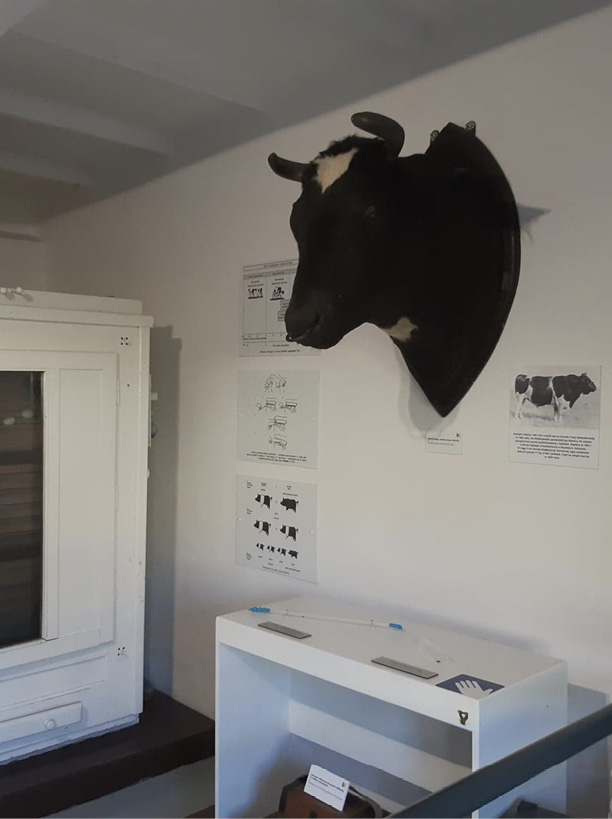
Fig. 1 The head of Geeltje’s Adema on display at the National Museum of Agriculture in Szreniawa, Poland.
Photograph by the author.
Notes
Głowiński, “Buhaj Geeltje’s Adema nie żyje”, 13. All translations my own.
Fleischman, Communist Pigs.
Ritvo, Animal Estate.
White, “Environmental History”.
Mitman, State of Nature; Anker, “Environmental History”.
Krebber and Roscher, “Biographies, Animals and Individuality”.
Tsovel, “What Can a Farm Animal”, 246.
Fudge, “Animal Lives”, 21–23.
Krebber and Roscher. “Biographies, Animals and Individuality.”
Baratay, Animal Biographies.
See Morton, Dark Ecology.
See, for example, Fiddes, Meat; Bulliet, Hunters, Herders, and Hamburgers; Contreras, “Meat Consumption throughout History”; Leroy & Praet, “Meat Traditions”; Zaraska, Meathooked; Chiles and Fitzgerald, “Why Is Meat So Important”.
See, for example, Tansey and D’Silva, The Meat Business; Fitzgerald, Every Farm a Factory; Lee, Meat, Modernity, and the Rise; Leder, “Old McDonald’s”; Stanescu, “Beyond Biopolitics”; Twine, “Animal–Industrial Complex”; Neo and Emel, Geographies of Meat; and Blanchette, Porkopolis.
Raczyk, “Uwagi do artykułu inż. Balwierza”, 25.
Balwierz, “Rozwój i osiągnięcia”, 22.
Głowiński, “Zasłużony buhaj”, 64.
Głowiński, “Zasłużony buhaj”, 65.
Głowiński, “Buhaj Geeltje’s Adema nie żyje”, 13.
Głowiński, “Buhaj Geeltje’s Adema nie żyje”, 13.
Głowiński, “Zasłużony buhaj”, 65.
Głowiński, “Buhaj Geeltje’s Adema nie żyje”, 13–14.
Głowiński, “Buhaj Geeltje’s Adema nie żyje”, 13.
Raczyk, “Uwagi do artykułu”, 26.
Raczyk, “Uwagi do artykułu”, 26.
Balwierz, “Rozwój i osiągnięcia”, 5.
Raczyk, “Uwagi do artykułu”, 26.
Głowiński, “Buhaj Geeltje’s Adema nie żyje”, 13.
Głowiński, “Zasłużony buhaj”, 64.
Głowiński, “Zasłużony buhaj”, 64.
Głowiński, “Buhaj Geeltje’s Adema nie żyje”, 14.
Głowiński, “Buhaj Geeltje’s Adema nie żyje”, 14.
Campbell, Hero with a Thousand Faces.
See Holloway et al., “Choosing and Rejecting Cattle”; Nash, “Breed Wealth”.
Holloway and Morris, “Contesting Genetic Knowledge-Practices”.
Petitt and Eriksson, “Breeding beyond Bodies”.
Pasztor and Jarosz, Increase Supply, Reduce Demand.
Jarzębowska, “State Capitalism”.
Morton, Dark Ecology.
See Fedorovych et al., “Genetic Potential and Breeding”.
Wojtuś, “Chów i hodowla zwierząt gospodarskich”.
Works Cited
Anker, Peder. “Environmental History versus History of Science.” Reviews in Anthropology 31, no. 4 (2002): 309–22. https://doi.org/10.1080/00988150214748.
Balwierz, Eugeniusz. “Rozwój i osiągnięcia Stacji Sztucznego Unasieniania Bydła w Kosowie.” Przegląd hodowlany 5 (1957): 19–23.
Baratay, Éric. Animal Biographies: Toward a History of Individuals. Translated by Lindsay Turner. Athens: The University of Georgia Press, 2022.
Blanchette, Alex. Porkopolis: American Animality, Standardized Life, and the Factory Farm. Durham, NC: Duke University Press, 2020.
Bulliet, Richard W. Hunters, Herders, and Hamburgers: The Past and Future of Human-Animal Relationships. New York: Columbia University Press, 2005.
Campbell, Joseph. The Hero with a Thousand Faces. Pantheon Books, 2008.
Chiles, Robert M., and Amy J. Fitzgerald. “Why Is Meat So Important in Western History and Culture? A Genealogical Critique of Biophysical and Political-Economic Explanations.” Agriculture and Human Values, 35, no. 1 (2018): 1–17. https://doi.org/10.1007/s10460-017-9787-7.
Contreras, Jesus. “Meat Consumption throughout History and across Cultures.” Sciences des aliments 28, no. 4–5 (2008): 293–302.
Fedorovych, E. I., V. V. Fedorovych, I. Y. Semchuk, N. M. Fedak, L. V. Ferenents, N. P. Mazur, P. V. Bodnar, et al. “Genetic Potential and Breeding Value of Animals — An Essential Component of the Genetic Progress in Dairy Cattle.” Ukrainian Journal of Ecology 11, no. 2 (2021): 306–12.
Fiddes, Nick. Meat: A Natural Symbol. London: Routledge, 2004.
Fitzgerald, Deborah. Every Farm a Factory: The Industrial Ideal in American Agriculture. New Haven, CT: Yale University Press, 2003.
Fleischman, Thomas. Communist Pigs: An Animal History of East Germany’s Rise and Fall. Seattle: University of Washington Press, 2020.
Fudge, Erica. “Animal Lives.” History Today 54, no. 10 (2004): 21–26.
Głowiński, Jan. “Buhaj Geeltje’s Adema nie żyje.” Przegląd Hodowlany 6 (1959): 13–14.
Głowiński, Jan. “Zasłużony buhaj Geeltje’s Adema skończył 15 lat.” Przegląd Hodowlany 8–9 (1958): 64–65.
Holloway, Lewis, Carol Morris, Ben Gilna, and David Gibbs. “Choosing and Rejecting Cattle and Sheep: Changing Discourses and Practices of (de)Selection in Pedigree Livestock Breeding.” Agriculture and Human Values 28, no. 4 (2011): 533–47. https://doi.org/10.1007/s10460-010-9298-2.
Holloway, Lewis, and Carol Morris. “Contesting Genetic Knowledge-Practices in Livestock Breeding: Biopower, Biosocial Collectivities, and Heterogeneous Resistances.” Environment and Planning D: Society and Space, 30, no. 1 (2012): 60–77. https://doi.org/10.1068/d2911.
Jarzębowska, Gabriela. “Historia jednego buhaja: Przyczynek do analizy zwierzęcych biografii.” Czas Kultury 39, no. 2 (2023): 34–43.
Jarzębowska, Gabriela. “State Capitalism as a Crisis of Imagination. Factory Farms in the Polish People’s Republic in the 1970s.” Praktyka Teoretyczna, 51, no. 1 (2024): 51–72. https://doi.org/10.19195/prt.2024.1.3.
Krebber, André, and Mieke Roscher. “Introduction: Biographies, Animals and Individuality.” In Animal Biography: Re-Framing Animal Lives, Cham: Palgrave Macmillan, 2018.
Mitman, Gregg. The State of Nature: Ecology, Community, and American Social Thought, 1900–1950. Chicago: University of Chicago Press, 1992.
Morton, Timothy. Dark Ecology: For a Logic of Future Coexistence. New York: Columbia University Press, 2016.
Leder, Drew. “Old McDonald’s Had a Farm: The Metaphysics of Factory Farming.” Journal of Animal Ethics 2, no. 1 (2012): 73–86. https://doi.org/10.5406/janimalethics.2.1.0073.
Lee, Paula Young, ed. Meat, Modernity, and the Rise of the Slaughterhouse. Durham: University of New Hampshire Press, 2008.
Leroy, Frédéric, and Istvan Praet. “Meat Traditions: The Co-Evolution of Humans and Meat.” Appetite 90 (2015): 200–11. https://doi.org/10.1016/j.appet.2015.03.014.
Nash, Catherine. “Breed Wealth: Origins, Encounter Value and the International Love of a Breed.” Transactions of the Institute of British Geographers 45, no. 4 (2020): 849–61. https://doi.org/10.1111/tran.12383.
Neo, Harvey, and Jody Emel. Geographies of Meat: Politics, Economy and Culture. London: Routledge, 2017.
Pasztor, Maria, and Dariusz Jarosz. Increase Supply, Reduce Demand and Punish Severely: A Contextual History of Meat in Communist Poland. Translated by Alex Shannon. Berlin: Peter Lang, 2020.
Petitt, Andrea, and Camilla Eriksson. “Breeding beyond Bodies: Making and ‘Doing’ Cattle.” Society & Animals 30, no. 1 (2019): 108–26. https://doi.org/10.1163/15685306-00001733.
Raczyk, Włodzimierz. “Uwagi do artykułu inż. Balwierza.” Przegląd Hodowlany 10–11 (1957): 25–26.
Ritvo, Harriet. The Animal Estate: The English and Other Creatures in the Victorian Age. Cambridge, MA: Harvard University Press, 1989.
Stanescu, James. “Beyond Biopolitics: Animal Studies, Factory Farms, and the Advent of Deading Life.” PhaenEx, 8, no. 2 (2013): 135–60. https://doi.org/10.22329/p.v8i2.4090.
Tansey, Geoff, and Joyce D’Silva, eds. The Meat Business: Devouring a Hungry Planet. London: Earthscan, 1999.
Tsovel, Ariel. “What Can a Farm Animal Biography Accomplish? The Case of Portrait of a Burger as a Young Calf.” Society & Animals 13, no. 3 (2005): 245–62. https://doi.org/10.1163/1568530054927744.
Twine, Richard. “Addressing the Animal–Industrial Complex.” In The Politics of Species: Reshaping Our Relationships with Other Animals, edited by Raymond Corbey and Annette Lanjouw, 77–91. Cambridge: Cambridge University Press, 2013.
White, Richard. “Environmental History, Ecology, and Meaning.” The Journal of American History 76, no. 4 (1990): 1111–16. https://doi.org/10.2307/2936588.
Wojtuś, Mateusz. “Chów i hodowla zwierząt gospodarskich.” Muzeum Narodowe Rolnicta, https://muzeum-szreniawa.pl/chow_i_hodowla_zwierzat/.
Zaraska, Marta. Meathooked: The History and Science of Our 2.5-Million-Year Obsession with Meat. New York: Basic Books, 2016.