“Elephants Are the Founders of Ways and Maps”
More-than-Human Mobility in Katavi, West Tanzania
DOI: http://doi.org/10.52537/humanimalia.19613
Keywords: More-than-human, animal mobility, spatial development, hunting, forest history, environmental anthropology
Email: emelien.devos@ugent.be
Humanimalia 16.1 (Winter 2025)
Abstract
This paper discusses elephants’ active role in creating animal pathways and how these have provided critical infrastructure for human mobility in West Tanzania. It highlights elephant pathways as a case that flips the conventional view of humans as the dominant shapers of space. Documenting this elephant network through mental maps drawn by elders with hunting experience, it shows how elephants have spaced human mobility, and how Bende and Tongwe communities spatially attuned to elephant movements. This interaction between elephant and human spatial use throughout time complicates the dominant focus on human-elephant conflicts, showing how both elephants and humans have spatially adapted to each other. I discuss the Bhujheghe hunting association which transmitted knowledge about the elephant network as well as practices necessary to deal with the ontological closeness elephants share with humans. This paper situates elephant movements within the broader relationships between animals, forest spirits, humans, and mountains in the lively landscape.
The field of geography has widely recognized that human movement and its infrastructures shape space.1 Scholars of spatial development have studied how shifts in transportation technology have re-ordered space, transforming the landscape from one organized around walking and horse-drawn vehicles to one built for railway and automobile transport systems. Extensive literature details how the mass adoption of private automobiles in the twentieth century restructured space, causing urban sprawl, the architectural transformation of incorporating garages in homes, and relocating economic activity towards the motorways.2 However, little attention has been paid to how non-human movements shape space. Calls for going beyond anthropocentrism and attending to non-human lifeworlds have been mounting in the fields of geography, mobility, and infrastructure studies,3 yet the majority of research has focused on how more-than-human entities are affected by (or exploited as) mobility infrastructure, and how ecologies and organisms respond to and inhabit built infrastructures.4
As Hodgetts and Lorimer state in their work on animal’s mobilities, the predominant focus in this literature is on “how animals have been spaced by humans”.5 The focus on how humans affect non-human spaces responds to the growing recognition of the extent to which humans and their socio-economic relations affect the biophysical world — leading some to describe our era as the Anthropocene or Capitalocene.6 While noting the importance of this research agenda, this paper argues for the need to consider the more-than-human movements that shape space, including the spaces within which humans move.
This paper seeks to complement the study of how animals are spaced by humans by exploring a case of how humans are spaced by animals. Drawing on knowledge from Bende and Tongwe communities, I investigate the critical role African elephants play in shaping the landscape and human mobility through creating a long-distance network of pathways in West Tanzania. This paper does so by following the relational understanding of space in animal geography, one that attends to the socio-technical ecologies of “spatial formations and temporal rhythms along which bodies move, and within which human and animal mobilities are enabled and constrained”.7
This paper follows the traces of more-than-human movements that my walking companions have taught me to attend to during our walks. It thus seeks to offer an interpretation of this landscape attentive to the more-than-human movements, animating what Pierre du Plessis has called the “liveliness of landscapes”.8 In doing so, this paper expands our understanding of how animals space humans — in contrast to the predominant focus on humans spacing animals — by investigating the significance and use of elephant paths. Furthermore, this paper argues that an understanding of the emergence and use of elephant paths must exist within a broader lively landscape of various human and nonhuman movements. In pursuing the shift in perspective I experienced when my interlocutors showed me how most of the roads I used daily were not of human origin, this paper aims to contribute to a scholarly decentring of humans as the sole shapers of space.
The landscape of hilly miombo woodland and strips of riparian forest of rural Katavi has remained relatively disconnected from the rest of the country’s road infrastructure until 2024, when the road between Mpanda town and Tabora was tarmacked. The region was thus one of the last in the country without tarmacked roads, which many attributed to the government’s reluctance to invest in this part of the country where the opposition party CHADEMA is strong. Bende and Tongwe ethnic groups, living between Lake Tanganyika, the Malagarassi river, and Mpanda, are the inhabitants who hold the oldest ties to this landscape. Estimated at a total population of 40,000 to 57,000, Bende and Tongwe people share the closely related languages of Sibhende and Sitongwe9 alongside a history of predominantly forest-based livelihoods of hunting, beekeeping, as well as some farming. They cohabit with communities descending from the Kenyan and Rwandan refugees that settled in the region in the early 1960s and the Burundian refugees, who have been living in the region since the early 1970s.10 More recent inhabitants are Sukuma agro-pastoralists from central Tanzania, a population group that has been growing in the Katavi region in the last four decades.11
Following the tracks of African elephants (Nsofu, Sibhende and Sitongwe / Loxodonta Africana, binominal nomenclature) in West Tanzania, this paper adds to the scant literature documenting the historical role of herbivores in facilitating human migration and mobility, attending to the little studied cases of wild herbivores’ landscape modifications serving as mobility infrastructure. The trails made by elephants’ extinct relatives, as Gary Haynes argues, were most likely crucial to late Pleistocene human dispersal.12 By digging for water and stimulating rich vegetational regrowth through foraging, mammoths and mastodons created a network of trails connecting waterpoints and areas with high prey availability for hunter-gatherers to spread across. Bison trails established between salt licks in the Ohio valley provided long-distance trails for First Nations societies and later enabled the rapid colonisation of Kentucky by American settlers. The spatial distribution of towns subsequently developed around the structure of nodes along bison trails.13 Paul G. Keil has similarly investigated how paths created by free-roaming elephants in the Indo-Myanmar highlands enabled diverse social groups to navigate the challenging mountainous landscape.14
According to Jan Vansina, rivers and elephant trails provided ways through the rainforest for the Bantu migration from Southern West Africa throughout Central, Eastern, and Southern Africa between the middle of the second millennium BCE and the middle of the first millennium CE.15 Yet, despite the stated importance of elephant trails for navigation, especially in literature on African hunter-gatherer groups, there has been little dedicated scholarly attention to the cultural, spatial, political, and economic significance of elephant trails in African Studies.16 This paper addresses this gap by drawing on local knowledge of the historical evolution of elephant paths and by situating this knowledge within emic perspectives on elephant subjectivity and its relation to the lively landscape and its other-than-human inhabitants.17
Elephants Paved the Way
Pointing to Mpanda, a town 130 kilometres East of his home in Mwese village, James Robert Katwikula shared with me and my research collaborator Majaliwa Adolf Mpalamba that “in the past, there were a lot of small animal paths (mapalilo), starting from here […] all the ways (nsila) up to Mpanda.”18 A pastor, beekeeper, and farmer in his late fifties, James knows the landscape and its ways well. Like many of the people who told me of the animal paths, James emphasized that the paths and roads currently used by humans originated from animal paths created by elephants. The Sibhende and Sitongwe languages distinguish animal paths from nsila, the general term for “path, road, or way”, with the specific word iipagha / mapagha (singular / plural). James’s example, the main road connecting Mwese to Mpanda town, is an unpaved road maintained by the Tanzanian regional road agency that provides crucial infrastructure as the only motor vehicle connection for the daily buses transporting people, goods, and harvests to and from town. The road, James explained, was built upon one of the animal pathways created by elephants on their regular movements between what is now Katavi National Park and the Mahale mountains. The first white settler in Mwese, remembered under the name of Nyangula,19 established the current road by enlarging the existing elephant path in 1958. Smoothly zigzagging both his hands around imaginary obstacles, James explained that the path followed the elephants’ habit of avoiding crossing big rivers or mountains. He implied that the path provided a convenient trajectory for the road by avoiding steep slopes and river crossings.
The convenience of elephant paths was a common theme of my conversations with the elders. Elephant clear vegetation, thereby allowing movement through the forested landscape. Kasole Mtemi Nkumilwa20 (henceforth referred to as Kasole), a famous Mufumo healer and a chief in his early fifties, evoked how elephants facilitate human movement by saying “where the elephants pass people also pass, the one with a bicycle passes, even the one with a motorcycle can pass where elephants passed”. Some elephants would veer off the main path between Katavi National Park and the Mahale mountains and head for Ng’ondo, James continued. The kaburi wazi21 path, which leads to Ng’ondo, is about half a day’s walk from Mwese. This path is one of the main ways used by inhabitants of Mwese to reach their farms in Ng’ondo, and Majaliwa and I had recently walked it to visit his father’s beekeeping camp. “About kaburi wazi over there, people are not saying that it was the grandfathers or the great-grand fathers who built [the way], these were animal paths,” James said. Majaliwa’s father, Adolf Mpalamba, who shares clan ties to the forest of Ng’ondo with James, had made the same observation. According to him, the kaburi wazi path was a very old elephant path and existed before people settled in Ng’ondo.
This emphasis on the elephant origin of paths now used by humans, returned in many of my conversations. Kasole, for instance, stated that “elephants are the founders (mwanzilishi)22 of ways and maps… elephants [with emphasis]”. Kasole echoed James’s statement that the ways were created by elephants rather than by the forefathers by using the culturally loaded term “founder” — usually employed in Sibhende and Sitongwe speaking contexts to refer to the clan relative who first settled in the clan forest of origin and originated the lineage.
The scarcity of colonial road construction efforts added to the centrality of elephant pathways as infrastructure for human mobility. Compared to other parts of Tanganyika, colonial road construction was limited and did not start until the late 1950s. Other than water transport on Lake Tanganyika, long-distance travel followed tracks that my interlocutors emphasize were created by elephants, and these tracks laid the foundation for most later state-led road construction. German and British colonial administrations had seen little economic opportunity and had invested little in the region south of the Malagarassi river.23 The District Officer’s 1946 report described the region as “that waterless, uninhabited, and fly infested area which, by its nature, earned the name of the Southern Wilderness”.24 Until the construction of the road connecting Uvinza to Mpanda town in 1939, the only motor vehicle road in the “Southern Wilderness” was a short stretch of road built by the Belgian occupation connecting the Mica mines to Sumbwa and Karema.25 In 1964, the United Nations High Commissioner for Refugees and the Tanzanian government constructed a road from Mpanda up to Katuma to support the settlement of Kenyan refugees in Katuma .26 Elderly interlocutors remember the track between Katuma and Mwese, which followed a major elephant trail, to have been established by a white settler. This track was improved for motor vehicle transport in 1965 in order to facilitate the settlement of Rwandan refugees in Mwese.27 Having described emic perspectives foregrounding how elephants have spaced humans by establishing mobility infrastructure, let us now turn to the wider lively landscape informing and being formed by elephant movements.
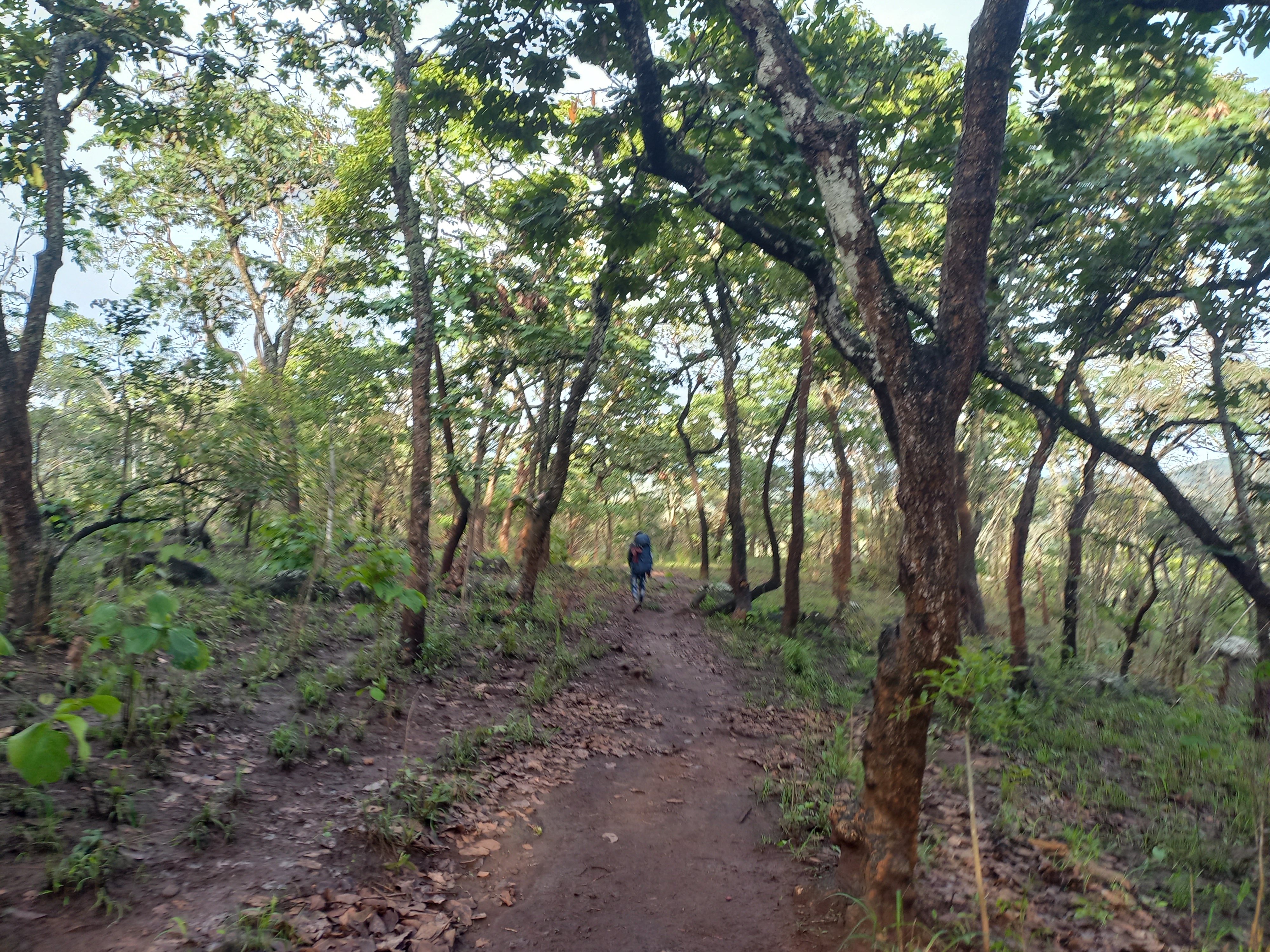
Fig. 1 Kaburi Wazi path following the elephant trail.

Fig. 2 The road between Mpanda and Mwese following the elephant trail.
All photographs by the author.
Elephant Movements in the Lively Landscape
Bryson Mringo (henceforth Mzee Mringo), an energetic farmer and trader in his 70s who moved to Mwese from Arusha in the late 1960s, shared his extensive knowledge of the elephant pathways in the region with us. He had invited Majaliwa and me to Lubhalisi, an area about twenty kilometres Northwest of Mwese, where many elephant paths could be seen. In Lubhalisi, we were joined by Raymond Simon Luntu, a Tongwe man in his 60s who had worked as a park guard at Mahale National Park, a place from which Tongwe communities were evicted in 1985.28 On our way to the path, we passed by several muhama/mihama trees (Borassus aethiopum), which Raymond and Mzee Mringo recognized as clear traces of past elephant movement. The dispersal of mihama trees is one of the ways in which elephants shape landscapes. As a result of their fondness for the fruit, elephants spread mihama seeds through their dung. Raymond pointed to a path climbing up a hill. He indicated to us that we could not follow it further uphill because the people who were living there might fear that we were inspecting if they had a right to stay on this old elephant pathway. With recent evictions in the region said to be related to the restoration of wildlife corridors, elephant pathways had become a sensitive subject.
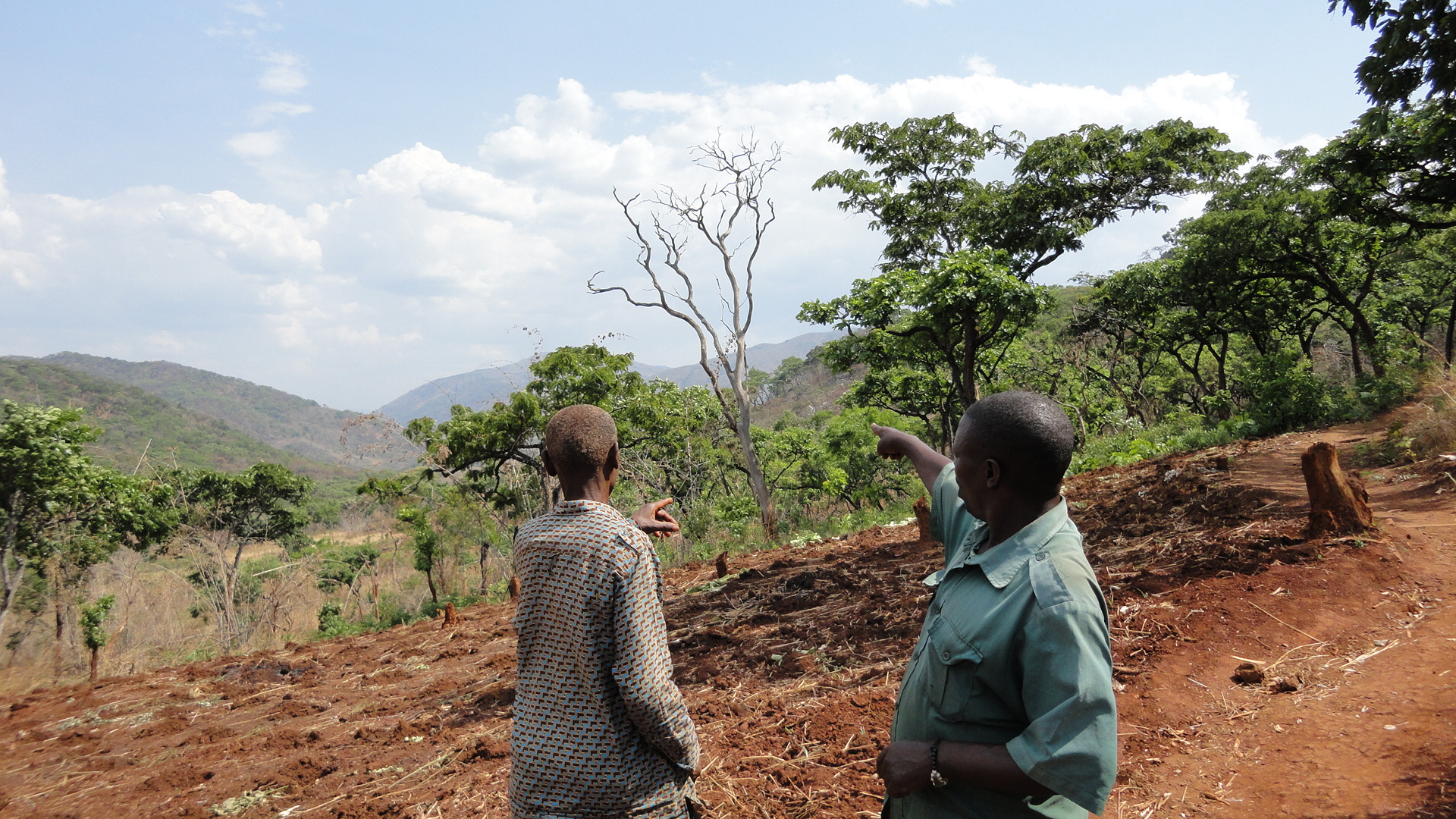
Fig. 3 Raymond Simon Luntu and Mzee Mringo at an old elephant trail. They point to the direction of the Ntakata mountains where the trail leads to from Lutaghano forest.
Photograph by the author.
Pointing to the Ntakata mountains in the distance, to which the path lead, Raymond noted that the elephants often used this path on their way to Ntakata, sometimes opting for an alternative route depending on the seasons, which influenced where water and good vegetation could be found. He explained that the elephants chose this trajectory because it offered the least steep incline. In addition to the consideration for steepness, elephants make their navigation choices based on the availability of food sources, water, and salt licks (nkukuta). This is why, as many had pointed out to me, you could easily find water sources along elephant trails.
Raymond and Mzee Mringo showed us how the shape of the trail, which was similar to the curvature of a riverbed, revealed that the path was used not that long ago. It had been forty years since Raymond last saw an elephant pass by here. Reflecting on the passage of time, Mzee Mringo said that elephants can never forget their paths, even after years of disuse. Raymond agreed. He was sure that a time would come when elephants would pass by again. “Even in the years to come people will be surprised,” he said, “they will hear the hodi [Kiswahili expression used when approaching a home indicating and asking permission to enter], because even the grandchildren don’t forget”. Mzee Mringo agreed, “they don’t forget […] even when generations pass, they will continue to pass by”. He added that the coming generations of animals such as lions and buffalos will continue to follow the elephant paths. Biologists have also noted the elephants’ remarkable spatial memory. Haynes recorded the repeated use of trails by nomadic elephants over centuries.29 In line with Mzee Mringo’s comment that trail knowledge is passed on over generations, Fishlock, Caldwell, and Lee demonstrate that elephant knowledge of paths is transmitted inter-generationally in social learning contexts.30 Elephants create pathways that persist throughout long timeframes, spacing human mobility, because of sustained choices over successive generations.
During that walk, Mzee Mringo and Raymond directed our attention to how elephant movements interact with and enable other more-than-human movements. When moving, elephants consider the availability of water and vegetation as these change with the seasons. The movements of the elephants influence the movements of other animals who use their paths and adapt to the changes in vegetation patterns brought about by the elephants by, for instance, the spreading of mihama seeds.
Pierre du Plessis has conceptualized such attentiveness as the art of noticing “the liveliness of landscapes”.31 For this conceptualisation of landscapes, du Plessis built upon approaches within multispecies ethnography, more-than-human geography, and ecological anthropology to uncover the ways in which landscapes are held together and animated by continuously shifting more-than-human relationships.32
Based on his ethnographic fieldwork with San trackers in the Kalahari desert in Botswana, du Plessis argues that, for those who have the skills to perceive it, landscapes are:
lively, dynamic spaces of emergent relations, full of human and nonhuman movement. Far from static, they are the sedimentations of movement over time, gathering within them the stories of more-than-human histories and emergent futures.33
Following du Plessis’ conceptualization of landscape, this paper aims to document the liveliness of the landscape formed by elephant and other more-than-human movements. The next section outlines the mobility infrastructure established by elephant movements and describes how it has emerged over time in relation to human and more-than-human movements. Describing this lively landscape through mental maps, this section highlights how this local knowledge of the elephant network has developed through the everyday practices of hunting and walking the landscape.
Getting to Know the Shifting Elephant Path Network
The network of elephant pathways consists of a range of bigger main paths and smaller, less used paths and shortcuts. The pathways predominantly connect the plains in what is now Katavi National Park to the mountains of what is now Mahale National Park, a distance of about 150 kilometres as the crow flies. From the Mahale mountains, some elephants would then continue northwards through paths that interlocutors remembered to go as far as present day Burundi. While elephants no longer regularly migrate between these stops as they used to, they continue to be occasionally seen along the pathways every few years. My interlocutors generally distinguished between three major routes. The Southern route is the main route, one that supports the most animal movement. It starts in the Katavi plains, where it is called the Iipagha lya Mwasi (“animal pathway of Mwasi [forest spirit]”’). The route then takes on the name Iipagha lya Filongwa (“animal pathway of Filongwa [forest spirit]”), crosses the Katuma river, and passes through Bhujhombe and Mwina to reach the Mahale mountains. Next to the main route, my interlocutors distinguished two other important routes. To the North of the Iipagha lya Mwasi/Filongwa, one route starts from the Katavi plains, crosses Mpembe river, and climbs the Ityasho mountains. From there, the route reflects how elephants navigate the mountain tops in order to avoid too much ascending and descending. It continues to the higher altitudes of the Ntakata forest, crosses the Mugambazi river, and bifurcates, either continuing Northwards or to Mahale. The other route, situated between the Southern and Northern route, is the path on which the road from Mpanda was built, passing through Mwese and up to Lokoma at Lake Tanganyika.
How people come to know and represent the network of elephant ways varies, as the mental maps included in this paper illustrate. These mental maps were produced on my request, either by interlocutors themselves, or by Majaliwa, who drew the map based on his knowledge of the landscape with the guidance of the interlocutor. Although mental maps are useful as visual translations, it is important to note that this spatial knowledge emerged and is transmitted through an embodied relation to the landscape, by walking and storytelling rather than by reading the representation of a map. Some interlocutors would draw the pathways in the sand with a stick, but most only pointed in the direction of the relevant mountains and rivers, while referring to stories of events that happened in specific locations to convey the trajectory of the pathways.
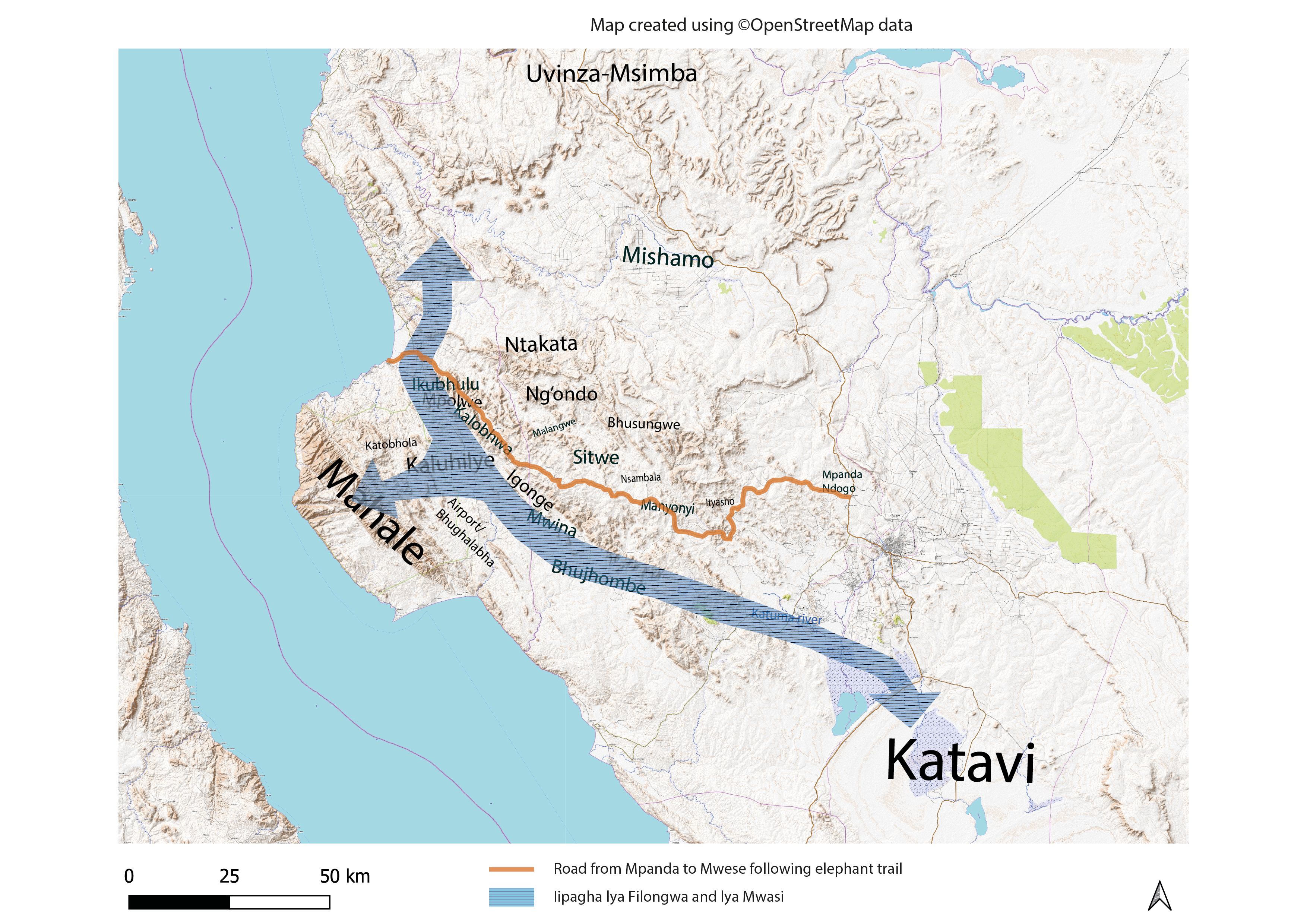
Fig. 4 Map created by the author, indicating Iipagha lya Mwasi and lya Filongwa, relevant place names and the road between Mpanda and Lokoma.
A tradition of drawing visual representations of the network does exist for the Southern route, which, as I will discuss later, is significant in the Bhujheghe hunting cult.
The practical experience of walking the landscape during past hunting trips and other travels has been a significant source of knowledge of the elephant paths. Young boys would often learn to move through the landscape as they accompanied their elders. Mzee Mringo, who moved to Mwese from Arusha as a young man, learned about the network through joining his peers on trips. His knowledge was not acquired through initiation into the Bhujheghe hunting association. This exemplifies the significance of the practical, empirical source of this knowledge next to the more formalized transmission through Bhujheghe which also addresses the spiritual context of human-elephant relations.
The detailed knowledge of the long-distance network of elephant paths, which is especially extensive amongst elderly men who hunted frequently in the past, indicates the lasting importance of hunting in Bende and Tongwe life until recently. Hunting was a gendered activity reserved for men. Women occasionally participated to carry the heavy catches. Elephant hunting was a prestigious activity, partly because this region was part of the lucrative ivory trade sphere, which reached the height of its intensity in the late 19th century. Nowadays, hunting has been reduced to a rare and clandestine activity due to the increased suppression and expansion of protected areas, which started in colonial times and culminated in the confiscation of the local hunting guns in 2015. Still, the experiences of navigating the forest in search of wild animals and plants and beekeeping, and the memory of the taste of wild meat continues to be shared by many, including younger generations.
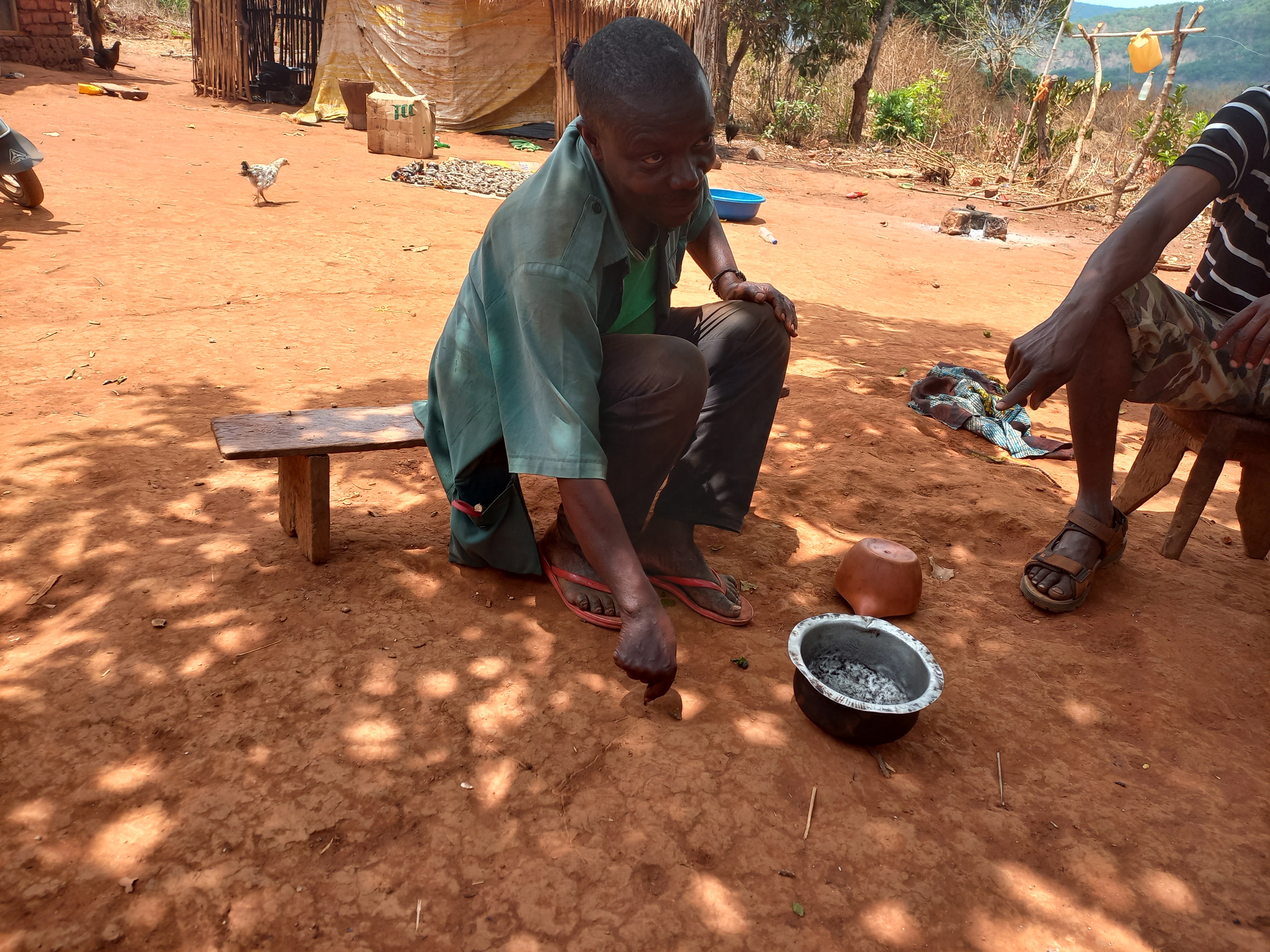
Fig. 5 Raymond Simon Luntu drawing elephant pathways on the ground while describing the elephant path network.
Photograph by the author.
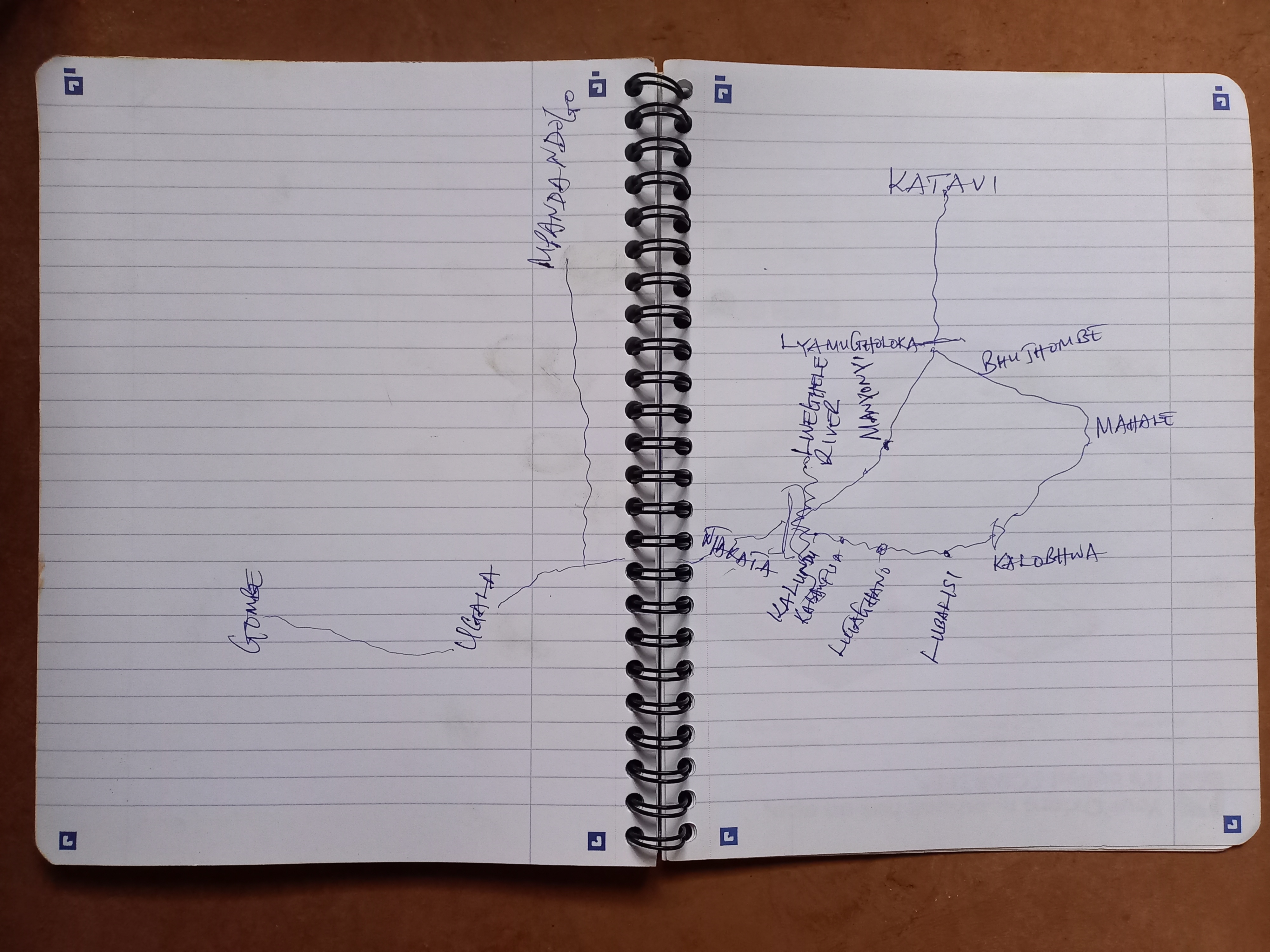
Fig. 6 Map of elephant ways drawn by Raymond Simon Luntu in Lubhalisi.

Fig. 7 Map of elephant ways drawn by James Robert Katwikula in Mwese.
Photograph by the author.
Being attentive to the more-than-human movements of the landscape was especially important considering this history of hunting and beekeeping. Highly mobile livelihoods based on deep knowledge of a vast network of animal pathways are recorded in oral history. Elders’ accounts of the past are replete with references to ancestors’ movements for hunting, trade, and migration up to locations as far as what is now Kibondo district, Tabora, and the Democratic Republic of Congo. Many clans trace their origins to the opposite side of Lake Tanganyika and Buha, and clan histories are often recounted with reference to stops along specific mountains or trees on the way to the forests of origin, where clan founders eventually settled. Those who travel far and wide, exemplified in the figures of the hunter and the healer, continue to be admired for their capacity to navigate unknown environments.
Upon my request, Mzee Mringo detailed the history of shifting elephant movements and guided Majaliwa in mapping the paths through time. The obstacles he described ranged from increased human smell and noise, which was disliked by elephants, to deforestation. In landscapes shared with human populations, elephants are known to adopt behavioural strategies of risk avoidance such as avoiding pathways near larger human settlements and cultivated land, and moving by night.34 Mzee Mringo’s account documents not only the impact of humans on elephant spatial choices, but also the ways in which elephants actively responded to these changing circumstances by, amongst other strategies, creating new paths.
Mzee Mringo explained that following the arrival of a large Rwandan refugee community in Mwese in 1964, elephants became more hesitant to enter the forest of Sitwe, which served as a stopover on the path between Bhujhombe and Ng’ondo. Elephants eventually stopped using the path altogether, but buffalos continued employing the route and resting in Sitwe along the way. The path to Ng’ondo through Manyonyi gained importance because of the blockage in Sitwe. A similar rerouting happened when a large refugee settlement was created in Mishamo in 1972. Elephants and other animals responded to this obstacle by starting to use the path through the Ntakata forest instead of the path through Mishamo. When increased human settlement and agriculture in Malangwe in the 1980s discouraged elephants to employ this route, they created two new paths to circumvent this obstacle. To the left of Malangwe, a path emerged from elephants’ recurring movements between Z mountain and Kamakofu hill. To the right of Malangwe, elephants created the path known as Ipala Maghele. From the late 1980s on, increasing human settlement and agriculture reduced elephant movement on the path between Bhujhombe and Mahale, also known as the Iipagha lya Mwasi and Filongwa. By the 1990s, elephants almost completely stopped using the path. Elephants responded to the obstacles on their main route by using smaller paths to the South of the original path, which have since become bigger and have taken on the role of the new main route. In the same decade, the path through Manyonyi became blocked due to the arrival of a tobacco company. Between 2000 and 2004, further increases in human settlement and farming have made it difficult for elephants to use the paths between Mpanda Ndogo and Bhusungwe that connected the Katavi plains to Ng’ondo. Some elephants took to hiding in Ntakata forest until the end of rainy season to avoid the livestock grazing between Ntakata and Mpanda Ndogo in this period.
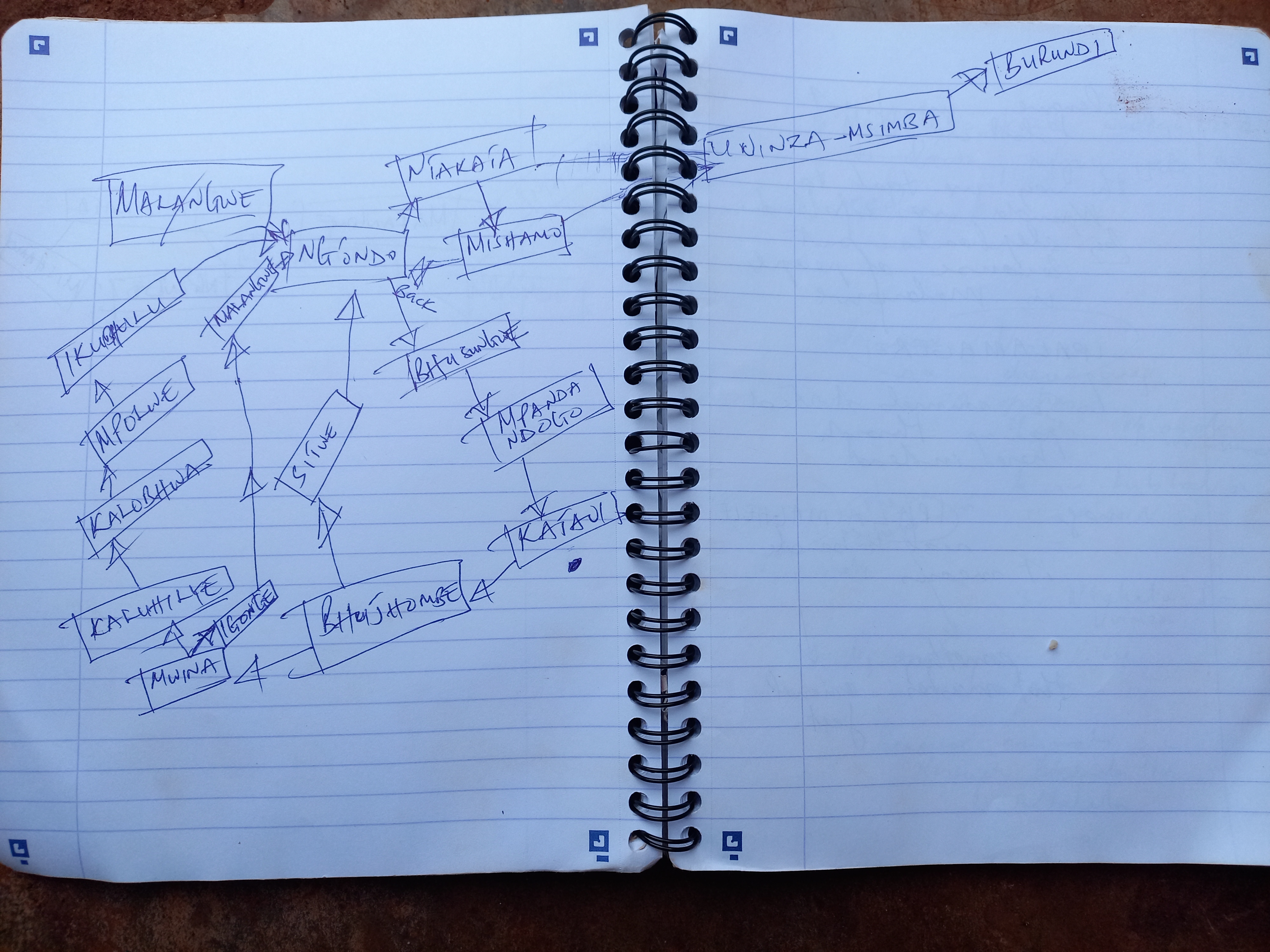
Fig. 8 Map of elephant ways drawn by Majaliwa Adolf Mpalamba following the instructions of Bryson Mringo in Mwese.
Photograph by the author.
According to elders, early Bende and Tongwe inhabitants often chose to settle in “thick forests,” which provided a good habitat for beekeeping and hunting wild animals. Because of this, elephant paths often passed in the vicinity of settlements. However, people took care to build residences at a distance from elephant paths. Wiederroth’s research indicates that this careful spatial attunement to elephant paths was also practiced with regards to the placement of beehives in the 1930s.35 She argues that one of the ways Tongwe residents in Isenga phrased their opposition to the sleeping sickness resettlement was by pointing out that they would not be able to attune the placement of beehives to elephant migratory routes if resettled to unknown territory. Isenga was situated on an elephant migratory route towards Mahale, and its inhabitants drew on their knowledge of elephant movement to safely place their hives .36 Elephants adjust their movements to human presence as well. Elephant rarely damaged houses and crops when passing through or near settlements when population density was still low, according to Mzee Mringo. Although migration outside of protected areas has strongly decreased, wild animals continue to occasionally pass through Mwese. The passing of lions in 2021 and of elephants in 2022 and 2024 generated much talk in the village. Mzee Mringo shared that one of the circulating interpretations saw the damage to crops and livestock as the result of the animals simply following their old ways.
Population has increased markedly from the 1960s due to natural growth, the establishment of refugee settlements in Mwese, Katuma, and Mishamo, and the migration of Sukuma agro-pastoralists growing since the mid-1980s. The expansion of protected areas for conservation further increased land pressure,37causing an increase in population density outside the protected areas and leading to more potential human-elephant conflict along elephant pathways. This new context of land scarcity stands in marked contrast to the frequent re-locations of Tongwe settlements in the 1930s, observed by a colonial administrator lamenting how the constant abandonment of villages rendered earlier maps useless.38 Due to shifting livelihoods, population increase, and expanding protected areas, humans and elephants have less room to spatially attune to one another, and both have become less mobile as a result.39
The next section considers the elephants’ unique properties that — as our interlocutors emphasized — allow them to shape space and adapt to human spatial developments in the ways described above.
Elephants’ Consciousness, Will, and Memory
Most interlocutors agreed that all animals have a certain capacity for communication, decision making, and memory. They supported this view by referring to their experiences of interacting with animals, such as when defending crops from bushpigs, observing domestic chickens, and encountering animals during forest trips. Elephants, along with chimpanzees, eastern red colobuses, and mitis monkeys, were generally considered to have the highest degree of personhood, holding an extraordinary capacity of consciousness (fahamu),40 memory, and foresight into future events. Most interlocutors remained unsure of how elephants transmitted this knowledge, but it was clear to them that they shared knowledge pertaining to the elephant path network and the changing conditions of distinct paths between the groups and over generations. This strong sense that elephants possess extensive consciousness and intuition is furthermore clear from the way interlocutors describe how successful hunts required medicine to make elephants “ignorant” and “stupid”, thereby reducing their consciousness which would otherwise alert the elephants to the hunters’ presence.
Several elders with hunting experience located the elephants’ extensive consciousness in a body part called tutalala. This body part, described as a small tree inside the region of the jaw or temple, was a prized medicine for inducing foresight in humans. This description possibly corresponds to the hyoid bone.41 The occurrence of strikingly similar descriptions of “wisdom sticks” (mingano) known to hold the elephants’ consciousness among VaShona hunters in Zimbabwe42 indicates that Bende and Tongwe understandings of elephant consciousness are part of regionally spread knowledge. VaShona hunters equally used the sticks, described as having the size of matchsticks and located in pairs at both temples, to make medicine for dreaming about elephants the night before the hunt.43 Bende and Tongwe interlocutors agreed that the tutalala sticks are what enables the elephants to know when the hunters they met had breached taboos, such as having sex in the bush, which is the elephants’ domain. Elephants will also be angered when women approach them during menstruation, or when a man who had sex with his wife during her period approaches them. VaShona hunters took similar care to ascertain that they were not accompanied by hunters who had transgressed sexual taboos to avoid charges from tuskless elephants and cows with calves.44 Among Bende and Tongwe communities, the Bhujheghe hunting association transmitted knowledge on how to manage the risk of elephant attacks which resulted from defying their will and breaching these rules. It educated hunters about what behaviours to avoid, and if necessary, what medicine could be used to make the elephants “ignorant” to the hunters’ transgressions.
Some interlocutors emphasize the ontological closeness of elephants and humans. So did Kasole, who stressed that “elephants are human beings (binadamu)”.45“ When I asked him to elaborate, he referred to the observation shared by many of his peers who hunted in the past. Several elders had observed that, upon meeting a dead hunter in the bush, groups of elephants would conduct a burial by covering his body with branches and staying around the grave to mourn for seven days. If a hunter approached a group of animals at a time when one of his relatives passed away back home, they would try to communicate this to the hunter by throwing sand on their backs. If a hunter did not return home and continued to move closer upon seeing these signs, the elephants might attack him, as they did not want him to bring the curses from the village to the group. Other elders shared similar stories of how elephants mirrored the behaviour of the hunters’ wives back home. If she was having sex with another man, the elephants would mirror the same gestures. To avoid elephants looking up and seeing the hunters hidden above in the trees, the wives were required to bring down all household items before the hunt. If they were to reach up to pick an item, the elephant would also reach up and spot the hunter.
The ontological closeness of elephants and humans and the delicate relationship between the elephants and the wives at home has also been observed among the BaAka and related forest people communities of the Congo Basin46 and VaShona communities.47 The BaAka and related forest people communities are most well-known for their elephant hunting practices and institutions. The notion of ontological closeness between humans and elephants amongst Bende and Tongwe communities can be seen in a more pronounced degree in the figure of the shapeshifting mokila elephant-men in Baka communities.48 Further similarities are present in the connection between women and elephants, as BaAka women remaining in camp played a central role in directing the elephants to male hunters.49 Mavhunga notes the women’s connection to elephants in VaShona hunting practices in which wives would create a powerful elephant medicine with their placenta and had to observe taboos to ensure their husbands’ safety. If the wives were to have sex during their absence, the elephants would attack the hunters and indicate that wives were breaking the taboo of bathing by throwing sand on their backs. Like the Bende and Tongwe notions of the elephants’ foresight of deaths in the village, VaShona hunters interpret the sight of an elephant curling its trunk around its head as an indication of tragedy in the hunter’s family.50 This shows that, for Bende and Tongwe hunters, elephant hunting entailed dealing with their will, by not breaching taboos, and consciousness, by using medicine to make them “ignorant”.
The next section discusses how relationships to elephants and their pathways, not only entailed dealing with their will, but also with the will of the lively spiritual landscape of which they are part.51
Dealing with the Will of the Spiritual Landscape
The social significance of elephants and their paths cannot be understood in isolation from the liveliness of the broader landscape within which elephants and humans move. Hunting, beekeeping, farming, and collecting wild foodstuffs and medicinal plants have all depended on developing the practical skills of engaging with this landscape, as well as on relating to the forest spirits known as Mighabho who own all the animals and plants within their forest section. By commanding access over the beings of the forest, and over fertility and life in general, Mighabho forest spirits are critical forces to be reckoned with. Oral histories of clan origins emphasize how ancestors were faced with the challenge of getting to know their new environments and developing good relationships with its forest spirits. Tongwe and Bende clans are identified by the forest of origin52 where the first patrilineal clan elder settled and stepped into relation with its forest spirits. These forests of origin hold a central place in social life, even though they have become increasingly inaccessible because of conservation policy. The significance of forests of origin manifests in daily life in the customary greetings where seniors respond to their younger relatives with a standardized phrase referring to their respective clan origin. Fostering life and wellbeing for the chieftainship and the clan hinges on maintaining a good relationship with the Mighabho of one’s forest of origin. Rituals to sustain these relationships might lead people to travel to their clan forest of origin. When ritual access to forests of origin are inaccessible due to conservation policy, clans maintain these relationships by transplanting trees housing Mighabho spirits such as the mujhimo tree to homes. Another way the lively landscape manifests in daily life is through the naming practice. A child might receive, next to their religious name, a name referring to a mountain or forest, which is often interchangeable with the name of the Mughabho of that landscape feature.
The necessity of establishing and maintaining good relations with the Mighabho who control the forest’s life-giving potential is clear from the following song, which expresses the sadness of the unsuccessful hunter:
Isenga lilikuntuna, lilikuntuna likete
Isenga lilikuntuna, lilikuntuna likete
Nankabha sipigha miti, nankabha sipigha mijhombo.53
(The forest section it refuses me, it refuses me while holding
[the animals and not offering them to the hunter]
The forest section it refuses me, it refuses me while holding
I have already become the shooter of trees, I have already become the shooter of worms
[implying the hunter fails to catch animals])
The song reminds its listeners that regardless of the forest’s abundance in game, it is the forest section’s owner who denies or gives catch to the hunter. Hunters, like healers collecting medicinal plants or farmers establishing a new field, should request the forest spirits’ permission to obtain what they seek. Hunters, like healers, depend on their relationship with their hunting forest spirit known as Mudimi to guide them to find wild animals or medicinal plants. This dependence on the forest spirits’ guidance accords with VaShona hunters’ dependency on ancestral spirits for navigating the sacred space of the forest and receiving its bounty, which Mavhunga terms “guided mobility”.54 If one’s relationship with their Mudimi is in disarray, it will refuse to fulfil its role of mediating with other forest spirits and guiding Bende and Tongwe hunters to animals. It might go so far as to prevent the hunter from finding game altogether by, for instance, chasing away all nearby animals — a situation called ntimusi (“the chaser”).
This was the case for Kasoka, an elder in his mid-eighties who was a famous hunter in his youth. Kasoka had been an extremely successful hunter who used medicine to attract animals and relied on the help of his Mudimi, as well as a second Mudimi spirit that joined him in hunting because it seemed to like him. During a divination with a healer, it became clear that his first Mudimi was unhappy about the new Mudimi. Kasoka promised that if he were to be successful again, he would make offerings to his Mudimi to mend the relationship. His hunt did turn out to be successful. “They ran towards me. They didn’t run away, they were ignorant,” Kasoka explained. However, instead of fulfilling his promise after this plentiful hunt, Kasoka used the money obtained from his catch to buy a suit. “That suit I still have today,” Kasoka said sadly while contemplating the mistake that caused him much bad luck in hunting and life in general. This relationship of dependency on spirits who gatekeep the forest’s wealth, medicine, and life-giving potential, as Koen Stroeken has described, is a common theme in hunting cults, medicinal associations, and chiefly rule across Bantu-speaking Africa.55 This dependency, Stroeken shows, requires the person to fulfil a personal obligation towards the spirit by observing certain food taboos, and returning the spirit’s reciprocity in offerings. For Kasoka and his peers who used to hunt in the past, the obligation towards the various spirits animating the landscape is a weighty one, entailing great risks if disobeyed.
Dealing with Elephant Spirits and Elephant Ways in the Bhujheghe Association
As discussed above, the Bhujheghe hunting association is the central institution through which knowledge elephants and their movements has been transmitted. Bhujheghe has also been central to managing the precarious relationship with various powerful forest entities. The basic structure of Bhujheghe hunting initiations, according to Kasole and Kajhembe, mirrors that of the Bhufumo healing initiation. Novices are brought inside a ritual hut where they spend the night before being brought outside and going to the forest. Then, traps placed at the courtyard and the inside of the hut are connected with grasses. The tying of inside and outside with these grasses enacts the connection between the home and the forest mastered by healers, hunters, and chiefs who all depend on their Mudimi hunting spirit.
In addition to transmitting knowledge on how hunters should entertain good reciprocal relationships with their own Mudimi (forest hunting spirit) and the various Mighabho (forest spirits) of the forest section where they hunted, Bhujheghe serves to manage the dangerous consequences of killing an elephant. Killing elephants entailed consequences for the moral universe of which elephants and humans are part through their ontological closeness. Kajhembe explained that “when you killed an elephant, in Bende customs, you started something [bad]”. Elephants are considered to have a Musimu (ancestral spirit) that, just like for humans, remains after it has passed away. Upon killing an elephant, its ancestral spirit follows the hunter. This creates a situation known as ilimba where the ancestral spirit of the hunter and the elephant are “together”. The ancestral spirit of the elephant should not be with the hunter, but rather with the relative of the killed elephant who had come to the corpse to “inherit” its ancestral spirit. Being away from its correct “home” (mji)56 with the elephant’s relative, the ancestral spirit becomes a mukuli (curse), bringing adversity to the hunter.
Explaining the risks necessitating Bhujheghe (hunting ritual), Kajhembe said that “it is a very bad thing to kill an elephant. Elephants have very bad mikuli (curse) […]. The mukuli of the elephant has to be straightened [‘rectified’ or ‘healed’ in ritual contexts]. It can harass you if you killed an elephant without preparing [Bhujeghe], like making you sick or other problems”. The Bhujheghe hunting ritual called Katukula is aimed at returning the elephant’s ancestral spirit to its elephant relative’s body. If the hunter fails to do the Bhujheghe hunting ritual during his lifetime, the curse will be passed down to his descendants who “inherit” the elephant’s ancestral spirit who will continue to disturb them. According to Kajhembe and Kasole’s descriptions, the general process of Bhujheghe rituals consisted of moving the novice inside a ritual hut, where he stays throughout the night while other Bhajheghe (members of hunting cult) and community members slaughter a goat, feast, and dance to Bhujheghe drums. The critical moment for returning the elephant’s ancestral spirit to its rightful home happens just before the novice is brought outside as a newly initiated Mujheghe (member of hunting cult [singular]). An image of an elephant is drawn with white ashes on the doorstep of the novice’s hut. The ashes representing the elephant’s ancestral spirit are then swept together and brought to a termite hill, from which it makes its way to the elephant relative. The use of the term mukuli (curse) indicates how elephants are understood to be ontologically close to humans, as the same term refers to afflictions caused by human misimu (ancestral spirits). Like the procedure of bringing the elephant mukuli (curse) to a termite hill, healing procedures dealing with human mukuli (curse) end by transferring the curse from the patient’s body to its rightful dwelling place at a termite hill.57
Next to dealing with the risks of killing an ontological close being, Bhujheghe hunting rituals functioned as spaces of education for initiated members and uninitiated bystanders about the manners of the forest and its inhabitants. Songs transmitted knowledge about taboos and the behaviour of various animals. Experienced hunters drew animals and mapped the network of elephant pathways on the ground. Novices had to memorize these drawings and were tested on their ability to identify animals and reproduce maps of the elephant ways. The main path of Iipagha lya Mwasi and Filongwa received special attention and was celebrated in praise songs. The first part of the route was named after Mwasi, a spirit of the Fipa-speaking region. The second part was named after Filongwa, a forest spirit who is the child of Nkungwe, the Mughabho of Mahale. Being the main route for animal migration, the Iipagha lya Mwasi and Filongwa was an important hunting ground. It is also remembered as the main path used by people travelling to the lake and further on by boat to what is now the Democratic Republic of Congo. Kajhembe described it as the “main road” (njia kuu). It was “the main road of elephants, [and] even of people,” Kajhembe said, “it means that in the past elephants were preparing the ways”. Furthermore, this was a very good pathway, because “even cars can pass”.
Kasole referred to the old Bhujheghe practice of drawing and praising the Iipagha lya Mwasi and Filongwa during an offering ritual I attended. The offering was directed to Kakekulu, the first clan elder who settled in Katobhola forest, the forest of origin over which Kasole rules as chief. Kasole explained that the reference to Bhujheghe practices was necessary in this offering, because Kakekulu was Mujheghe himself, and his Bhujheghe practice of praising the big paths had to be continued. Before building a house for Kakekulu, his wife, his twin and breech-born children, his Mudimi spirit, and Lyang’ombe forest sprit at an empty spot on his farm compound, Kasole prepared the ground. Supported by the singing of a fellow elder, and his son, Kasole sang the following while evening the ground:
Lumbugha ni lwa bhasimu
Lumbugha ni lwa bhasimu
Lwabhalungu mwasesa haghali
(The bush belongs to ancestral spirits
The bush belongs to ancestral spirits
To the strict ones, slash a wide space)58
He then continued to sweep away dirt while singing:
Isila lya Nkumbi lilikuhyaahila
Isila lya Nkumbi lilikuhyaahila
Nalihyahile
(The elephant tail is sweeping
The elephant tail is sweeping
And may it sweep)
Kasole then referred to the good luck desired by travellers that may be granted by forest spirits by singing:
Kamwilabhae tambe lwa mpemba nyonga kamwilabha.
(Smart ones go by mpemba [luckily] move smart ones.)
Once the ground had been prepared, Kasole squatted down and ran his index fingers to approximate where the big elephant ways would be drawn while singing:
Nanja kukyelula
Kemukyelule
(I am about to draw
Let me draw him)
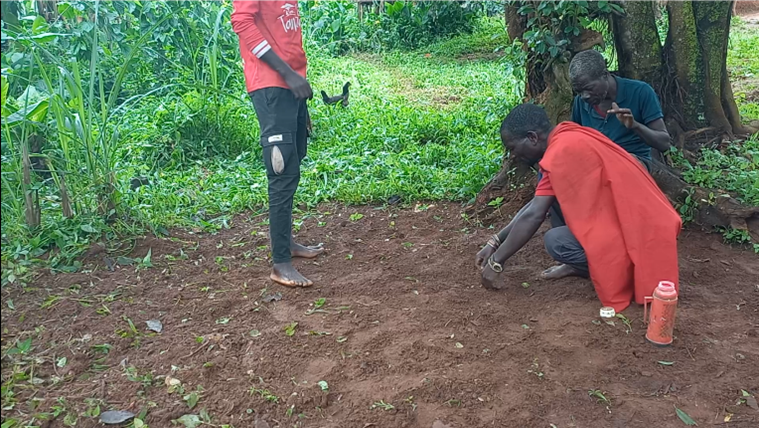
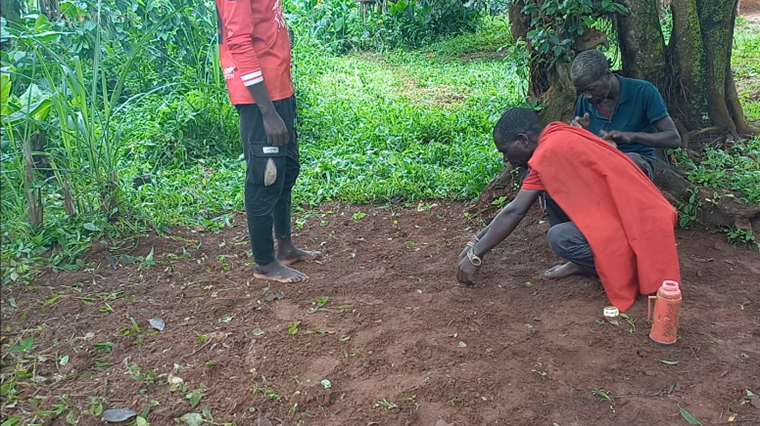
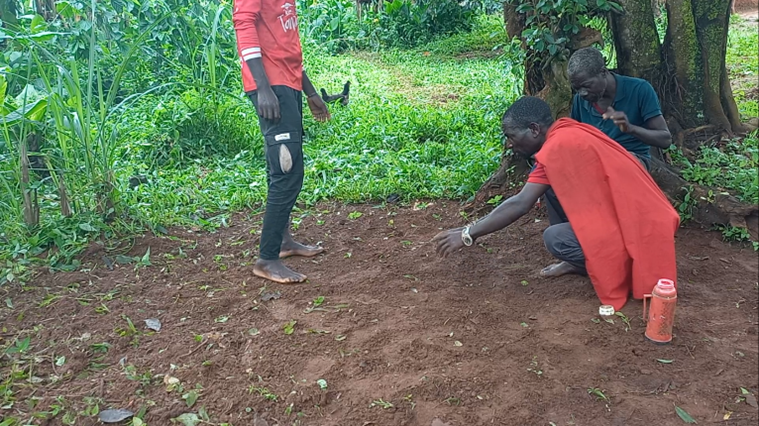
Fig. 9a–c Kasole replicating animal movements along the Iipagha lya Mwasi and Iipagha lya Filongwa.
Photographs by the author.
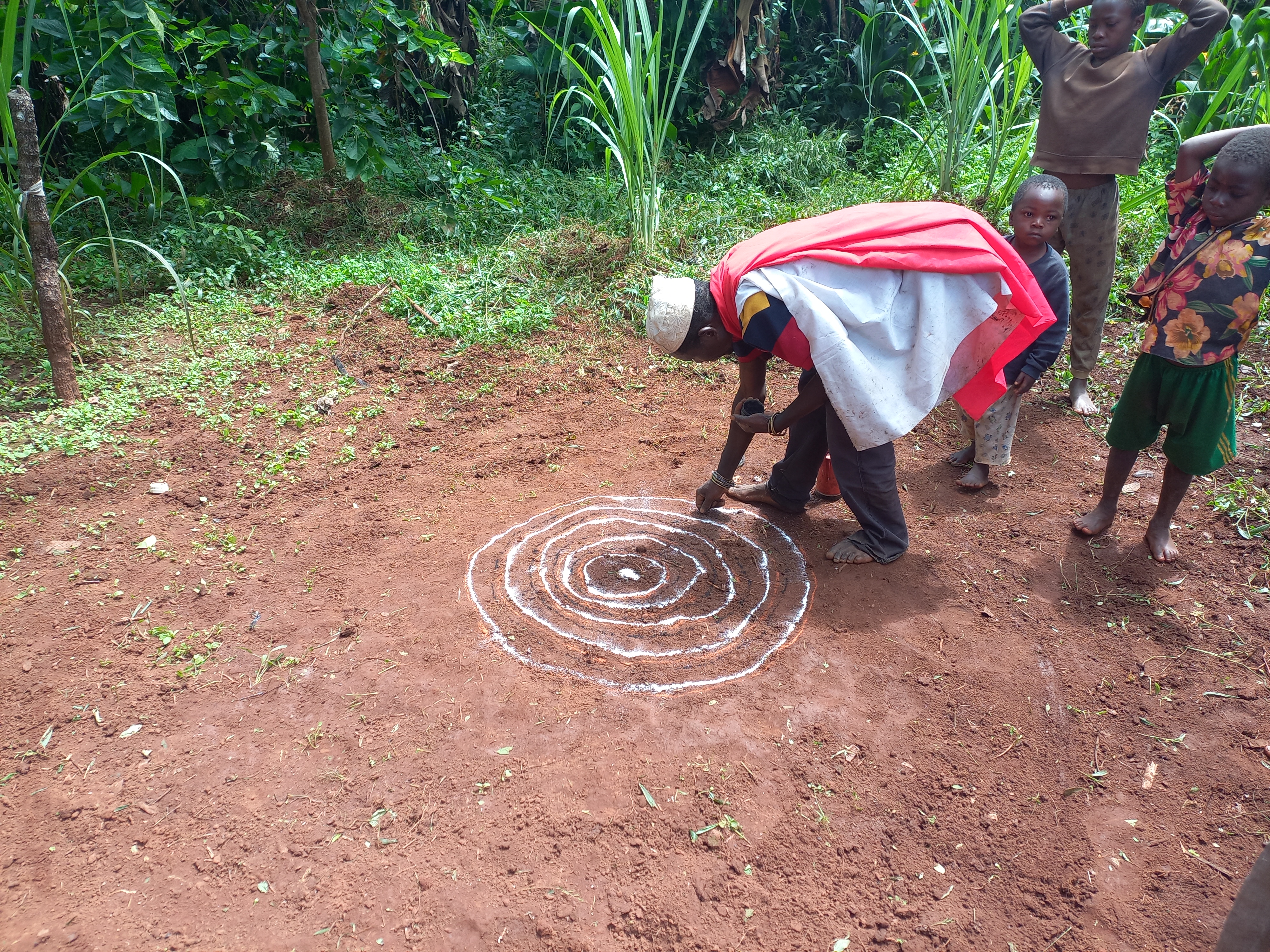
Fig. 10 Kasole drawing during the process of building a house for my Mudimi hunting spirit. The big ways used to be drawn in the same manner on the ground in Bhujheghe.
Fig. 11 A White flour drawing by Kasole of Kakekulu, his wife, his twin and breech-born children, his Mudimi spirit, and the Lyang’ombe forest spirit.
Photographs by the author.
Then, he moved the back of his hands from back to front, his fingertips lightly touching the soil in a movement replicating how animals walked the Iipagha lya Mwasi and Filongwa. All the while, they sang:
Maghana makulu ghajhile mwalwasa, nangalondela
(The big pathways are going to the chieftainship, I have followed them)
As he told us later, the Iipagha lya Mwasi and Filongwa he drew was an abbreviated version of how the ways used to be drawn with white flour in Bhujheghe in the past. He turned to me and Majaliwa to explain that this is a Mudimi (hunting spirit) and Bhujheghe (hunting ritual) song, typically sung when receiving an oath to become Mujheghe (member of hunting cult). Kasole then continued to sing songs that referred to hunting signs and taboos relating to the sun. He then proceeded to draw with white flour the structure of the houses he was about the build for Kakekulu.
Elephant Ways Following the Chain of Mountaintops of Related Forest Spirits
When I asked Kasole about the meaning of tying two traps on the inside and the outside of the ritual hut during my training in the Bhufumo (healing association), he elaborated on the protective role of setting the traps. “It has many meanings,” he said, “but the main one is forests, the protection (uhifadhi) of forests, and river sources”. Using the Kiswahili term uhifadhi, he referred to the dual meaning of uhifadhi, first as the protection of forests and river sources, which is his role as a chief, and second as the state-led nature conservation through protected areas. He continued by pointing out how the rivers surrounding Mwese had been unusually dry despite abundant rain. The rivers did not fill up, Kasole explained, because people in power are establishing farms and settlements at the tops of mountains, which are the source of rivers.
The source [of rivers] is the mountain America […] that mountain is the rain of Mwese in relation to the forest of Mwese. What is the forest of Mwese in relation to? To the forest of Mahale, Eeh, to Nkungwe [Mughabho forest spirit of Mahale]. So these mountains bring rain right? Now you see.
Referring to the relationship between the Mwese and Nkungwe forest spirits, Kasole thus drew attention to how the chain of mountains between Katavi and Mahele are interrelated through the family kinship connecting the forest spirits inhabiting the mountains. He continued giving examples of the various mountains in the region of Mwese and of how human disturbance damages not only the ecology of the river source but also the forest spirits staying at the mountains who bring rain. Alluding to the tensions in the broader region over evictions conducted by the government over restoring animal migratory corridors between Katavi and Mahele, Kasole asked:
Now, why would animals here have the main road [referring to Iipagha lya Mwasi and Filongwa]? Okay, So the government has already opened the way for it, in order for it to be the way for animals. Aha! Then why now has the rain itself stopped filling the river? The origin of rain and animals?
In doing so, Kasole raised the question of how effective the state-led conservation sense of uhifadhi is when the protection of river sources and forests with their spirits is not respected. He continued by talking about various rivers, mountain tops, and kinships connecting forest spirits:
There is one mountain, it starts from here. There, in the forest of Mwese, it goes straight to the lake and comes to join with the mountain that comes from Kasilipu, this one from Lwegha that goes straight to the lake. Now that all the grass is gone […] it should stay in a good state. […][A]nd the rivers that come down, like this forest of Mwese, here comes the forest of, of, of this [mountain] America, you see. You come and follow America up to this big mountain here, you see, where does it connect? Mahale. When it connects, it becomes… So there is a manner in which animals are being attracted by the rain. There are animals that… For us, as we know, there are animals that walk with the rain. Like, for example, elephants.
His explanations draw attention to how the elephant pathways developed in response to the workings of a lively landscape in which related forest spirits generate streams of rain, which elephants and other animals follow. This exemplifies how an analysis of pathways should be situated within a larger more-than-human cosmology. In this cosmology, humans are just one actor among a host of other entities shaping the landscape. Elephants themselves actively seek the best way through the physical and historical topography. The interrelation of forest spirits, mountains, rivers, and humans steers the rain patterns which inform elephant movement. The perspective Kasole shared questions the way in which mainstream conservation in the area has established wildlife corridors without considering the local perspectives on the relationships required for viable more-than-human movements. In their study on elephant trails and their use by BaAka forest people communities the Central African Republic, Remis and Jost Robinson combine biological anthropology and multispecies ethnography to describe similar findings on how elephants have shaped the ecologies along elephant trails while facilitating long-distance movement for other animals and humans.59 Similar to the context of Katavi, the authors describe how the high biodiversity along elephant trails in the Dzanga-Sangha Protected Areas in the Central African Republic has attracted conservation policy, which, through protected areas, has divided the shared ecologies that emerged from human-elephant interactions along trails.
Conclusion
Drawing on Bende and Tongwe knowledge of elephant pathways, this paper has highlighted how elephant movements have shaped the landscapes and human mobility in West Tanzania. In doing so, this paper has sought to contribute to expanding our understanding of spatial development beyond human-directed processes, by adding to the literature documenting the influence of animals on human landscapes and mobilities. In researching the case of elephant pathways, I have argued for the need to complement the study of how animals are spaced by humans by attending to how humans are spaced by animals. Although elephants are the most visible more-than-human entities doing the heavy work of clearing vegetation, finding gentle slopes, and trampling soils, this paper has argued that elephants do not shape human landscapes by themselves. In order to understand the emic perspectives on elephant movement presented in this paper, elephants must be understood in relation to other more-than-human entities in the lively landscape. I have drawn on the practical and ritual knowledge transmitted in Bhujheghe hunting to elucidate how the lively landscape emerges from the movements of its more-than-human inhabitants, be they elephants, other animals, forest spirits, mountains, and rain. The Bhujheghe hunting association, I have maintained, addressed the need to manage the will of this lively landscape with its many inhabitants and their demands, as well as the need to manage the repercussions of killing a being so ontologically close to humans as an elephant.
Fig. 12 Drawing by Kasole of the mountaintops of related forest spirits, rain movements, and rivers.
Photograph by the author.
This paper has foregrounded an emic perspective on the lively landscape that questions the way in which mainstream conservation disregards local perspectives on the importance of relationships between forest spirits, mountains, rivers, humans, and rain patterns for viable more-than-human movement. The interaction between elephant and human spatial use throughout time complicates the dominant focus on human-elephant conflicts. Although human-elephant relations were by no means simply harmonious — after all, this paper has discussed hunting — oral history and archival sources indicate that both elephants and humans have spatially adapted to each other. The expansion of protected areas and the shift in livelihoods have restricted the mobility that allowed humans and elephants to space each other in attuned ways.
Notes
Warf, Handbook on Geographies of Technology, 4, 8–9.
See Knowles, Ferbrache, and Nikitas, “Transport’s Historical”; Golub and Johnson, “Automobility”.
See Hodgetts and Lorimer, “Animals’ Mobilities”; Barua, “Infrastructure and Non-Human Life”; Panelli, “More-than-Human Social Geographies”; Swart, “Reviving Roadkill?”; Mavhunga, “Organic Vehicles and Passengers”.
See among others Enns and Sneyd, “More-than-Human Infrastructural Violence”; Carse, “Nature as Infrastructure”; Morita, “Multispecies Infrastructure”.
Hodgetts and Lorimer, “Animals’ Mobilities,” 4.
Malm and Hornborg, “Geology of Mankind?”
Hodgetts and Lorimer, “Animals’ Mobilities,” 7.
du Plessis, “Tracking Meat of the Sand”.
Abe, “Bende,” 2; Kotarska-Boczek, “A Sociolinguistic Survey”.
Mwapinga, “Politics of Citizenship”.
Hausser, Weber, and Meyer, “Bees, Farmers, Tourists and Hunters”.
Haynes, “Mammoth Landscapes”.
Jakle, “The American Bison”.
Keil, “On the Trails”. On elephant paths, spatiality, and more-than-human cartography, see also Lim and Campos-Arceiz, “Human-Elephant Ecological Relations”; Barua, Plantation Worlds; Keil, Presence of Elephants.
Vansina, Paths in the Rainforests, 35.
But see Remis and Jost Robinson, “Elephants, Hunters, and Others”.
This paper draws on eighteen months of ethnographic fieldwork in the Katavi region in Tanzania, as well as on archival research at the Tanzania National Archives in Dar es Salaam in the context of my PhD research. Interviews in Kiswahili were conducted by myself, with assistance from my research collaborator Majaliwa Adolf Mpalamba. He provided invaluable help in the whole research process, including translation from Sibhende and Sitongwe to English for interviews, and the transcription of recordings made during participant observation. This paper is based on research funded by the Research Foundation Flanders (11J1321N and V441222N).].
Unless indicated otherwise, terms in italic are Sibhende/Sitongwe. All direct quotes were translated from Kiswahili or Sibhende/Sitongwe by my research collaborator Majaliwa Adolf Mpalamba or myself.
Possibly Mr. Kielland (personal communication with Deo Mwapinga).
This is the name by which he asked to be referred to in research publications. Kasole is the name by which he is known. The Kiswahili term mtemi refers to his position as chief, and Nkumilwa is his chiefly name.
Kiswahili term.
Kiswahili term.
Wiederroth, “Tanganyika’s Unhealthy Wilderness”.
B.W. Savory, District Officer’s reports Kigoma District 1938–1955, 1946. Tanzania National Archives 967.821.1, 7.
B.W. Savory, Report of a tour to investigate conditions in the Tongwe area of Kigoma district, 1934. Tanzania National Archives 967.821.1, 11; District Officer’s reports Kigoma District 1938–1955, 1939. Tanzania National Archives 967.821.1, 18–21.
Mwapinga, “The Politics of Citizenship,” 164.
Wiederroth, “Das Mwese Highland Refugee Settlement,” 96.
Nakamura et al., Mahale Chimpanzees, 682.
Haynes, “Elephants (and Extinct Relatives),” 100.
Fishlock, Caldwell, and Lee, “Elephant Resource-Use Traditions”.
du Plessis, “Tracking Meat of the Sand”.
See related notions such as the meshwork (Ingold, Being Alive), dispersed ontologies (Chao, “In the Shadow of the Palm”), and more-than-human sociality (Tsing, “More-than-Human Sociality”).
du Plessis, “Tracking Meat of the Sand,” 54.
Songhurst, McCulloch and Coulson, “Finding Pathways to Human–Elephant Coexistence”.
Wiederroth, “Tanganyika’s Unhealthy Wilderness”.
Wiederroth, 237.
Hausser and Mpuya, “Beekeeping in Tanzania,” 2684.
B.W. Savory, Assistant District Officer, Report of a tour to investigate conditions in the Tongwe area of Kigoma district. Tanzania National Archives 967.821.1, 11.
See Kamau and Sluyter, “Challenges of Elephant Conservation” for similar spatial dynamics of human-elephant conflict around the Tsavo protected areas in Kenya.
Kiswahili term.
Personal communication with Annie Antonites.
Mavhunga, Transient Workspaces.
Mavhunga, 60.
Mavhunga, 61.
Kiswahili term.
Remis and Jost Robinson, “Elephants, Hunters, and Others”; Joiris, “Baba Pygmy Hunting Rituals in Southern Cameroon”.
Mavhunga, Transient Workspaces.
Köhler, “Half-Man, Half-Elephant”.
Lewis, “Forest Hunter-Gatherers and Their World”; Joiris, “Baba Pygmy Hunting Rituals in Southern Cameroon”.
Mavhunga, Transient Workspaces, 61-62.
See Devos, “They are healthy because they are free” for an elaboration on the concept of will.
In the often-used phrase mwisala wa asili, the Sibhende / Sitongwe term for forest (mwisala) is combined with the Kiswahili term (asili).
Song shared by Mama Didas in Mwese. This song is sung in Bhujheghe contexts, or during ngoma dances at rituals, weddings or other celebrations.
Mavhunga, Transient Workspaces, 20.
Stroeken, Medicinal Rule.
Kiswahili term.
see also Kakeya, “Curing Ritual of the Tongwe Traditional Doctor”.
Meaning to make the ground even.
Remis and Jost Robinson, “Elephants, Hunters, and Others”.
Works Cited
Abe, Yuko. “Bende.” In The Oxford Handbook of African Languages, edited by Rainer Vossen and Gerrit J. Dimmendaal, 495–506. Oxford: Oxford University Press, 2020.
Barua, Maan. “Infrastructure and Non-Human Life: A Wider Ontology.” Progress in Human Geography 45, no. 6 (2021): 1467–89. https://doi.org/10.1177/0309132521991220.
Barua, Maan. Plantation Worlds. Durham: Duke University Press, 2024.
Carse, Ashley. “Nature as Infrastructure: Making and Managing the Panama Canal Watershed.” Social Studies of Science 42, no. 4 (2012): 539–63. https://doi.org/10.1177/0306312712440166.
Chao, Sophie. “In the Shadow of the Palm: Dispersed Ontologies among Marind, West Papua.” Cultural Anthropology 33, no. 4 (2018): 621–49. https://doi.org/10.14506/ca33.4.08.
Devos, Emelien. “‘They are healthy because they are free’: Conservation Borders and More-than-Human Autonomy in West Tanzania.” Environmental Values 34, no. 6 (2025): 457–72. https://doi.org/10.1177/09632719251334414.
du Plessis, Pierre. “Tracking Meat of the Sand: Noticing Multispecies Landscapes in the Kalahari.” Environmental Humanities 14, no. 1 (2022): 49–70.
Enns, Charis, and Adam Sneyd. “More-than-Human Infrastructural Violence and Infrastructural Justice: A Case Study of the Chad–Cameroon Pipeline Project.” Annals of the American Association of Geographers 111, no. 2 (2020): 481–97. https://doi.org/10.1080/24694452.2020.1774348.
Fishlock, Victoria, Christine Caldwell, and Phyllis C. Lee. “Elephant Resource-Use Traditions.” Animal Cognition 19, no. 2 (2016): 429–33. https://doi.org/10.1007/s10071-015-0921-x.
Golub, Aaron, and Aaron Johnson. “Automobility in Space and Time.” In Handbook on Geographies of Technology, edited by Barney Warf, 195–210. Cheltenham: Edward Elgar, 2017.
Hausser, Yves, and Pauline Mpuya. “Beekeeping in Tanzania: When the Bees Get Out of the Woods. An Innovative Cross-Sectoral Approach to Community-Based Natural Resource Management.” Game and Wildlife Science 21, no. 3 (2004): 291–312.
Hausser, Yves, Helene Weber, and Britta Meyer. “Bees, Farmers, Tourists and Hunters: Conflict Dynamics around Western Tanzania Protected Areas.” Biodiversity and Conservation 18, no. 10 (2009): 2679–703. https://doi.org/10.1007/s10531-009-9667-6.
Haynes, Gary. “Elephants (and Extinct Relatives) as Earth-Movers and Ecosystem Engineers.” Geomorphology 157–58 (2012): 99–107. https://doi.org/10.1016/j.geomorph.2011.04.045.
Haynes, Gary. “Mammoth Landscapes: Good Country for Hunter-Gatherers.” Quaternary International 142–43 (2006): 20–29. https://doi.org/10.1016/j.quaint.2005.03.002.
Hodgetts, Timothy, and Jamie Lorimer. “Animals’ Mobilities.” Progress in Human Geography 44, no. 1 (2020): 4–26. https://doi.org/10.1177/0309132518817829.
Ingold, Tim. Being Alive: Essays on Movement Knowledge and Description. London: Routledge, 2011.
Jakle, John A. “The American Bison and the Human Occupance of the Ohio Valley.” Proceedings of the American Philosophical Society 112, no. 4 (1968): 299–305.
Joiris, Daou V. “Baba Pygmy Hunting Rituals in Southern Cameroon: How to Walk Side by Side with the Elephant.” Civilisations 41, no. 1/2 (1993): 51–81.
Kakeya, Makoto. “Curing Ritual of the Tongwe Traditional Doctor: Its Process and Logic.” African Study Monographs, Supplementary Issue 1 (1982): 105–139. https://doi.org/10.14989/68303.
Kamau, Peter Ngugi, and Andrew Sluyter. “Challenges of Elephant Conservation: Insights from Oral Histories of Colonialism and Landscape in Tsavo, Kenya.” Geographical Review 108, no. 4 (2018): 523–44. https://doi.org/10.1111/gere.12288.
Keil, Paul G. “On the Trails of Free-Roaming Elephants: Human–Elephant Mobility and History across the Indo-Myanmar Highlands.” Transfers 10, nos. 2–3 (2020): 62–82. https://doi.org/10.3167/TRANS.2020.10020305.
Keil, Paul G. The Presence of Elephants: Sharing Lives and Landscapes in Assam. London: Routledge, 2024.
Knowles, Richard D., Fiona Ferbrache, and Alexandros Nikitas. “Transport’s Historical, Contemporary and Future Role in Shaping Urban Development: Re-evaluating Transit Oriented Development.” Cities 99 (2020): 102607. https://doi.org/10.1016/j.cities.2020.102607.
Köhler, Axel. “Half-Man, Half-Elephant: Shapeshifting among the Baka of Congo.” In Natural Enemies, edited by Knight John, 50–77. London: Routledge, 2013.
Kotarska-Boczek, Ania. “A Sociolinguistic Survey of the Tongwe Community”. In Journal of Language Survey Reports. Dallas: SIL International, 2015.
Lewis, Jerome. “Forest Hunter-Gatherers and Their World: A Study of the Mbendjele Yaka Pygmies and Their Secular and Religious Activities and Representations.” PhD diss., University of London, 2002.
Lim, Teckwyn, and Ahimsa Campos-Arceiz. “A Review of Human-Elephant Ecological Relations in the Malay Peninsula: Adaptations for Coexistence.” Diversity 14, no. 1 (2022): 36. https://doi.org/10.3390/d14010036.
Malm, Andreas, and Alf Hornborg. “The Geology of Mankind? A Critique of the Anthropocene Narrative.” The Anthropocene Review 1, no. 1 (2014): 62–69. https://doi.org/10.1177/2053019613516291.
Mavhunga, Clapperton Chakanetsa. “Organic Vehicles and Passengers: The Tsetse Fly as Transient Analytical Workspace.” Transfers 6, no. 2 (2016): 74–93. https://doi.org/10.3167/trans.2016.060206.
Mavhunga, Clapperton Chakanetsa. Transient Workspaces: Technologies of Everyday Innovation in Zimbabwe. MIT Press, 2014.
Morita, Atsuro. “Multispecies Infrastructure: Infrastructural Inversion and Involutionary Entanglements in the Chao Phraya Delta, Thailand.” Ethnos 82, no. 4 (2017): 738–57. https://doi.org/10.1080/00141844.2015.1119175.
Mwapinga, Deo Osmund. “The Politics of Citizenship as a Durable Solution for Refugees in Tanzania: A Comparative Case Study of Naturalization of the Rwandese Refugees (1980–1995) and Burundian Refugees (2008–2023).” PhD diss., Carleton University, 2024.
Nakamura, Michio, Kazuhiko Hosaka, Noriko Itoh, and Koichiro Zamma. Mahale Chimpanzees: 50 Years of Research. Cambridge: Cambridge University Press, 2015.
Panelli, Ruth. “More-than-Human Social Geographies: Posthuman and Other Possibilities.” Progress in Human Geography 34, no. 1 (2010): 79–87. https://doi.org/10.1177/0309132509105007.
Remis, Melissa J., and Carolyn A. Jost Robinson. “Elephants, Hunters, and Others: Integrating Biological Anthropology and Multispecies Ethnography in a Conservation Zone.” American Anthropologist 122, no. 3 (2020): 459–72. https://doi.org/10.1111/aman.13414.
Savory, B. W. District Officer Reports. Tanzania National Archives.
Songhurst, Anna, Graham McCulloch, and Tim Coulson. “Finding Pathways to Human–Elephant Coexistence: A Risky Business.” Oryx 50, no. 4 (2016): 713–20. https://doi.org/10.1017/S0030605315000344.
Stroeken, Koen. Medicinal Rule: A Historical Anthropology of Kingship in East and Central Africa. New York: Berghahn Books, 2018.
Swart, Sandra. “Reviving Roadkill? Animals in the New Mobilities Studies.” Transfers 5, no. 2 (2015): 81–101. https://doi.org/10.3167/trans.2015.050206.
Tsing, Anna. “More-than-Human Sociality: A Call for Critical Description.” In Anthropology and Nature, edited by Kirsten Hastrup, 27–42. New York: Routledge, 2014.
Vansina, Jan. Paths in the Rainforests. Toward a History of Political Tradition in Equatorial Africa. Madison: University of Wisconsin Press, 1990.
Warf, Barney. Handbook on Geographies of Technology. Cheltenham: Edward Elgar, 2017.
Wiederroth, Nicole. “Das Mwese Highland Refugee Settlement und (Neu-)Interpretationen des Wandels. Zum Ringen zwischen Mensch und Natur.” Saeculum 69, no. 1 (2019): 79–108. https://doi.org/10.7788/saec.2019.69.1.79.
Wiederroth, Nicole. “Tanganyika’s Unhealthy Wilderness: The Visibility of Colonial Space.” International Journal of African Historical Studies 56, no. 2 (2023): 215–41.